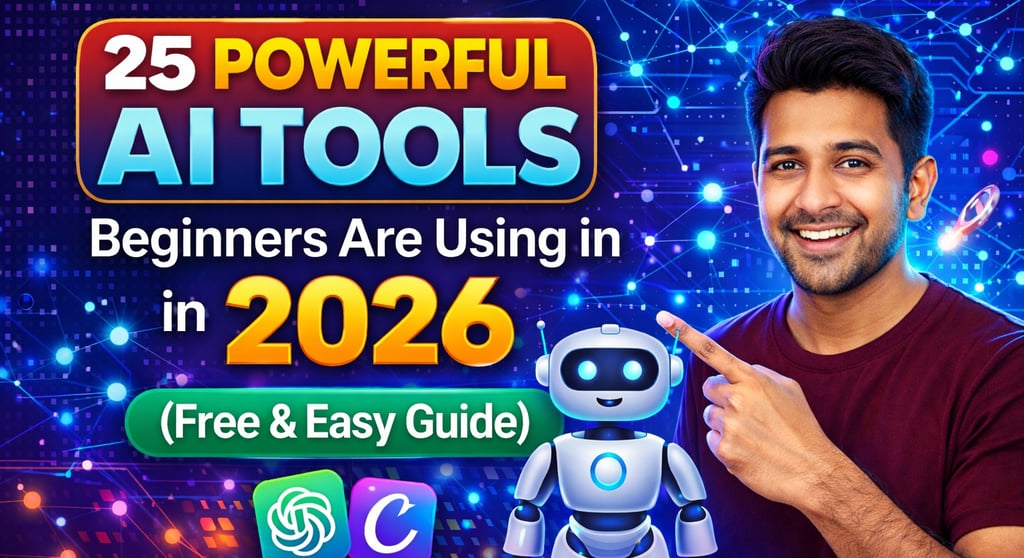
25 Powerful AI Tools Beginners Are Using in 2026 (Free & Easy Guide)
Looking for the best free AI tools in 2026? Discover 25 beginner-friendly AI apps that automate work, create content, and save hours daily — tested and explained simply.
,AI FOR BEGINNERSTECHNOLOGY & AIONLINE EARNING & AI TOOLS
DIPJYOTI SHARMA
2/11/20263 min read

The artificial intelligence landscape in 2026 bears little resemblance to what we saw just a few years ago. We are no longer evaluating isolated chatbots or standalone image generators. Instead, we are operating in an era defined by autonomous agents, multimodal intelligence, and deeply integrated ecosystems.
For the average user, the distinction between “software” and “AI” has effectively disappeared. AI is now infrastructure — embedded into operating systems, productivity suites, creative tools, and developer environments.
Below is a structured, strategic analysis of the 25 AI tools everyone is talking about in 2026, categorized by function and real-world utility.
The Titans of Generative Text & Research
Large Language Models (LLMs) remain foundational — but in 2026, they function less as chat interfaces and more as reasoning engines capable of executing workflows.
1. OpenAI – ChatGPT
ChatGPT continues to dominate global usage.
In 2026, ChatGPT operates as an agentic system, capable of:
Browsing the web autonomously
Executing code
Managing files and apps
Performing multi-step task chains
It remains the default AI for general-purpose use — from drafting emails to building small SaaS prototypes.
Best for: General users, entrepreneurs, students, automation workflows.
2. Anthropic – Claude
Claude has positioned itself as the leader in:
Long-context reasoning
Enterprise document drafting
Code explanation
Policy and compliance analysis
Its “Constitutional AI” framework appeals strongly to enterprises prioritizing governance and AI safety.
Best for: Legal teams, enterprises, researchers, long-document drafting.
3. Perplexity AI – Perplexity
Perplexity AI has redefined search.
It synthesizes real-time web data into structured answers with citations — functioning more like a research analyst than a search engine.
Best for: Journalists, students, researchers, data-driven professionals.
4. Google – Gemini
Google Gemini is deeply integrated into Google Workspace.
Strengths include:
Multimodal processing (video, audio, text)
Native integration in Docs, Sheets, Gmail
Enterprise-scale deployment
Best for: Corporate environments and Google Workspace users.
5. Quora – Poe
Poe aggregates multiple AI models under one interface.
Users can access:
Llama models
Claude variants
Proprietary bots
It functions as an “AI app store.”
Best for: Experimenters, developers, multi-model users.
Visual Creativity & Video Synthesis
AI video generation has moved from novelty to production-grade output.
6. Midjourney
Midjourney remains the leader in artistic fidelity.
Its 2026 web interface offers:
Advanced lighting control
Style precision
Cinematic rendering
Best for: Artists, brand designers, creative directors.
7. OpenAI – Sora
Sora has democratized high-fidelity video creation.
Marketers now generate:
B-roll
Explainer videos
Social media reels
Short films
Best for: Content creators, marketing agencies, educators.
8. Runway
Runway excels in controllable video editing.
It enables:
Background replacement
Object removal
Style transformations
Frame-level editing
Best for: Video editors and filmmakers.
9. Canva – Magic Studio
Canva Magic Studio democratizes design.
Features include:
AI image generation
Background removal
Magic resize
Instant branding kits
Best for: Social media managers, small businesses, beginners.
10. Adobe – Firefly
Adobe Firefly integrates directly into Photoshop and Illustrator.
It is known for:
Commercially safe datasets
Generative fill
Vector-based generation
Best for: Professional designers and agencies.
Productivity & Workflow Automation
AI now functions as an executive assistant layer.
11. Microsoft – Copilot
Microsoft Copilot powers:
Excel formula generation
Teams meeting summaries
PowerPoint drafting
Outlook email automation
Best for: Enterprise users.
12. Notion AI
Transforms Notion into a knowledge intelligence hub:
Database querying
Task summarization
Content drafting
Best for: Founders, creators, remote teams.
13. Zapier – Zapier Central
Zapier Central connects thousands of apps and allows AI-driven workflows without code.
Best for: Automation builders.
14. Otter.ai
Leads in:
Live transcription
Speaker identification
Action item extraction
Best for: Teams and consultants.
15. Beautiful.ai
Core Function: AI slide design
Strengths: Automatic layout formatting
Best For: Sales decks
Limitation: Limited customization flexibility
Coding & Technical Development
AI has become a pair programmer.
16. GitHub – Copilot
GitHub Copilot:
Predicts code
Writes unit tests
Explains logic
Best for: Professional developers.
17. Cursor
Core Function: AI-native IDE
Strengths: Codebase-wide refactor
Best For: AI-heavy dev workflows
Limitation: Paid subscription
18. Replit Ghostwriter
Core Function: Rapid app generation
Strengths: Instant deployment
Best For: Beginners & MVP builders
Limitation: Limited enterprise scalability
Audio, Music & Voice
19. ElevenLabs
Core Function: Voice synthesis
Strengths: Emotional, multilingual voice cloning
Best For: Audiobooks, YouTube voiceovers
Limitation: Ethical concerns around cloning
20. Suno
Core Function: Full song generation
Strengths: Lyrics + vocals + instrumentals
Best For: Content creators
Limitation: Commercial rights depend on plan
21. Descript
Core Function: Text-based audio editing
Strengths: Remove filler words instantly
Best For: Podcasters
Limitation: Requires transcript accuracy
Lifestyle & Niche Utilities
22. Grammarly – GrammarlyGO
Core Function: Tone-aware writing AI
Strengths: Professional email rewriting
Best For: Business communication
Limitation: Limited creative depth
23. Synthesia
Core Function: AI avatar video creation
Strengths: Corporate training videos without filming
Best For: HR & internal communication
Limitation: Avatars may feel synthetic
24. Gamma
Core Function: Interactive document generation
Strengths: Blends slides + web pages
Best For: Modern presentations
Limitation: Internet-dependent
25. Hugging Face
Core Function: Open-source AI model hub
Strengths: Run AI locally, privacy control
Best For: Developers & researchers
Limitation: Requires technical expertise
Frequently Asked Questions
Are these AI tools free?
Most operate on freemium models. Advanced features require subscriptions.
Which tool is best for beginners?
ChatGPT and Canva Magic Studio remain the most accessible.
Are enterprise AI tools secure?
Enterprise tiers of Microsoft Copilot and Claude offer strict privacy controls and data isolation.
Final Strategic Takeaway
AI tools in 2026 are no longer experimental accessories — they are core operational infrastructure.
The competitive edge now lies not in whether you use AI, but:
How deeply you integrate it
How efficiently you combine tools
How strategically you automate workflows
For creators, executives, developers, and entrepreneurs alike, AI literacy is no longer optional — it is foundational.
If leveraged correctly, these 25 platforms can compress timelines, expand creativity, and fundamentally redefine productivity.