
AI for Beginners: How to Choose the Right Tool for Learning and Research
AI for beginners guide to choosing the right AI tool for learning and research. Discover simple ways to ask better questions and study smarter.
,AI FOR BEGINNERSTECHNOLOGY & AIONLINE EARNING & AI TOOLS
DIPJYOTI SHARMA
2/12/20262 min read
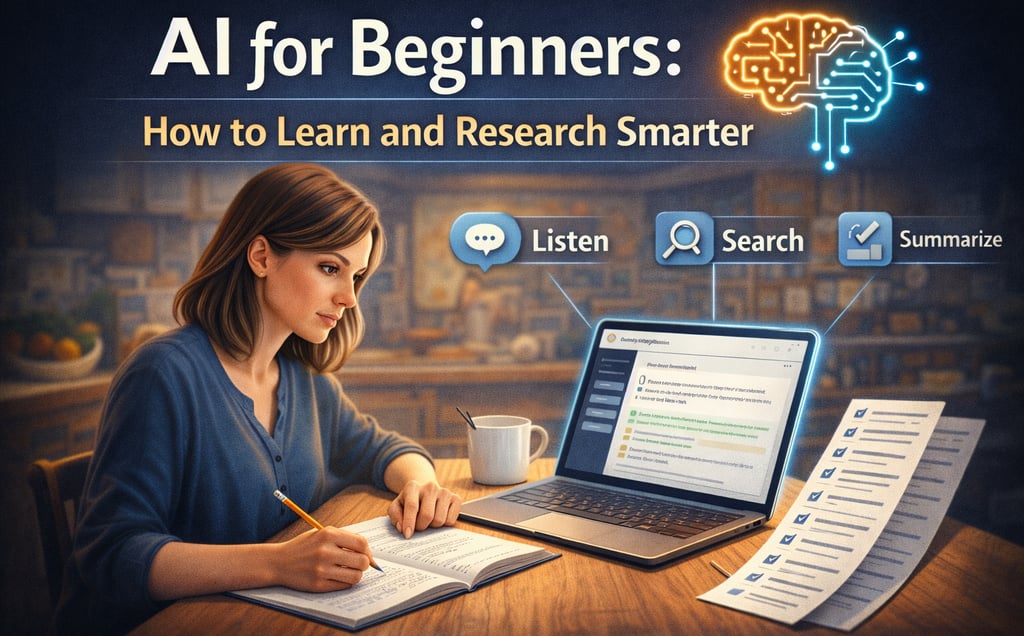

You sit down at your kitchen table with a notebook, a cup of tea, and a long list of topics you want to explore—maybe a new language, a science project, or a history paper.
The internet has everything.
And that’s the problem.
There’s too much information.
If you're just starting out, you might wonder:
“How do I choose the right AI tool to help me learn without wasting hours?”
That’s where AI for beginners becomes practical.
What Does an AI Helper Actually Do?
Think of an AI tool as a smart notebook that can:
Sort information
Summarize content
Suggest next steps
Create outlines
Answer focused questions
You type a clear question.
It gives you a structured response.
How AI Tools Work
Step 1: Listen
You type a request such as:
“Explain photosynthesis in simple terms.”
Step 2: Search
The system looks through learned information and identifies relevant material.
Step 3: Summarize
It presents the answer in a concise and understandable format.
This same process works for outlines, comparisons, brainstorming, and research support.
Why This Matters for Beginners
Reduces Overwhelm
Instead of opening multiple tabs, you receive a single organized response.
Builds Confidence
Seeing clear answers quickly makes the learning process feel manageable.
Saves Time
Busy learners benefit from fast summaries and structured guidance.
Practical Ways to Use AI for Learning
Planning a Study Session
You can request:
“Create a 30-minute study plan for basic algebra.”
The system generates a time-based outline.
Understanding a Complex Article
Ask:
“Summarize this article in simple language.”
You receive a clear recap.
Creating an Essay Outline
Type:
“Outline three key ideas about the Renaissance for a 500-word essay.”
You get a logical framework.
Learning a New Skill
Request:
“List the first five steps for a beginner to learn knitting.”
You receive actionable steps.
Checking Presentation Facts
Ask for updated statistics and review suggested sources.
Common Beginner Mistakes
Using Vague Prompts
Instead of “Tell me about biology,” ask:
“Explain how cells produce energy in simple terms.”
Expecting Perfect Accuracy
Always verify important facts with reliable sources.
Replacing Deep Reading
Use summaries as guidance, not as complete replacements for study.
Three Simple Steps to Start
Step One: Choose a Clear Question
Example:
“What are the main causes of the American Revolution?”
Step Two: Enter the Question into a Free Tool
Most web-based platforms require no download.
Step Three: Read and Verify
Review the summary and check original sources if needed.
Frequently Asked Questions
What if I don’t know the right words?
Start simple. Refine your question gradually.
Can I use AI answers for school assignments?
Use them for structure and understanding, but cite original sources.
Is it free?
Basic versions of many tools are free and sufficient for beginners.
How do I avoid outdated information?
Check publication dates and rely on reputable institutions.
Final Thoughts
Choosing the right AI helper is less about complexity and more about clarity.
Start with one focused question.
Use one free tool.
Verify important details.
Over time, this routine will make learning faster, more structured, and less overwhelming.
If you'd like, I can also format it in clean HTML-ready version for direct website upload.