ChatGPT in 2026: Real Workflows, SEO Strategies, Coding Use Cases & What Most People Still Get Wrong
A deep 2026 ChatGPT guide covering SEO workflows, coding, research, AI productivity, real screenshots, limitations, and expert strategies.
AI TOOLS
DIPJYOTI SHARMA
5/15/20266 min read
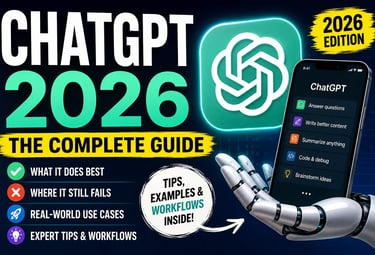
ChatGPT in 2026: Real Workflows, SEO Strategies, Coding Use Cases & What Most People Still Get Wrong
Most people still use ChatGPT like a smarter Google search.
That’s usually where the disappointment starts.
The people getting extraordinary value from ChatGPT in 2026 are using it very differently. They’re not asking random novelty questions. They’re building repeatable systems around it.
SEO writers are compressing six-hour research sessions into ninety minutes.
Developers are debugging repetitive code faster.
Small businesses are replacing fragmented workflows with AI-assisted systems.
Researchers are processing massive documents without reading every page manually.
That’s the real story behind ChatGPT now.
It stopped being “just an AI chatbot” a long time ago.
It became workflow infrastructure.
After months of testing ChatGPT across:
SEO
content creation
coding
AI research
automation
article planning
topical authority building
…the biggest insight became surprisingly simple:
The best AI workflows don’t replace human thinking.
They remove friction from repetitive work.
That distinction matters more than most AI tutorials explain.
What ChatGPT Actually Is in 2026
OpenAI originally launched ChatGPT as a conversational AI assistant.
In 2026, it functions more like a multi-purpose productivity environment.
Modern ChatGPT can:
analyze files
summarize reports
generate content
write code
explain APIs
build outlines
cluster SEO keywords
create automation workflows
generate images
process PDFs
organize research
The interesting part isn’t just capability.
It’s accessibility.
Most advanced software historically required technical expertise.
ChatGPT reduced that barrier dramatically.
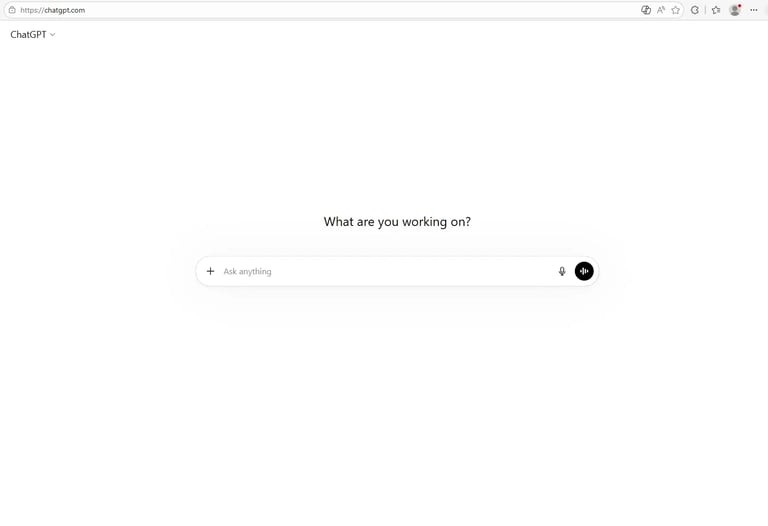
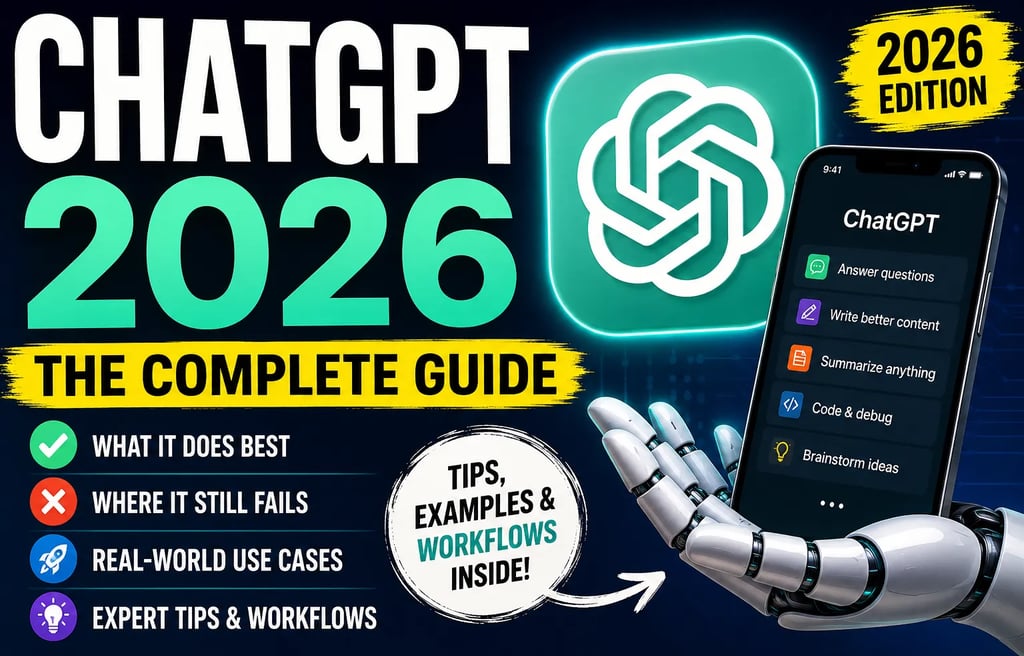
The modern ChatGPT interface dramatically lowered the barrier to advanced digital workflows.
Why ChatGPT Adoption Exploded So Fast
Most software requires users to learn interfaces.
ChatGPT requires users to describe intent.
That changes everything.
Instead of learning complex menus, people simply type:
“Analyze competitors and identify content gaps.”
or
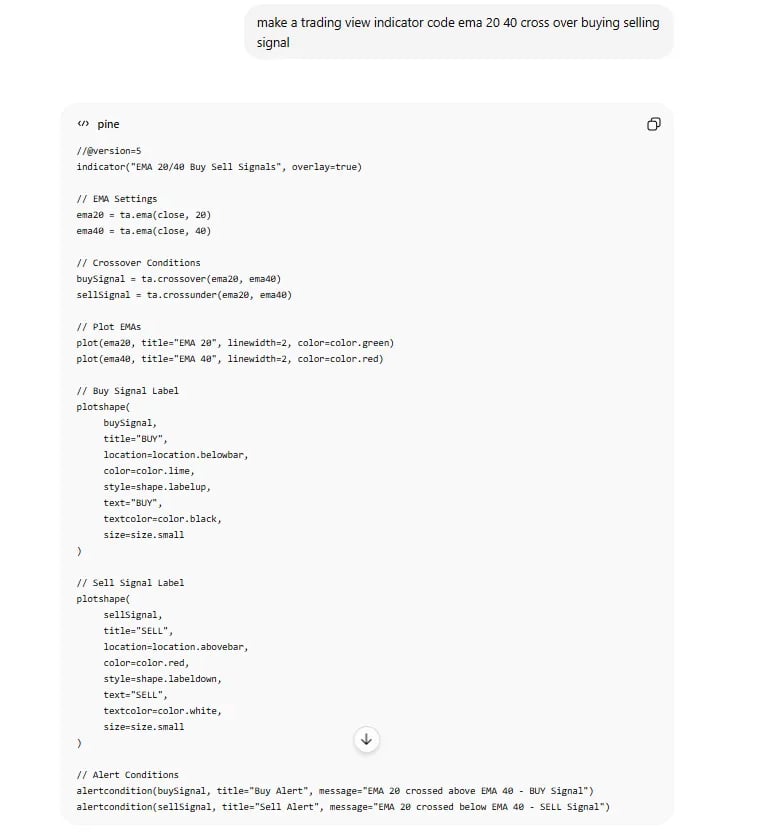
“Generate a TradingView EMA crossover indicator.”
That natural-language workflow made AI adoption significantly faster than many previous technology shifts.
The onboarding friction almost disappeared.
What ChatGPT Actually Does Well
A lot of articles either:
exaggerate ChatGPT massively
ordismiss it completely
Neither perspective is accurate.
ChatGPT is extremely useful in specific categories and noticeably weaker in others.
Understanding that boundary is what separates productive users from frustrated users.
1. Content Creation and Editing
This remains ChatGPT’s strongest mainstream use case.
But experienced users rarely ask:
“Write me a complete article.”
That usually produces generic output.
Instead, advanced users build layered workflows.
These workflows combine:
SERP analysis
semantic SEO
topical clustering
outline creation
rewriting
headline testing
readability optimization
internal linking
The difference in quality becomes enormous.
Professional creators increasingly use AI as an editorial assistant instead of a replacement writer.
Real Workflow Example
A realistic AI-assisted SEO workflow now looks like this:
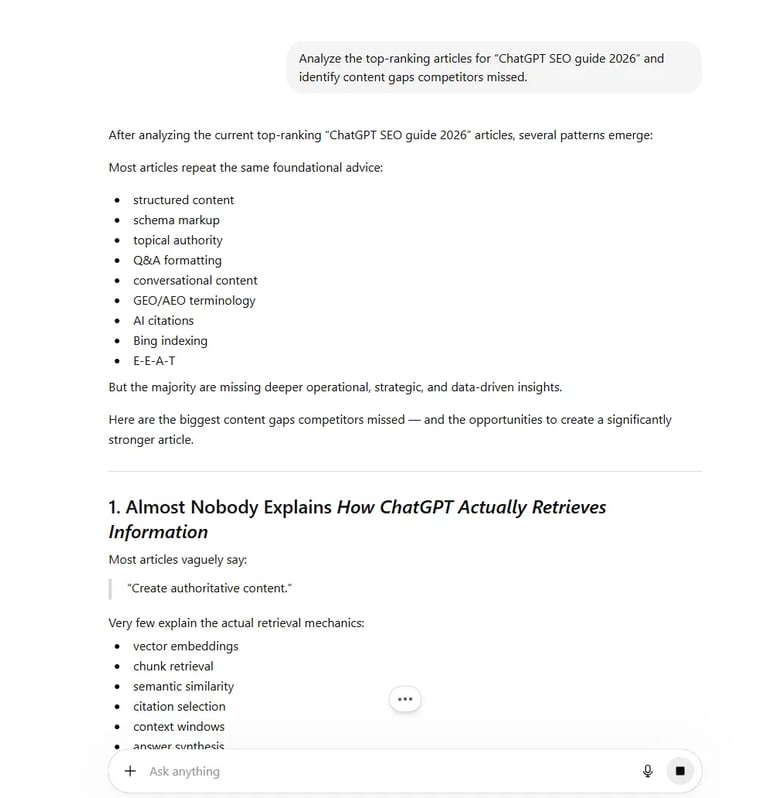
Analyze top-ranking competitors
Extract content gaps
Generate structured outline
Build semantic keyword clusters
Add original insights manually
Improve readability
Optimize internal links
Rewrite weak sections naturally
That workflow is dramatically stronger than one-shot AI generation.
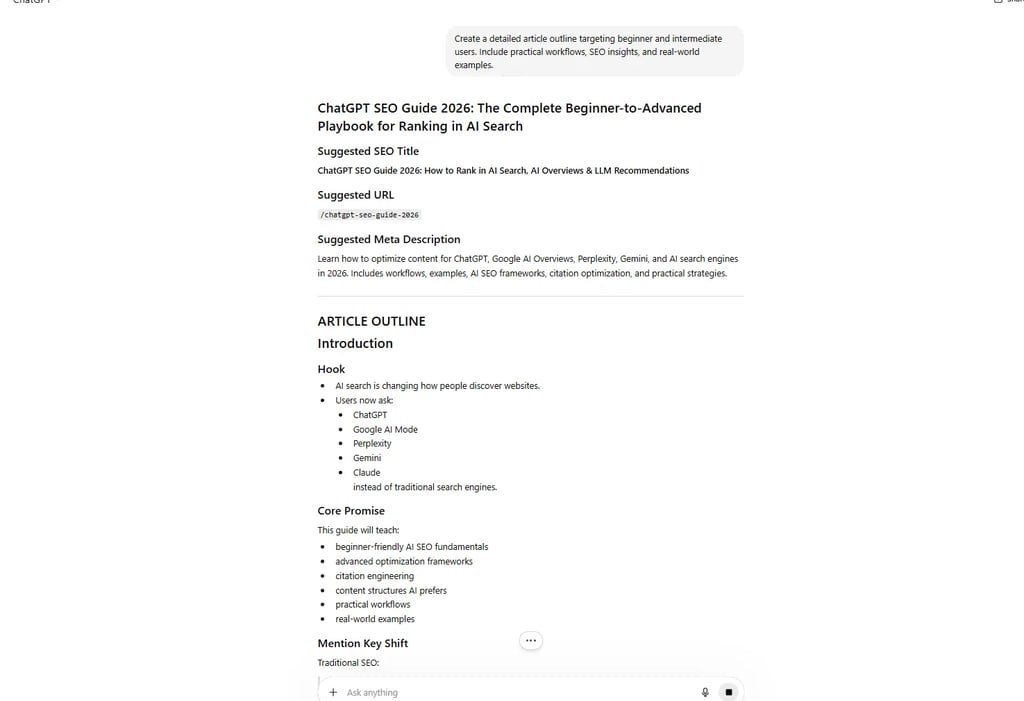
Experienced writers increasingly use AI for structured content planning rather than one-shot article generation.
Why Generic AI Content Fails So Fast
Once you start recognizing AI-generated patterns, they become impossible to ignore.
Weak AI content usually contains:
repetitive sentence rhythm
predictable headings
filler explanations
surface-level insights
exaggerated hype
generic conclusions
Ironically, AI made originality more valuable.
Because generic content became easier to create, genuinely useful content became easier to identify.
That shift changed SEO more than most people realize.
Competitor Analysis Became a Massive Advantage
One of the biggest differences between average AI content and high-performing AI-assisted content is strategic depth.
Experienced publishers increasingly use ChatGPT to identify:
missing subtopics
weak competitor sections
shallow explanations
overlooked user pain points
missing FAQs
weak semantic coverage
That strategic layer matters far more than generating text quickly.
AI-assisted competitor analysis helps uncover strategic content gaps that many articles completely miss.
This is one reason why experienced SEO creators still outperform mass AI publishing systems.
2. SEO and Search Optimization
SEO workflows changed dramatically after AI matured.
But not in the way many people expected.
ChatGPT did not kill SEO.
It increased the importance of strategic SEO.
Modern SEO increasingly revolves around:
semantic relationships
topical authority
search intent
entity optimization
internal linking
user engagement signals
EEAT perception
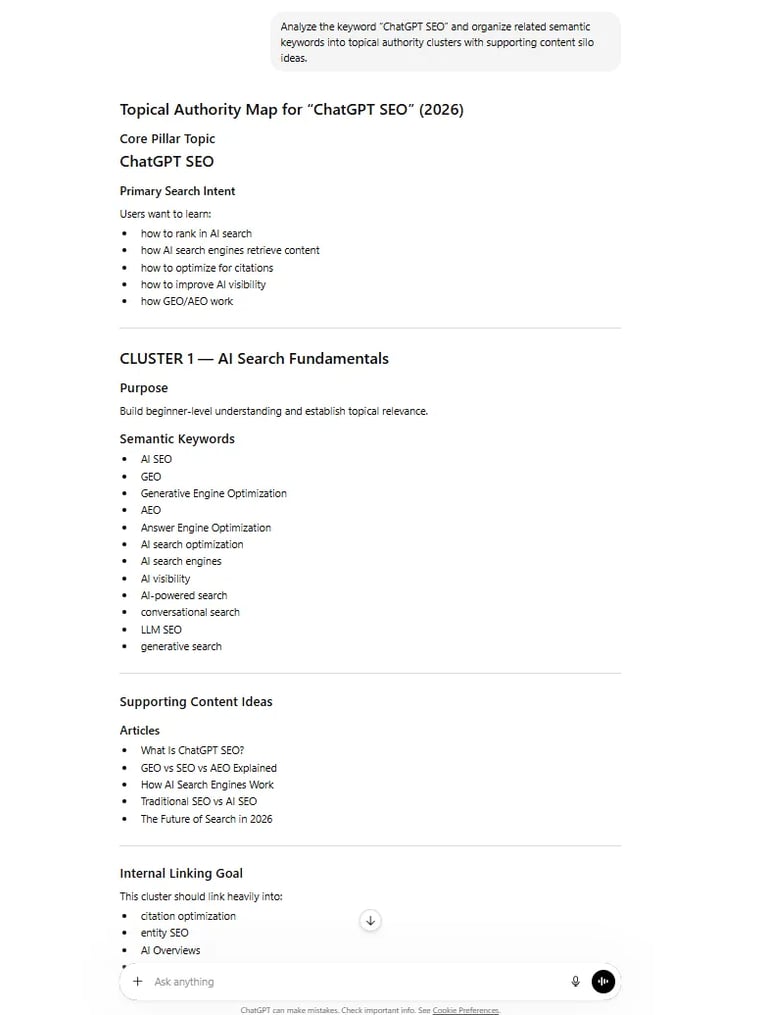
This is where AI-assisted topical clustering became extremely powerful.
Practical SEO Workflow
Modern SEO creators now use ChatGPT for:
semantic keyword mapping
FAQ extraction
topical authority planning
content silo generation
search intent analysis
entity discovery
internal linking structures
The biggest time savings often happen before writing even begins.
AI-assisted topical clustering dramatically reduces SEO planning time while improving semantic coverage and topical authority.
This is one of the strongest practical AI SEO use cases today.
If you’re exploring AI-assisted publishing systems further, these guides also connect well with this topic:
https://www.asimplifiedhub.blog/2026/05/manus-ai-review-2026-autonomous-ai-agent.html
https://www.asimplifiedhub.blog/2026/02/canva-tutorial-for-beginners-2026-step-by-step-guide.html
https://simplifiedaihub.com/hostinger-horizons-ai-dentist-website-case-study
3. Coding Assistance
ChatGPT became surprisingly useful for developers.
Not because it writes flawless software.
It doesn’t.
But because it removes repetitive development friction.
Developers increasingly use ChatGPT for:
debugging
API explanations
syntax troubleshooting
boilerplate generation
Pine Script indicators
regex creation
code refactoring
rapid prototyping
For solo founders and smaller creators, these workflow accelerations save enormous amounts of time.
Real Coding Workflow
Instead of manually troubleshooting repetitive indicator logic, developers increasingly ask ChatGPT to:
generate base structures
identify logic errors
explain APIs
optimize repetitive syntax
The productivity gains become substantial for repetitive coding tasks.
Developers increasingly use ChatGPT to generate, debug, and refine repetitive coding workflows faster.
4. Research and Information Compression
This is one of ChatGPT’s most underrated capabilities.
Researchers, marketers, students, and analysts increasingly use AI to compress large information sets into usable summaries.
This becomes incredibly useful for:
industry reports
scientific papers
SEO studies
earnings documents
market research
trend forecasting
The time savings can become enormous.
One strategist described reducing a four-hour research session into under forty minutes using AI-assisted summarization workflows.
The important part is:
compress first
validate second
Because hallucinations still exist.
That part never fully disappeared.
The Biggest Mistake New Users Make
Most beginners ask weak questions.
They type:
“Write me an article about AI.”
That almost guarantees generic output.
Advanced users provide:
audience context
search intent
tone guidance
formatting requirements
competitor weaknesses
SEO goals
structural constraints
examples
Prompt quality directly affects response quality.
But something even more important matters:
Editorial judgment.
The best AI users know:
what to trust
what to verify
what sounds robotic
what feels original
what needs rewriting
That human filtering layer creates the biggest quality differences.
ChatGPT vs Google Search
A lot of people predicted AI would replace search engines completely.
That prediction turned out to be incomplete.
Instead, user behavior split into two layers.
Search Engines Work Better For
live information
local businesses
product reviews
shopping
source discovery
breaking news
ChatGPT Works Better For
summarization
synthesis
restructuring information
brainstorming
workflow acceleration
drafting
explanation
Most experienced users now combine both.
They use search engines for discovery.
Then use ChatGPT to process information faster.
The Hidden Cost Nobody Talks About
AI productivity gains are real.
But there’s also a downside.
Overdependence can weaken originality.
You can already see this happening online.
Large volumes of content now sound strangely similar:
same structures
same transitions
same phrasing
same recycled ideas
That creates a strange paradox.
The more AI-generated content floods the internet, the more valuable authentic expertise becomes.
That means creators combining:
AI efficiency
real experience
editorial judgment
nuanced insights
…are likely to dominate future search rankings.
Not the people mass-producing generic AI filler.
Who Should Use ChatGPT?
Excellent Fit For
SEO professionals
writers
freelancers
agencies
marketers
students
developers
YouTubers
researchers
small businesses
Probably Not Ideal For
users expecting perfect accuracy
blind automation systems
fully unedited AI publishing
high-risk industries without verification
AI works best as augmentation.
Not blind replacement.
Final Thoughts
ChatGPT in 2026 is no longer a novelty tool.
It’s becoming part of modern digital infrastructure.
Used lazily, it creates shallow content faster.
Used intelligently, it:
compresses research
accelerates workflows
improves productivity
enhances SEO planning
speeds up development
removes repetitive friction
The biggest misconception about AI is that it replaces thinking.
The people getting the best results are actually thinking more deeply than before.
They’re using AI to eliminate friction — not originality.
And that distinction will likely define who succeeds in the next era of digital publishing.
FAQ Section
Is ChatGPT still free in 2026?
Yes. Free plans still exist, although advanced reasoning models and higher usage limits are typically part of paid subscriptions.
Is ChatGPT good for SEO?
Yes. Many SEO professionals now use ChatGPT for semantic clustering, search intent analysis, topical authority mapping, and workflow acceleration.
Can ChatGPT replace human writers?
Not entirely. Human originality, editorial judgment, and firsthand expertise still matter heavily for high-quality content.
Does ChatGPT still hallucinate?
Yes. Hallucinations are less common than earlier versions, but users should still verify important statistics, technical explanations, and citations.
Why do experienced users get better AI results?
Because they use layered workflows, strategic prompting, manual editing, and editorial judgment instead of relying entirely on raw AI output.