Indus AI: India’s ChatGPT Killer? Full Review (2026)
Indus AI Review 2026: Is India’s ChatGPT alternative worth it? Explore features, multilingual support, real use cases, and SEO potential for bloggers and creators.
AI TOOLS
Dipjyoti Sharma
4/22/20264 min read
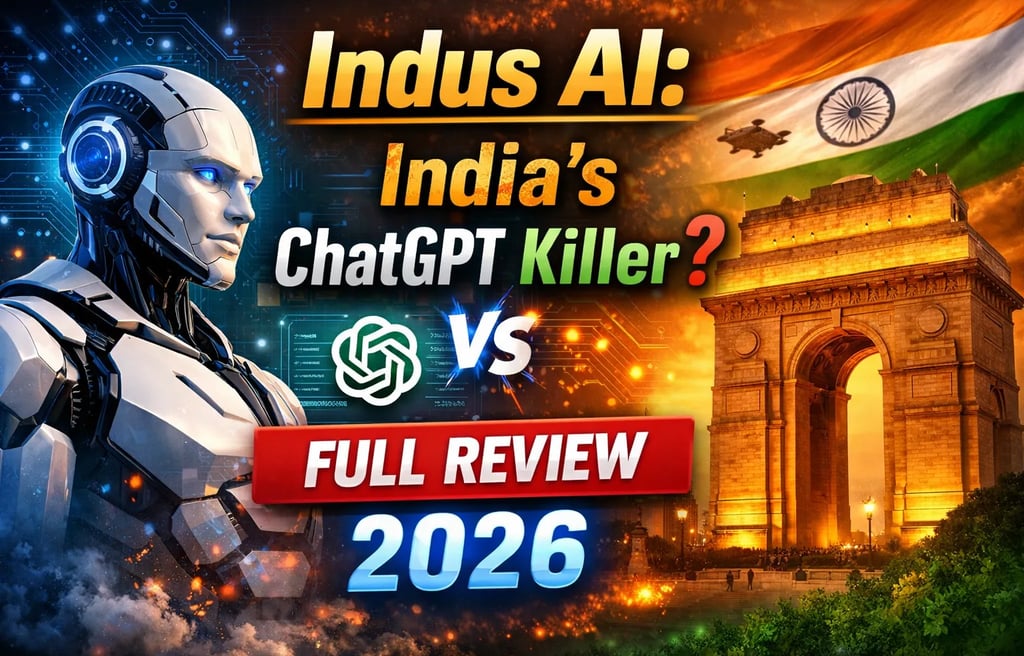
Indus AI: India’s ChatGPT Killer? Full Review (2026)
Artificial Intelligence is evolving rapidly, but 2026 feels different. Instead of just global tech giants dominating the space, we’re now seeing region-specific innovation take center stage. One of the biggest examples of this shift is Sarvam AI’s Indus AI, a chatbot built specifically for Indian users.
Naturally, comparisons with tools like ChatGPT are unavoidable. Many are even calling it a “ChatGPT killer.” But does it really live up to that claim, or is it simply a strong alternative designed for a different purpose?
This detailed Indus AI review explores exactly that—through real use cases, performance insights, and practical applications for creators, bloggers, and businesses.
What Makes Indus AI Different
Most AI tools today are designed with a global audience in mind, which often means they prioritize English and a handful of widely used languages. Indus AI takes a completely different approach. It is built around India’s linguistic diversity, supporting more than 20 Indian languages and even understanding mixed-language inputs like Hinglish.
This is more important than it might seem at first. A large portion of India’s internet users prefer consuming and creating content in their native language. That makes Indus AI particularly valuable for anyone trying to reach regional audiences, whether through blogging, social media, or local business marketing.
Another major advantage is its voice-first design. Instead of typing complex queries, users can simply speak naturally and receive responses in both text and audio. This makes the platform far more accessible, especially for beginners or non-technical users.
Real-World Performance and Practical Use
When you start using Indus AI in real scenarios, its strengths become clear. It performs especially well when dealing with culturally relevant topics—things like local festivals, regional business ideas, or language-specific content. In these areas, it often provides more context-aware responses than global AI tools.
For bloggers, this opens up a major opportunity. Instead of competing for highly saturated English keywords, you can target regional search queries that are still underserved. Writing content in Hindi, Assamese, or Bengali using AI assistance is not just easier—it’s also more likely to rank faster.
At the same time, it’s important to stay realistic. When it comes to advanced reasoning, coding, or highly technical queries, tools like ChatGPT still have the upper hand. Indus AI is improving quickly, but its current strength lies in accessibility and localization rather than complexity.
Indus AI vs ChatGPT: A Practical Perspective
Rather than thinking in terms of “which one is better,” it’s more useful to understand where each tool fits.
Indus AI excels in areas where local understanding matters. If your goal is to create content for Indian audiences, especially in regional languages, it offers a clear advantage. ChatGPT, on the other hand, remains stronger for global research, detailed analysis, and complex problem-solving.
This means the smartest approach is not choosing one over the other, but using both strategically—leveraging ChatGPT for depth and Indus AI for localization.
Why This Matters for SEO and Content Creation
One of the most overlooked opportunities in 2026 is regional SEO. While millions of articles are published in English every day, content in Indian languages is still relatively underdeveloped. This creates a unique gap that tools like Indus AI can help fill.
For example, instead of targeting a highly competitive keyword like “best AI tools for blogging,” you could focus on a localized variation in Hindi or Assamese. These types of queries often have lower competition but strong search intent, making them ideal for faster rankings.
This approach aligns perfectly with broader AI content strategies, where the goal is not just to create content, but to create strategically positioned content. If you’ve explored how AI is transforming workflows—like in this guide on https://simplifiedaihub.com/sider-ai-review-2026-how-this-ai-sidebar-cut-my-workload-in-half—you’ll see how combining tools can dramatically improve productivity and output quality.
Similarly, building a content-driven online business becomes much easier when you integrate AI into your workflow. A practical example of this is explained in https://simplifiedaihub.com/start-a-website-business-with-ai-build-and-sell-websites-using-hostinger-2026-guide, where AI is used to scale website creation and monetization.
Even broader trends show that AI is becoming a core part of digital growth strategies, as highlighted in https://simplifiedaihub.com/ai-in-2026-best-tools-side-hustles-automation-and-future-guide. Indus AI fits directly into this ecosystem, especially for creators targeting Indian audiences.
Strengths and Limitations
Indus AI’s biggest strength is that it lowers the barrier to entry. It makes AI usable for people who may not be comfortable with English or traditional tech interfaces. This alone gives it massive potential in a country like India.
However, it is still in its early stages. You may occasionally notice limitations in depth or consistency, particularly with complex queries. This is expected, and it doesn’t diminish its value—it simply defines its current role.
So, Is Indus AI a ChatGPT Killer?
The short answer is no—but that doesn’t mean it’s not important.
Indus AI is not trying to replace ChatGPT on a global scale. Instead, it is solving a very specific and very large problem: making AI accessible and relevant for Indian users.
And in that space, it is already proving to be incredibly effective.
Final Verdict
Indus AI represents a shift toward localized, user-centric artificial intelligence. It may not yet match the global capabilities of tools like ChatGPT, but it offers something equally valuable—relevance.
For bloggers, this means new SEO opportunities. For creators, it means easier content production. And for businesses, it means better connection with local audiences.
In 2026, success with AI isn’t about using the most powerful tool—it’s about using the right tool for the right audience. And if your audience is in India, Indus AI is quickly becoming one of the smartest tools you can use.
FAQs
What is Indus AI?
Indus AI is an Indian AI chatbot developed by Sarvam AI, designed for multilingual and voice-based interaction.
Is Indus AI better than ChatGPT?
It depends on your use case. For Indian languages and local content, Indus AI performs better. For advanced tasks, **ChatGPT still leads.
Can I use Indus AI for blogging?
Yes, especially for regional content and low-competition SEO topics.
Is Indus AI free?
It is currently available in beta with limited access.
Does it support voice?
Yes, voice interaction is one of its key strengths.