Narayana Murthy’s AI Warning: Are We Overhyping Artificial Intelligence in 2026?
Is AI overhyped in 2026? Narayana Murthy questions the AI bubble, job fears, and the real impact of artificial intelligence on professionals and startups.
,AI FOR BEGINNERSTECHNOLOGY & AI
DIPJYOTI SHARMA
2/27/20265 min read
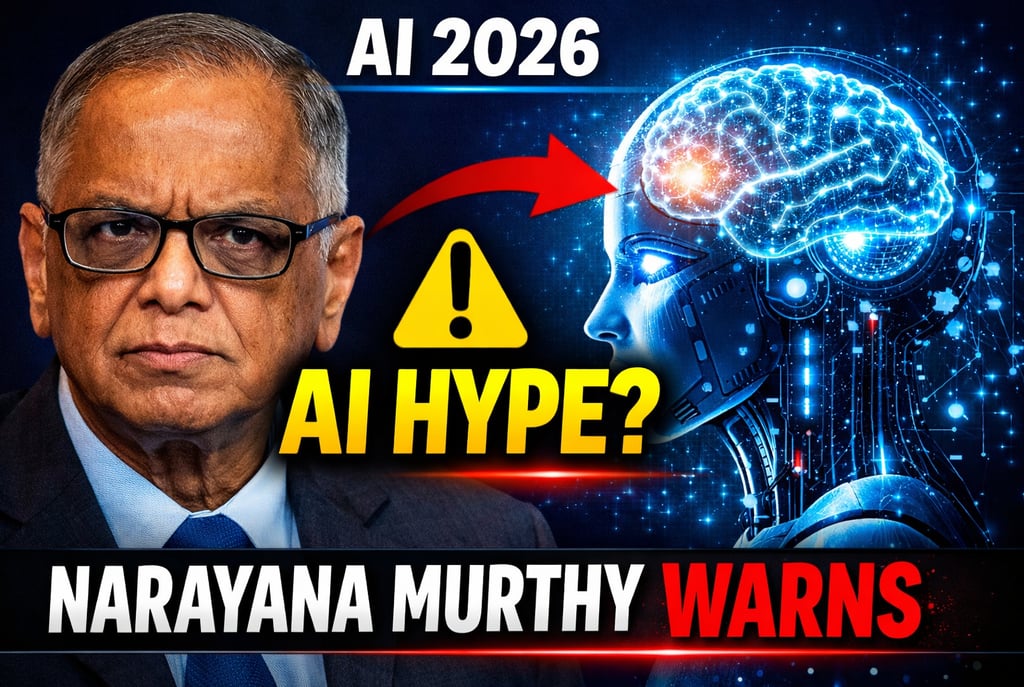
Narayana Murthy's AI Warning: Are We Overhyping Artificial Intelligence in 2026?
Is artificial intelligence the greatest breakthrough of our era — or the most overhyped bubble since the dot-com crash? When Infosys founder Narayana Murthy speaks about AI, the global tech industry listens. His warning in 2026 isn't about fear — it's about realism.
The conversation around Narayana Murthy AI warning has intensified in recent months, bringing sharp focus to a critical question that's dominating boardrooms and living rooms alike: Is artificial intelligence being oversold?
"Don't fear AI. Learn to use it better than others."
— Narayana Murthy
The Infosys founder's recent comments paint a nuanced picture of the AI hype 2026 landscape that differs significantly from doom-and-gloom narratives circulating online.
In February 2026, Murthy addressed growing concerns among young Indians and professionals worldwide about AI replacing jobs and the impact on career prospects. His message was clear: don't fear the technology, but don't underestimate the competitive advantage it creates.
The Current State of AI Overhyping
The tech sector has witnessed an AI bubble prediction cycle reminiscent of the dot-com era. Many companies are simply rebranding old programs as cutting-edge AI innovations.
Murthy characterized much of India's AI enthusiasm as involving "silly, old programs" being rebranded as innovations. While some companies drive real advancement, many capitalize on the trend without meaningful technological progress.
This matters for understanding AI impact on Indian IT companies and the broader AI industry analysis 2026. The reality is more measured than headlines suggest.
Generative AI and Human Productivity
Murthy's hands-on experience with AI shows that "a smarter mind will get better quality and better productivity from using these assistive technologies," demonstrating that technology rewards those who think faster rather than automatically replacing workers.
This is the heart of the AI productivity debate. Technology doesn't uniformly displace workers; it creates workforce bifurcation. Those who leverage AI tools thrive. Those who resist struggle.
The Job Displacement Question: Separating Fact from Fiction
Anxiety around AI job impact 2026 is palpable but deserves scrutiny. Former HDFC CEO Aditya Puri noted that "there is too much hype on what AI can do" and warned against accepting that "60% of jobs will be lost," noting "nothing like that happens" in reality.
Historically, AI replacing jobs follows a pattern: railroad workers didn't disappear when trains arrived—rail employment exploded. Telegraph operators evolved into telephone operators. Transitions are painful, but economies don't collapse.
For mid-career professionals, the next 5-10 years are critical. Should students worry about AI jobs? Yes—but strategically, by building complementary skills rather than competing directly with machines.
Why the AI Bubble Fears Persist
Several factors explain why Is AI overhyped remains relevant:
Market Dynamics: Investor enthusiasm drives inflated valuations. VC funding pours into companies with untested models simply because they use "AI."
Real Capabilities Are Impressive: Generative AI genuinely is transformative. ChatGPT represents a breakthrough. But breakthroughs and bubble hype aren't mutually exclusive.
Unknown Timelines: The AI future jobs prediction is genuinely uncertain. Disruptions in 2-3 years or 10-15? This uncertainty breeds both hope and fear.
Sector-Specific Vulnerability: Legal research, financial analysis, and software development face near-term displacement risk. Healthcare, education, and trades remain largely protected.
Dot-Com vs. AI Hype 2026: Side-by-Side
Tools Professionals Should Master in 2026
Preparing for the AI era means mastering the tools that will define competitive advantage. Here are the essential platforms professionals should prioritize:
1. ChatGPT by OpenAI
ChatGPT is the gold standard for natural language interaction. Learn prompt engineering, content creation, research synthesis, and advanced reasoning. Get started with ChatGPT →
2. Claude by Anthropic
Claude excels at nuanced reasoning, long-form analysis, and complex problem-solving. Ideal for researchers, analysts, and strategic thinkers. Explore Claude capabilities →
3. AI Coding Assistants (GitHub Copilot, Cursor, CodeStarter)
If you're a developer, AI-powered code generation is transforming productivity. Master GitHub Copilot or Cursor for 10x faster development cycles. Compare AI code tools →
4. AI Research & Analysis Tools (Perplexity, Elicit, Consensus)
For researchers and business professionals, AI research assistants accelerate information discovery. Perplexity finds answers with sources; Elicit summarizes academic papers. Compare research AI tools →
What Murthy Actually Advocates: A Balanced Approach
Rather than dismissing AI concerns, Murthy advises young professionals to master AI as an assistive tool—not fearfully, but strategically.
For Young Professionals: Learn to use AI tools effectively. Master prompt engineering, understand limitations, integrate into workflows.
For Established Professionals: Reskilling means leveraging AI, not building from scratch. Human-AI collaboration will define 2030's most valuable roles.
For Organizations: Competitive advantage comes from building cultures where employees continuously integrate new tools.
For Policymakers: Investment in reskilling programs makes more sense than restricting AI through regulation.
Frequently Asked Questions
Q1: Is AI going to replace my job?
Probably not your specific job, but requirements will change. Expect transformation, not replacement. Skills that matter: creativity, emotional intelligence, complex reasoning, ethical judgment. Build these alongside technical competency.
Q2: What's the difference between AI hype and real value?
Real AI solves concrete problems faster, better, or cheaper. Hype is when "AI" gets applied without advantage. Before adopting any solution, ask: Does this genuinely improve our outcome?
Q3: How long until AI disrupts my industry?
Financial analysis, legal research, software development: 2-5 years. Skilled trades, healthcare, counseling: 10-20 years. Start adapting now—earlier preparation prevents career disruption.
Q4: Should I learn to build AI models?
Only if pursuing specialized roles. For most professionals, mastering existing AI tools is more valuable than building from scratch. Tools available today: ChatGPT, Claude, GitHub Copilot.
Q5: Is the AI bubble going to burst?
Partially. Overvalued companies will decline, but AI has demonstrated productivity benefits. Unlike dot-com, correction will be selective, not comprehensive.
Q6: What should young Indians do right now?
Learn to use AI tools in your domain. Stay curious. Develop complementary skills. Don't panic—but don't ignore it either.
The Bottom Line: Your AI Future Starts Now
Narayana Murthy's AI warning isn't bearish or bullish—it's a call for realism. The technology is transformative, the hype is partially inflated, and the trajectory is significant but not immediate.
Success in the AI era belongs to those who recognize it as a tool requiring skillful, disciplined application rather than a magic solution.
The AI era won't reward panic. It will reward preparation. The question isn't whether AI will change your career — it's whether you'll adapt faster than the change itself.
Start with one tool. Master ChatGPT or Claude this week. Integrate it into your workflow. Build the habits now that will define your competitive advantage in 2027 and beyond. The professionals who thrive won't be those who feared AI—they'll be those who saw it coming and prepared accordingly.
Related Articles You May Like
Understanding Prompt Frameworks: A Beginner-Friendly Guide
How to Get Clients as an AI Website Designer in 2026 | AI Simplified Hub
Top Free AI Tools for Small Businesses in the USA (2026 Guide)
I Tested 15 Free AI Tools for 30 Days — Here Are the Only Ones Beginners Actually Need (2026)
Google AI Studio Full Tutorial 2026: Complete Guide to All Features, Models & Tools
Jasper vs Copy.ai – Which Is Better for Small Businesses? (2026 Comparison)
AI Agents Explained: The Next Internet Revolution (2026)
Information Overload AI: How Smart Tools Help You Manage the Digital Flood
AI Project Planning: Turning To-Do Lists Into Clear Action Plans
📘 Want a Complete Online Income Blueprint?
If you’re serious about turning AI skills into real online income — not just learning tools — you need a structured system.
I explain the complete roadmap, including freelancing, digital products, blogging, and scalable income strategies, in my book:
This book is designed as a step-by-step implementation guide so you don’t need to jump between YouTube tutorials or random courses.
🔗 Get the book here:
The Ultimate Online Income System