Nokia and NVIDIA’s AI Partnership Could Redefine AI-Powered 6G Networks in 2026
Nokia and NVIDIA are building AI-powered 6G networks using AI-RAN technology, edge AI computing, and advanced AI inference chips. Here’s why this partnership matters in 2026.
AI NEWS
DIPJYOTI SHARMA
5/11/20264 min read
Nokia and NVIDIA’s AI Partnership Could Redefine the Future of 6G Networks
The next AI revolution may not happen inside chatbots.
It may happen inside telecom towers.
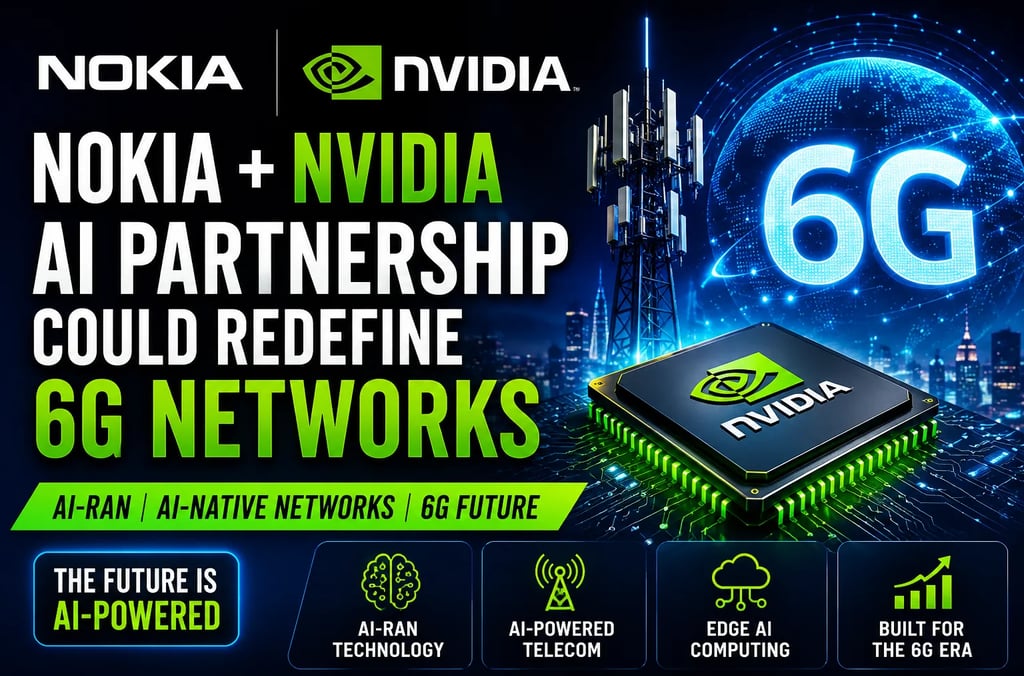
In 2026, Nokia and NVIDIA are building what could become the foundation of future AI-powered mobile networks through a major partnership focused on AI-RAN technology, edge AI computing, and AI-native 6G infrastructure.
This collaboration is important because it combines two industries that are rapidly converging:
Telecommunications
Artificial Intelligence
For years, telecom companies focused mainly on faster connectivity. But future networks will require something much bigger — real-time AI processing directly inside network infrastructure.
That is exactly what Nokia and NVIDIA are trying to build.
What Is the Nokia NVIDIA AI Partnership?
The Nokia NVIDIA AI partnership focuses on creating AI-native telecom infrastructure powered by accelerated computing and GPU-based network systems.
The core goal is to develop AI-RAN (Artificial Intelligence Radio Access Networks), where telecom operations and AI workloads run on the same infrastructure.
Traditional telecom networks use dedicated hardware built specifically for networking tasks. AI-RAN changes this model completely by allowing GPU-powered systems to handle both:
Wireless network traffic
AI inference processing
This creates a smarter, more flexible, and more efficient telecom ecosystem.
The partnership includes development in:
AI-powered 5G Advanced systems
Future 6G architecture
Edge AI computing
Telecom AI automation
GPU acceleration for mobile networks
AI-native cloud infrastructure
Industry analysts believe AI-RAN could become one of the biggest transformations in telecom infrastructure since the arrival of 5G.
What Is AI-RAN and Why Does It Matter?
AI-RAN stands for Artificial Intelligence Radio Access Network.
It combines artificial intelligence with mobile network infrastructure to create self-optimizing telecom systems.
Instead of relying entirely on fixed telecom hardware, AI-RAN uses programmable GPU-based computing platforms that can dynamically allocate resources for networking and AI tasks simultaneously.
Why AI-RAN Is Important
1. Smarter Networks
AI models can optimize traffic routing, improve signal quality, reduce congestion, and predict network failures in real time.
2. Lower Infrastructure Costs
Telecom companies can consolidate AI computing and networking workloads onto shared infrastructure instead of operating separate systems.
3. Better Edge AI Performance
AI applications can run closer to users through edge computing, reducing latency for real-time services.
4. Faster 6G Development
Future 6G networks are expected to depend heavily on autonomous AI systems for network optimization and service delivery.
This is why many telecom companies are now investing heavily in AI-native infrastructure.
Why NVIDIA’s AI Inference Chips Are Critical
NVIDIA is no longer just a GPU company.
The company is rapidly becoming one of the most important AI infrastructure providers in the world.
Its next-generation AI inference hardware is designed specifically for real-time AI deployment at scale.
That makes telecom infrastructure a perfect opportunity.
Previously, NVIDIA introduced advanced inference-focused AI chips aimed at reducing AI processing costs while improving large-scale deployment efficiency.
You can read our earlier analysis here:
Those inference chips could eventually power:
AI-native telecom towers
Smart cities
Autonomous transportation systems
AI assistants at the network edge
Industrial robotics
Real-time AR and VR applications
This shows NVIDIA’s long-term strategy clearly:
From AI training → toward global AI deployment infrastructure.
Why Nokia Needs NVIDIA
Nokia already has deep expertise in telecom systems, networking equipment, and wireless infrastructure.
But AI-native networks require enormous computing power.
That is where NVIDIA becomes essential.
NVIDIA contributes:
GPU acceleration
AI computing platforms
AI inference systems
Edge AI architecture
High-performance networking
AI software ecosystems
Meanwhile, Nokia contributes:
Telecom infrastructure expertise
Wireless networking technology
5G and future 6G systems
Carrier-grade deployment experience
Together, they are building a telecom architecture designed specifically for the AI era.
How This Partnership Could Shape 6G Networks
6G will likely become far more intelligent than 5G.
Instead of focusing only on internet speed, future networks may support:
Autonomous AI agents
Smart factories
Real-time language translation
Immersive AR and VR
AI-powered robotics
Massive IoT ecosystems
Digital twins and industrial automation
These applications require continuous low-latency AI inference directly inside telecom infrastructure.
Traditional telecom systems were never designed for this type of workload.
AI-native infrastructure changes that completely.
This is why AI-RAN may become one of the core foundations of future 6G networks.
T-Mobile and Other Telecom Giants Are Already Exploring AI-RAN
The Nokia NVIDIA partnership is not happening in isolation.
Several major telecom operators are already exploring AI-RAN deployments and AI-native infrastructure strategies.
Companies involved in AI-RAN initiatives include:
T-Mobile
Deutsche Telekom
SoftBank
Orange
Indosat
TIM Brasil
This indicates that AI-powered telecom infrastructure is becoming a serious industry trend rather than an experimental concept.
Nokia vs Ericsson vs Huawei in the AI-RAN Race
The race for AI-native telecom infrastructure is becoming highly competitive.
Nokia
Strong focus on AI-RAN partnerships and GPU-accelerated telecom systems through NVIDIA collaboration.
Ericsson
Investing heavily in cloud-native telecom architecture and programmable network systems.
Huawei
Aggressively developing AI-powered telecom infrastructure despite geopolitical restrictions in several markets.
The competition for AI-powered 6G leadership could become one of the defining technology battles of the decade.
The Bigger Shift: AI Infrastructure Is Moving Toward Inference
For years, the AI industry focused mainly on training larger models.
But in 2026, the focus is shifting toward AI inference — the process of running AI models efficiently in real-world environments.
That shift is changing the entire AI industry.
Companies now need infrastructure capable of handling:
Real-time AI deployment
Continuous inference workloads
Edge AI applications
Low-latency processing
Autonomous systems
This is exactly why telecom infrastructure is becoming a major AI battleground.
Nokia and NVIDIA are positioning themselves at the center of this transition.
Final Thoughts
The Nokia NVIDIA AI partnership represents far more than a telecom collaboration.
It signals the beginning of AI-native communication infrastructure where networking, edge computing, and artificial intelligence merge into a single ecosystem.
If AI-RAN succeeds, future telecom towers may become distributed AI computing centers powering everything from autonomous vehicles to real-time AI assistants.
And if NVIDIA’s inference-focused AI hardware becomes deeply integrated into telecom systems, the company could become one of the most influential infrastructure providers of the AI era.
The race toward AI-powered 6G networks has officially begun.
FAQ
What is AI-RAN technology?
AI-RAN stands for Artificial Intelligence Radio Access Network. It combines AI computing and telecom infrastructure into a shared GPU-powered system.
Why are Nokia and NVIDIA partnering?
Nokia provides telecom infrastructure expertise, while NVIDIA contributes AI computing and GPU acceleration technology for future AI-native networks.
How could AI impact 6G?
AI could automate network optimization, improve edge computing, reduce latency, and enable real-time intelligent applications across future 6G systems.
What role does NVIDIA play in telecom AI?
NVIDIA provides accelerated computing platforms, AI inference hardware, and GPU infrastructure that can power AI-native telecom networks.