The Future of AI (2026): How AI Will Transform Jobs, Business, and Technology
Explore the future of AI in 2026. Learn how artificial intelligence will impact jobs, businesses, technology, and global industries in this complete guide.
ONLINE EARNING & AI TOOLS
DIPJYOTI SHARMA
3/15/20266 min read
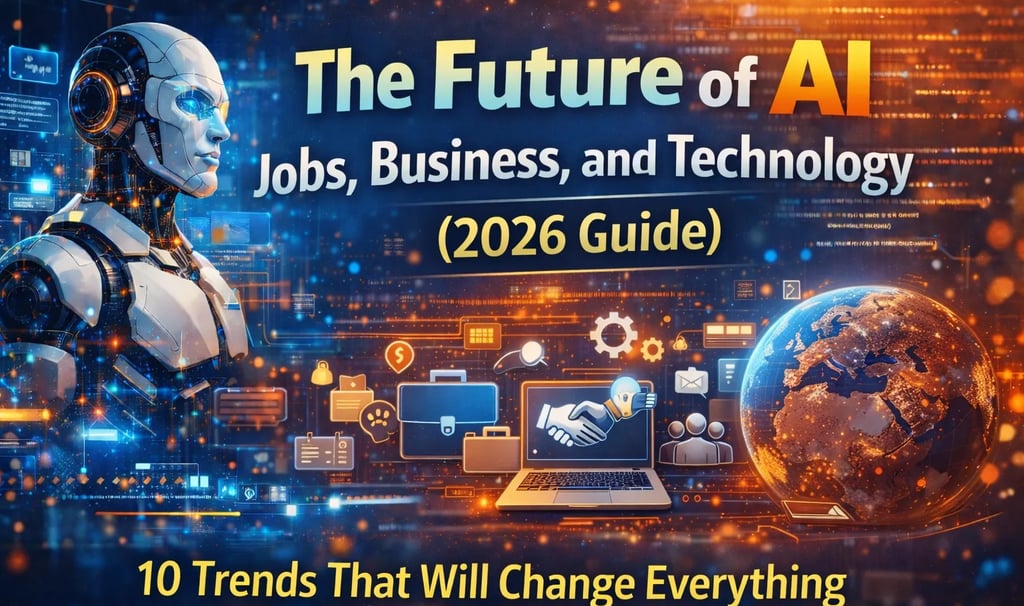
The Future of AI: Jobs, Business, and Technology (2026 Guide)
Introduction
Artificial intelligence is no longer just a concept from science fiction. It has become one of the most transformative technologies shaping the modern world. From smart assistants to advanced automation systems, AI is rapidly changing how people work, communicate, and run businesses.
Companies across industries are adopting AI tools to increase productivity, improve decision-making, and create new products and services. At the same time, many people are wondering how AI will affect jobs, industries, and society in the coming years.
The future of artificial intelligence will influence nearly every aspect of life, including business operations, the global economy, healthcare, education, and technology development.
In this Future of AI Guide (2026) you will learn:
How AI is evolving
The impact of AI on jobs and employment
How businesses are adopting AI
The most important AI technology trends
Predictions about the future of artificial intelligence
Understanding these developments can help individuals and organizations prepare for the opportunities and challenges created by AI.
Table of Contents
What Is Artificial Intelligence
The Rapid Growth of AI
Why AI Is Transforming Industries
The Impact of AI on Jobs
Jobs That May Be Automated
Jobs That AI Will Create
AI in Business Transformation
AI Technology Trends
The Role of AI Hardware and Infrastructure
Ethical Challenges of AI
The Future of AI in Different Industries
AI and the Global Economy
Predictions for the Future of AI
Key Takeaways
FAQs
What Is Artificial Intelligence?
Artificial intelligence refers to computer systems designed to perform tasks that normally require human intelligence.
These tasks include:
learning from data
recognizing patterns
understanding language
solving complex problems
Modern AI systems are powered by machine learning and large language models that analyze massive datasets to generate insights and predictions.
Examples of AI applications include:
virtual assistants
recommendation algorithms
autonomous vehicles
AI content creation tools
intelligent automation systems
These technologies are becoming increasingly powerful as computing capabilities continue to advance.
The Rapid Growth of AI
The development of artificial intelligence has accelerated dramatically over the past decade.
Several factors have contributed to this rapid growth.
Increased Computing Power
Modern hardware allows AI systems to process large amounts of data quickly.
Large Data Availability
The internet and digital systems generate massive datasets that AI can analyze.
Machine Learning Advances
New algorithms have improved the accuracy and capabilities of AI systems.
As a result, AI adoption is expanding across industries worldwide.
Why AI Is Transforming Industries
AI technology provides several advantages that make it attractive to organizations.
Automation of Repetitive Tasks
AI systems can automate tasks that previously required human labor.
Data-Driven Decision Making
Businesses use AI to analyze data and improve strategic decisions.
Personalized Customer Experiences
AI systems analyze user behavior to deliver personalized recommendations.
Increased Productivity
Automation allows organizations to complete work faster and more efficiently.
Because of these benefits, companies across sectors are investing heavily in AI technologies.
The Impact of AI on Jobs
One of the most widely discussed topics about AI is its impact on employment.
Some experts believe AI will replace certain jobs, while others believe it will create new opportunities.
The reality is likely a combination of both.
AI will automate some tasks while also generating new roles and industries.
This debate is explored in more detail in this article:
https://simplifiedaihub.com/can-ai-really-replace-human-jobs-truth-vs-hype
Understanding the balance between automation and job creation is important when evaluating the future of work.
Jobs That May Be Automated
AI is particularly effective at automating tasks that are repetitive and rule-based.
Examples include:
data entry
customer service support
basic accounting tasks
manufacturing processes
simple content generation
However, automation typically focuses on tasks rather than entire professions.
Many jobs will evolve rather than disappear completely.
Jobs That AI Will Create
While some jobs may decline, AI will also create new opportunities.
Examples of emerging roles include:
AI engineers
machine learning specialists
data scientists
prompt engineers
AI ethics specialists
In addition, many traditional roles will incorporate AI tools into their workflows.
For example:
marketers using AI analytics
writers using AI research tools
designers using AI design assistants
These changes demonstrate how AI can augment human capabilities rather than simply replace workers.
AI in Business Transformation
Businesses are among the largest adopters of AI technologies.
Organizations use AI to improve operations in several areas.
Marketing
AI systems analyze consumer data to optimize marketing campaigns.
Customer Support
Chatbots provide automated responses and support services.
Product Development
AI analyzes data to identify market opportunities.
Supply Chain Management
AI optimizes logistics and inventory management.
These applications allow companies to operate more efficiently and respond quickly to market changes.
AI Technology Trends
Several important trends are shaping the future of AI technology.
Generative AI
Generative AI systems can produce text, images, video, and audio.
These tools are transforming creative industries and content production.
AI Automation
Automation systems combine AI with workflow tools to automate business processes.
This trend is driving efficiency improvements across industries.
Multimodal AI
Multimodal AI models can process multiple types of information such as text, images, and video simultaneously.
AI Assistants
Advanced AI assistants are becoming capable of performing complex tasks for users.
The Role of AI Hardware and Infrastructure
AI development relies heavily on advanced hardware systems.
Powerful processors and specialized chips are required to train and run AI models.
For example, innovations in AI chips are discussed in this article:
These technologies make it possible for AI systems to process enormous datasets efficiently.
Ethical Challenges of AI
As AI technology becomes more powerful, ethical considerations become increasingly important.
Key issues include:
Bias in AI Systems
AI models may reflect biases present in training data.
Privacy Concerns
AI systems often analyze large amounts of personal data.
Job Displacement
Automation may affect certain industries and workers.
Responsible AI Development
Developers and organizations must ensure AI systems are used responsibly.
Addressing these challenges will be essential for ensuring that AI benefits society as a whole.
The Future of AI in Different Industries
Artificial intelligence is expected to transform many industries.
Healthcare
AI can assist doctors with diagnostics, medical imaging, and treatment planning.
Finance
Financial institutions use AI for fraud detection, risk assessment, and trading strategies.
Education
AI tools support personalized learning and automated tutoring systems.
Transportation
Autonomous vehicles and AI navigation systems are changing the future of transportation.
Marketing
AI helps marketers analyze customer behavior and personalize campaigns.
AI and the Global Economy
Artificial intelligence is expected to have a major impact on the global economy.
Many economists believe AI will increase productivity and drive economic growth.
However, this transformation may also require workers to adapt and learn new skills.
Governments and organizations are increasingly investing in AI education and workforce development programs.
Predictions for the Future of AI
Experts have proposed several predictions about how AI will evolve in the coming years.
AI Will Become More Accessible
AI tools will become easier for individuals and small businesses to use.
AI Will Enhance Human Productivity
Rather than replacing humans entirely, AI will augment human capabilities.
AI Regulation Will Increase
Governments will introduce policies to ensure responsible AI use.
AI Will Create New Industries
Entirely new business sectors will emerge as AI technology evolves.
Key Takeaways
Artificial intelligence is rapidly transforming industries worldwide.
AI will automate certain tasks while creating new job opportunities.
Businesses are adopting AI to improve efficiency and decision-making.
Ethical considerations are essential for responsible AI development.
The future of AI will bring both challenges and opportunities.
Conclusion
Artificial intelligence is shaping the future of technology, business, and society.
As AI systems become more advanced, they will continue to influence how people work, interact, and innovate.
While AI may automate certain tasks, it will also create new opportunities for individuals and organizations that learn how to use the technology effectively.
Understanding the trends and implications of AI development can help businesses, professionals, and policymakers prepare for the changes ahead.
The future of AI is not just about technology—it is about how humans choose to integrate this powerful tool into society.
Frequently Asked Questions
What is the future of artificial intelligence?
The future of AI includes advances in automation, generative AI, robotics, and intelligent assistants that will transform industries and everyday life.
Will AI replace human jobs?
AI may automate certain tasks, but it will also create new jobs and industries.
Which industries will benefit most from AI?
Healthcare, finance, marketing, transportation, and education are among the industries expected to benefit significantly from AI technologies.
Is AI dangerous?
AI itself is not inherently dangerous, but responsible development and regulation are important to address potential risks.
How can individuals prepare for the future of AI?
Learning AI tools, developing digital skills, and staying informed about technological trends can help individuals adapt to the evolving job market.
📘 Want a Complete Online Income Blueprint?
If you’re serious about turning AI skills into real online income — not just learning tools — you need a structured system.
I explain the complete roadmap, including freelancing, digital products, blogging, and scalable income strategies, in my book:
This book is designed as a step-by-step implementation guide so you don’t need to jump between YouTube tutorials or random courses.
🔗 Get the book here:
The Ultimate Online Income System