What Is AGI in Artificial Intelligence? The Future of Human-Level AI Explained (2026 Guide)
What is AGI in Artificial Intelligence? Simple beginner guide explaining AGI vs AI, future timeline, benefits, risks, and how it could change our world.
AGI,AI FOR BEGINNERSTECHNOLOGY & AI
Dipjyoti Sharma
2/15/20265 min read
What Is AGI in Artificial Intelligence?
Simple Beginner Guide to the Future of AI (2026)
Have you ever wondered what it would mean if computers could think like humans? Not just following instructions or recognizing your face in a photo, but truly understanding, learning, and adapting to any challenge—just like we do? That’s the big idea behind AGI in artificial intelligence, or Artificial General Intelligence.
But what is AGI in artificial intelligence, really? How does it differ from the AI you use every day? And when might we actually see AGI become a reality? If you’re curious about the future of AI, you’re in the right place.
This in-depth beginner’s guide will break down everything you need to know about AGI: what it is, how it’s different from today’s AI, why it matters, and what the experts are saying about its future and timeline. Let’s unlock the mystery together!
Table of Contents
What is AGI in Artificial Intelligence?
AGI Explained for Beginners
AI vs AGI: What’s the Real Difference?
What Does Artificial General Intelligence Mean?
Why is AGI So Hard to Achieve?
AGI Capabilities: What Human-Level AI Could Actually Do
AGI vs Narrow AI: Understanding the Gap
AGI Timeline: Expert Predictions for Artificial General Intelligence
Potential Benefits and Risks of AGI
How Would AGI Change Everyday Life?
AGI in Popular Culture: Fact or Fiction?
Current Research: The Road to AGI
AGI Reality Check: Where Are We in 2026?
Why Everyone’s Talking About AGI in 2026
Quick Takeaways: AGI at a Glance
Frequently Asked Questions (FAQs)
What is AGI in Artificial Intelligence?
Let’s start with the basics: What is AGI in artificial intelligence?
AGI stands for Artificial General Intelligence. It refers to a type of artificial intelligence that possesses the ability to understand, learn, and apply intelligence across a wide range of tasks—much like a human. Unlike today’s AI, which excels at one specific job (like playing chess or recognizing faces), AGI would be able to adapt and perform almost any intellectual task a human can do.
Think of it this way:
Narrow AI (ANI): Great at one thing (e.g., Siri, Alexa, or a chess-playing program).
AGI: Capable of many things. Imagine a system that can write poetry, diagnose diseases, drive cars, and even help you cook dinner—all without being specially trained for each task.
While narrow AI is everywhere today, AGI remains a theoretical goal and the subject of intense research and debate.
💡 Did you know? According to the OECD AI Policy Observatory, AGI is still considered a long-term objective, with no confirmed systems in existence as of 2026.
AGI Explained for Beginners
Let’s break it down even further.
Suppose you’re a child learning to navigate the world. You see a red ball, you learn it bounces, you pick it up, and you can use that knowledge in many different ways. You don’t need to be reprogrammed every time you encounter something new.
That’s what researchers hope to build with AGI—an artificial system with that same kind of flexible, general intelligence.
Today’s AI is different. If you teach a computer to recognize cats in photos, it doesn’t automatically know how to recognize dogs, let alone write a poem or solve a math problem.
Today’s AI = Narrow
AGI = General
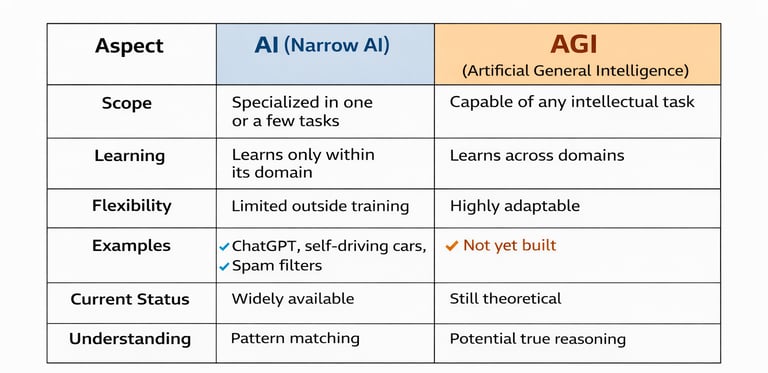
AI vs AGI: What’s the Real Difference?
In short:
Narrow AI = world-class specialist
AGI = polymath who can master anything
What Does Artificial General Intelligence Mean?
The meaning goes beyond a technical term—it’s about building machines that can match human cognitive flexibility.
Artificial: Created by humans
General: Works across many tasks
Intelligence: Reasoning, learning, and adaptation
Definition:
Artificial General Intelligence is a form of AI that can perform any intellectual task a human can do using flexible reasoning and learning.
Why is AGI So Hard to Achieve?
1. Common Sense Reasoning
Humans understand everyday logic effortlessly. AI does not.
2. Transfer Learning
Humans reuse knowledge in new situations; AI struggles here.
3. Context and Nuance
Sarcasm, humor, and social cues remain difficult for machines.
4. Self-Awareness and Goals
Some AGI definitions include autonomous goal-setting.
5. Safety and Alignment
Ensuring AGI aligns with human values is a major challenge.
📊 Expert insight: The Stanford HAI AI Index notes modern AI still struggles with robust generalization.
AGI Capabilities: What Human-Level AI Could Actually Do
If AGI arrived, it might:
Learn new skills quickly
Reason across domains
Transfer knowledge between fields
Understand and generate language deeply
Adapt to unexpected situations
Interact socially and understand emotions
Early AGI would likely still have limitations and might not be conscious.
AGI vs Narrow AI: Understanding the Gap
Narrow AI Examples
Spam filters
Self-driving cars
Language models
Game-playing AI
AGI (Theoretical)
Switch between tasks instantly
Learn from minimal explanation
Understand broad context like humans
Narrow AI = Specialist
AGI = Generalist
AGI Timeline: Expert Predictions
What Experts Say
Optimists: 2030s
Moderates: 2040s–2070s
Skeptics: Possibly much longer
A Metaculus forecast places transformative AI around the 2040s, but uncertainty is very high.
Why So Uncertain?
Hardware progress
Algorithm breakthroughs
Data availability
Safety constraints
As of 2026, no confirmed AGI exists.
Potential Benefits and Risks of AGI
Benefits
Solve global problems
Personalized education
Scientific discovery
Accessibility improvements
Economic growth
Risks
Job displacement
Alignment failures
Security misuse
Ethical responsibility issues
Existential risk (according to some experts)
📌 Key takeaway: AGI requires global cooperation on ethics and safety.
How Would AGI Change Everyday Life?
At Home
Personal assistants managing schedules, learning, and daily tasks.
At Work
Advanced collaboration, data analysis, and creativity support.
In Society
Smarter cities, better resource optimization, faster emergency response.
Science & Culture
Accelerated innovation and creative breakthroughs.
AGI in Popular Culture: Fact or Fiction?
Popular examples:
2001: A Space Odyssey — HAL 9000
The Terminator — Skynet
Her — emotional AI assistant
I, Robot — ethics and control
Reality Check
Real AGI would likely emerge gradually—not instantly superintelligent.
Current Research: The Road to AGI
Symbolic AI
Machine Learning & Deep Learning
Hybrid Systems
Reinforcement Learning
Large Language Models (LLMs)
Main Challenge
Generalization — applying knowledge to completely new problems.
AGI Reality Check: Where Are We in 2026?
No true AGI exists yet. All current AI systems are still narrow AI.
Even top models struggle with open-world reasoning outside training data.
Why Everyone’s Talking About AGI in 2026
Recent AI breakthroughs have made AGI feel closer. AI systems can now write code, pass exams, and hold conversations — but they are still narrow systems.
True AGI would require flexible reasoning and learning we have not seen yet.
Quick Takeaways: AGI at a Glance
AGI = human-like general intelligence
Today’s AI is narrow
AGI does not exist yet
Huge potential benefits and serious risks
Timeline remains uncertain
Safety and alignment are essential
Frequently Asked Questions (FAQs)
Q1: Is AGI the same as today’s AI?
No. Today’s AI is narrow and task-specific.
Q2: When will AGI arrive?
No consensus. Estimates range widely.
Q3: Biggest risks?
Alignment and safety challenges.
Q4: Will AGI be conscious?
Not necessarily.
Q5: How can I learn more?
Follow research institutions and AI ethics discussions.
Final Thoughts: The AGI Journey Ahead
AGI represents the pursuit of machines that can think, learn, and adapt like humans. As of 2026, it remains a frontier—not reality.
Every breakthrough in AI brings us closer to understanding intelligence itself. Whether AGI arrives in a decade or a century, the choices we make today will shape its future.
Stay curious. Stay informed. The story of AGI is still being written.
Related Article:
If you’re curious how AI is transforming business opportunities today, check out 5 AI Business Models Making Quiet Millionaires in 2026 — a practical guide showing how AI is already creating new income streams.
https://simplifiedaihub.com/5-ai-business-models-making-quiet-millionaires-in-2026