Who Is Matt Shumer? The AI Creator Everyone Is Talking About in 2026
Who is Matt Shumer? Discover the AI entrepreneur shaping conversations around open AI, innovation, and the future of artificial intelligence in 2026.
,AI FOR BEGINNERSTECHNOLOGY & AI
DIPJYOTI SHARMA
2/16/20263 min read
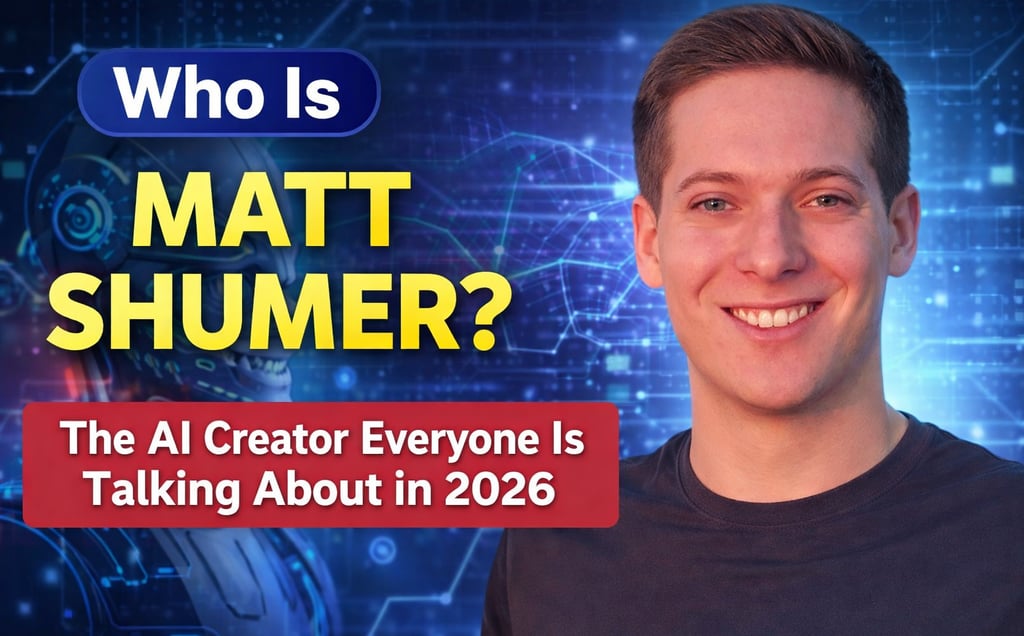
If you follow artificial intelligence, you’ve probably heard a new name echoing across tech headlines in 2026: Matt Shumer. As an AI entrepreneur and commentator, Shumer has become a well-known figure for anyone interested in the future of technology, business, and society. But who is Matt Shumer, and why is he suddenly at the center of AI conversations? Let’s break it down.
Quick Answer: Who Is Matt Shumer?
Matt Shumer is an AI entrepreneur and technology builder, widely known as the CEO of HyperWrite and cofounder of OthersideAI, as well as a prominent voice discussing how AI is reshaping industries. He is recognized for advocating practical AI adoption and sharing insights about how rapidly AI development could impact jobs, businesses, and society.
From Curiosity to Creator: The Early Journey
Matt Shumer wasn’t born into tech royalty. Raised in New York City, he developed an early fascination with computers and technology. As a teenager, he explored coding and digital creation, building a foundation that would later lead him into AI entrepreneurship.
After working in the tech ecosystem and startup space, Shumer began focusing heavily on artificial intelligence — especially tools designed to help people write, think, and work more efficiently.
It wasn’t until the early 2020s that his name started gaining wider attention in AI circles.
The Open-Source AI Conversation
While many AI companies focused on proprietary systems, Shumer became increasingly vocal about the importance of accessibility and openness in AI development.
At the same time, organizations like the Allen Institute for AI (Ai2) were advancing fully open language models such as OLMo, designed to make AI research more transparent and collaborative.
Shumer’s public discussions often aligned with broader industry debates around open vs closed AI systems — a major theme shaping the AI landscape in 2026.
Why Open AI Models Like Olmo Matter
Projects like OLMo helped push the idea that AI shouldn’t be a complete black box.
Open models allow:
Transparency: Researchers can inspect and evaluate how models are built
Customization: Developers can adapt models for different industries
Accessibility: Lower barriers for startups and smaller teams
Community Innovation: Global collaboration and experimentation
These ideas continue to influence many conversations around the future of AI development.
Matt Shumer’s Vision: Beyond Technology
Matt Shumer’s influence isn’t limited to product building. He’s become a visible voice discussing AI’s broader impact — especially how quickly AI may change the workplace.
In early 2026, he gained major attention after publishing a widely shared essay warning that AI disruption could arrive faster than many people expect.
His key message: individuals and businesses should start adapting to AI now rather than later.
Building a Business Around AI
Shumer is best known commercially for his work on:
AI writing assistance
Productivity tools
AI-assisted workflows
His companies focus on helping users leverage AI practically, rather than treating it purely as research technology.
Leadership Style: Collaborative and Community-Driven
People who follow Shumer’s work often describe his approach as:
Practical and product-focused
Community-oriented
Fast-moving and experimental
He frequently shares ideas publicly, contributing to larger AI discussions about accessibility, adoption, and future risks.
The Real-World Impact of His Message
By 2026, Shumer’s influence is visible less through research papers and more through how people talk about AI’s future.
His discussions focus on:
1. Workplace Transformation
AI tools becoming capable of handling increasingly complex professional tasks.
2. AI Adoption Speed
Encouraging individuals to learn AI early to avoid falling behind.
3. Public Awareness
Helping mainstream audiences understand that AI disruption may arrive faster than expected.
Challenges and Criticisms
Like many public AI voices, Shumer’s views have sparked debate.
The Debate Around AI Predictions
Some critics argue that AI disruption warnings can sound alarmist. Others believe these conversations are necessary to prepare society.
Open vs Closed AI
Industry leaders continue to debate whether open AI systems increase innovation or create new risks — a conversation that remains unresolved.
What’s Next for Matt Shumer?
As AI advances rapidly, Shumer continues focusing on:
AI productivity tools
Public discussion about AI’s impact
Encouraging widespread AI literacy
His role increasingly combines entrepreneurship, commentary, and technology advocacy.
Why Matt Shumer Matters in 2026
In an era where AI is reshaping how we work and communicate, voices like Matt Shumer represent a growing movement focused on rapid AI adoption and awareness.
Whether you agree with his predictions or not, his influence highlights one clear reality:
AI is moving faster than most people expect.
In 2026, he’s become one of the voices many people watch when trying to understand where AI is heading next.