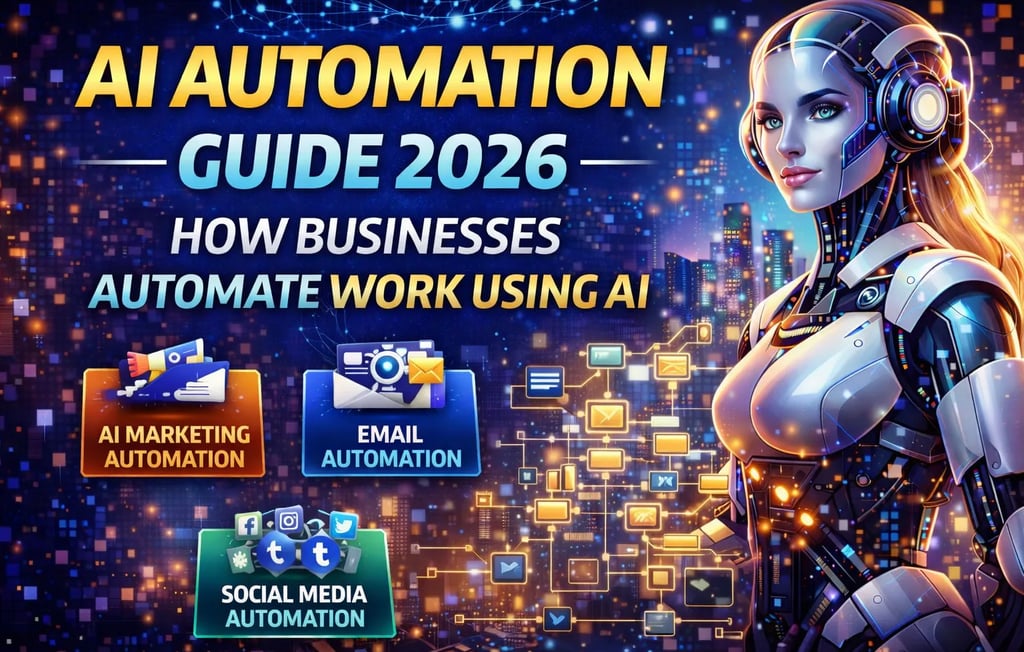
AI Automation Guide 2026: How Businesses Automate Work Using AI
Discover how businesses automate tasks using AI in 2026. Learn AI marketing automation, email workflows, social media automation, and business automation tools.
AUTOMATION
DIPJYOTI SHARMA
3/12/20266 min read
AI Automation Guide 2026: How Businesses Automate Work Using AI
Artificial intelligence is rapidly transforming how businesses operate. Tasks that once required hours of manual work can now be completed automatically with the help of AI-powered automation systems. From marketing campaigns and email responses to workflow management and customer support, automation is becoming one of the most powerful uses of artificial intelligence.
In 2026, companies of all sizes—from small startups to large enterprises—are using AI automation tools to increase efficiency, reduce costs, and improve productivity. Instead of hiring large teams to manage repetitive tasks, organizations are implementing automated workflows that operate continuously with minimal human involvement.
AI automation combines technologies such as machine learning, natural language processing, and workflow automation platforms to streamline business operations. These systems can analyze data, trigger actions, generate content, and interact with customers automatically.
This guide explores how AI automation works and how businesses can use it to improve marketing, communication, and operational workflows. Whether you are an entrepreneur, freelancer, or business owner, understanding AI automation can help you save time and scale operations more efficiently.
What Is AI Automation
AI automation refers to the use of artificial intelligence technologies to perform tasks without manual human intervention. Traditional automation relies on predefined rules and scripts, while AI automation uses intelligent systems capable of analyzing data and making decisions.
AI automation systems can:
analyze large amounts of data
generate content automatically
trigger workflows across multiple platforms
communicate with customers using chatbots
schedule and manage marketing campaigns
For example, a company might use AI automation to respond automatically to customer inquiries, send personalized emails to subscribers, or generate marketing reports.
The key advantage of AI automation is that it allows businesses to operate more efficiently without increasing operational costs. Instead of employees spending hours on repetitive tasks, AI systems can handle these processes instantly.
AI automation platforms typically integrate with tools such as:
email marketing platforms
CRM systems
social media accounts
analytics dashboards
productivity tools
By connecting these systems together, businesses can create workflows that operate automatically across multiple platforms.
AI Marketing Automation
Marketing is one of the areas where AI automation is making the biggest impact. Businesses must manage content creation, customer engagement, advertising campaigns, and analytics simultaneously. AI marketing automation tools help companies handle these tasks with minimal effort.
AI marketing automation platforms can analyze customer behavior and deliver personalized messages at the right time. This helps businesses improve engagement rates and increase conversions.
Some common uses of AI marketing automation include:
automatic social media posting
personalized email campaigns
ad campaign optimization
content scheduling
customer segmentation
AI tools can analyze user interactions, purchase history, and browsing behavior to determine which marketing messages are most effective. This level of personalization was previously difficult to achieve without large marketing teams.
For example, an AI system may automatically send product recommendations to customers based on their previous purchases. Similarly, businesses can automate the creation of marketing reports and campaign analytics.
Marketing automation tools also help businesses maintain consistent communication with their audience. Instead of manually posting content every day, AI tools can schedule posts, generate captions, and analyze engagement performance.
This allows marketing teams to focus more on strategy and creativity while automation handles repetitive tasks.
Email Automation Using AI
Email marketing remains one of the most powerful digital marketing channels, and AI automation is making it even more effective. AI-powered email systems can analyze subscriber behavior, personalize messages, and trigger automated responses.
AI email automation platforms can automatically send emails based on user actions such as:
subscribing to a newsletter
downloading a resource
abandoning a shopping cart
purchasing a product
These automated messages help nurture leads and maintain communication with customers.
For beginners who want to learn how AI-powered email workflows work, you can read this detailed tutorial:
https://simplifiedaihub.com/email-automation-using-ai-complete-beginner-guide-2026
This guide explains how AI tools can automate email campaigns, generate personalized messages, and improve marketing efficiency.
AI email automation systems often include features such as:
automatic subject line generation
AI-generated email content
audience segmentation
performance analysis
By using AI to optimize email campaigns, businesses can significantly improve open rates and conversion rates.
Another advantage of AI email automation is that it allows businesses to maintain continuous communication with their audience without manual effort. Once the automation workflow is set up, the system can run indefinitely.
Social Media Automation
Social media marketing requires consistent posting, engagement, and analytics monitoring. AI automation tools can simplify these tasks by managing social media accounts automatically.
Businesses use AI social media automation tools to:
generate post ideas
schedule content
respond to comments
analyze engagement metrics
Instead of manually posting content on multiple platforms, AI automation tools can publish posts automatically according to a predefined schedule.
Automation platforms such as Make.com allow users to connect multiple social media accounts and automate content publishing workflows. This enables businesses to maintain active social media profiles without dedicating hours every day to content management.
If you want to see how beginners are using automation to generate income, read this complete guide:
This article explains how entrepreneurs build automated social media services using AI tools.
AI social media automation also helps businesses analyze performance data. These tools can track metrics such as:
engagement rates
follower growth
click-through rates
content performance
Using this information, businesses can optimize their social media strategies and improve marketing results.
Business Workflow Automation
Beyond marketing and communication, AI automation can streamline many internal business operations. Workflow automation connects multiple systems together so that tasks move automatically from one stage to another.
For example, when a new customer submits a contact form, an automated workflow can:
add the customer to a CRM system
send a welcome email
notify the sales team
schedule a follow-up reminder
This entire process can happen automatically within seconds.
Workflow automation platforms allow businesses to connect tools such as:
Google Sheets
CRM platforms
email marketing software
project management tools
payment systems
By integrating these systems, businesses can create efficient workflows that reduce manual work.
AI-powered workflow automation can also analyze data and generate reports automatically. Instead of employees spending hours compiling reports, AI systems can generate insights instantly.
For example, an AI automation system might generate weekly performance reports for marketing campaigns, sales data, or website analytics.
Automation also helps reduce human error. When tasks are performed manually, mistakes can occur due to fatigue or oversight. Automated workflows follow predefined processes, ensuring consistency and accuracy.
Benefits of AI Automation for Businesses
AI automation provides several important advantages for organizations.
Increased Efficiency
Automation allows businesses to complete tasks faster and more consistently than manual processes.
Cost Reduction
By automating repetitive tasks, companies can reduce operational costs and allocate resources more effectively.
Scalability
Automation systems can handle large workloads without requiring additional staff.
Improved Accuracy
AI automation reduces the risk of human error and ensures tasks are executed consistently.
Better Customer Experience
Automated responses and personalized messaging help businesses maintain faster communication with customers.
How to Start Using AI Automation
For beginners who want to implement AI automation, the process can be relatively simple.
Step 1: Identify Repetitive Tasks
Look for tasks that are repeated frequently, such as sending emails, posting social media content, or generating reports.
Step 2: Choose an Automation Platform
Platforms such as Zapier, Make.com, and AI-powered CRM systems can help automate workflows.
Step 3: Connect Your Tools
Integrate the tools your business already uses, including email platforms, social media accounts, and analytics systems.
Step 4: Create Automated Workflows
Define triggers and actions that determine how the automation system operates.
Step 5: Monitor Performance
Regularly review automation performance and adjust workflows to improve results.
The Future of AI Automation
AI automation technology is evolving rapidly, and its capabilities will continue to expand. Future automation systems will likely include more advanced AI agents capable of performing complex tasks independently.
Emerging developments in AI automation may include:
fully autonomous AI business assistants
AI-powered decision-making systems
predictive automation workflows
advanced conversational AI agents
As these technologies mature, businesses that adopt AI automation early will gain significant competitive advantages.
Final Thoughts
AI automation is reshaping how businesses operate in the modern digital economy. By automating repetitive tasks and streamlining workflows, companies can improve efficiency, reduce costs, and focus on strategic growth.
Whether it is marketing campaigns, email communication, social media management, or internal business operations, AI automation provides powerful tools that can transform productivity.
As artificial intelligence continues to evolve, automation will become an essential component of business operations across industries. Entrepreneurs, freelancers, and organizations that learn how to leverage these technologies today will be better positioned for the future.
📘 Want a Complete Online Income Blueprint?
If you’re serious about turning AI skills into real online income — not just learning tools — you need a structured system.
I explain the complete roadmap, including freelancing, digital products, blogging, and scalable income strategies, in my book:
This book is designed as a step-by-step implementation guide so you don’t need to jump between YouTube tutorials or random courses.
🔗 Get the book here:
The Ultimate Online Income System