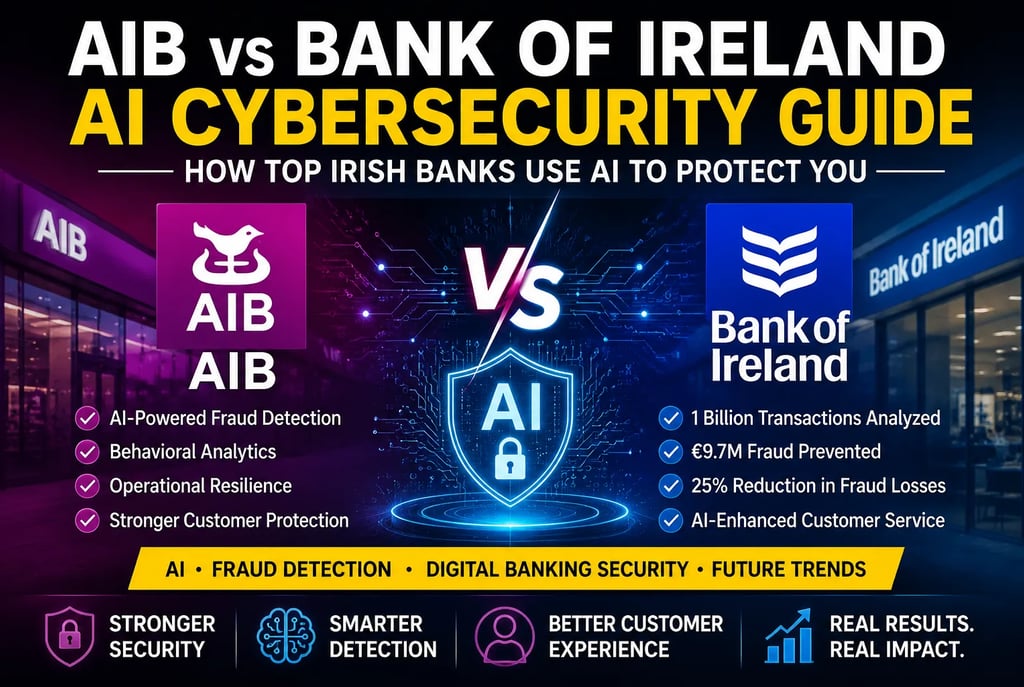
AIB vs Bank of Ireland AI Cybersecurity Guide (2026)
Discover how AIB and Bank of Ireland use AI for cybersecurity, fraud detection, and digital banking security. Compare strategies, benefits, and future trends.
AI NEWS
DIPJYOTI SHARMA
7/9/202620 min read
AIB vs Bank of Ireland AI Cybersecurity: How Artificial Intelligence Is Transforming Banking Security and Fraud Prevention (2026 Guide)
Table of Contents
Introduction
Why Is "AIB Bank of Ireland AI Cybersecurity" Trending?
What Is AI Cybersecurity?
Why the Banking Industry Needs AI More Than Ever
The Biggest Cybersecurity Threats Facing Banks
How AI Detects Fraud in Seconds
Why This Matters for Customers and Businesses
What's Coming Next
Introduction
Artificial intelligence is reshaping nearly every industry, but perhaps nowhere is its impact more significant than in banking cybersecurity.
Every second, banks process thousands of online payments, debit card purchases, ATM withdrawals, mobile banking sessions, international wire transfers, and digital wallet transactions. Behind these everyday activities lies an enormous cybersecurity challenge. Criminal organizations continuously develop new methods to steal money, compromise customer accounts, and exploit weaknesses in digital banking systems.
Traditional security tools are no longer enough.
Modern cybercriminals use automation, machine learning, and even generative AI to create convincing phishing emails, imitate voices through deepfakes, launch credential-stuffing attacks, and search for vulnerabilities at a scale that was impossible just a few years ago.
To stay ahead, financial institutions are increasingly relying on artificial intelligence. AI can analyze vast amounts of transaction data in real time, recognize suspicious behavior within seconds, and help security teams respond before fraud causes significant financial losses.
Two of Ireland's largest financial institutions—AIB (Allied Irish Banks) and Bank of Ireland—have publicly discussed how AI is becoming part of their cybersecurity and fraud prevention strategies. Although each bank has a different approach, both demonstrate a broader trend that is changing banking worldwide: AI is becoming a core component of digital security rather than an optional technology.
This guide explains:
Why this topic is attracting worldwide attention.
How AI protects modern banking systems.
The cybersecurity strategies used by AIB and Bank of Ireland.
The benefits and limitations of AI in financial services.
What businesses, technology professionals, and banking customers can learn from these developments.
Whether you're interested in artificial intelligence, cybersecurity, digital banking, or financial technology, understanding how AI is changing banking security has never been more important.
Why Is "AIB Bank of Ireland AI Cybersecurity" Trending?
One of the fastest-rising search topics in recent weeks has been "AIB Bank of Ireland AI Cybersecurity."
The growing interest reflects a much larger global shift.
Banks are investing heavily in artificial intelligence to strengthen fraud detection, improve customer protection, enhance operational resilience, and respond more quickly to increasingly sophisticated cyber threats. Public announcements from AIB and Bank of Ireland about their AI initiatives have brought additional attention to this transformation.
But the trend is about more than two banks.
Financial institutions across Europe, North America, and Asia are modernizing their security infrastructure because cybercrime continues to increase in both frequency and sophistication. Digital banking has become the primary way millions of people manage their finances, making robust cybersecurity essential.
Artificial intelligence offers banks several advantages over traditional security systems:
It can analyze enormous volumes of data continuously.
It identifies unusual activity in real time.
It adapts to emerging fraud patterns.
It reduces false fraud alerts.
It helps security analysts focus on the highest-risk incidents.
These capabilities explain why AI is now viewed as a strategic necessity rather than an experimental technology.
What Is AI Cybersecurity?
AI cybersecurity refers to the use of artificial intelligence, machine learning, and advanced analytics to identify, prevent, and respond to cyber threats.
Unlike traditional rule-based systems that depend on predefined conditions, AI continuously learns from new information.
For example, a traditional fraud detection system might block every international transaction above a fixed amount.
An AI-powered system goes much further.
It evaluates hundreds of signals simultaneously, including:
Customer spending history
Device information
Login location
Time of transaction
Merchant category
Payment frequency
Historical behavior
Account activity patterns
Instead of relying on one rule, AI calculates the overall level of risk and determines whether additional verification is appropriate.
This adaptive approach enables banks to detect emerging fraud techniques that static rules may miss.
Why the Banking Industry Needs AI More Than Ever
Banking is one of the world's most targeted industries because financial institutions manage valuable assets and highly sensitive customer information.
Every successful cyberattack can result in:
Financial losses
Identity theft
Service disruption
Regulatory penalties
Reputational damage
Loss of customer trust
Several trends have accelerated investment in AI.
1. Rapid Growth of Digital Banking
Customers increasingly use mobile banking apps, contactless payments, online transfers, and digital wallets.
While these services improve convenience, they also expand the number of systems that must be protected.
2. Smarter Cybercriminals
Attackers now automate many stages of cybercrime using AI-powered tools, making attacks faster, more targeted, and harder to detect.
3. Massive Data Volumes
Large banks process millions of transactions every day.
AI can review this information in real time—something that would be impossible through manual analysis alone.
4. Regulatory Expectations
Financial institutions operate under strict regulatory requirements covering cybersecurity, operational resilience, and customer data protection.
AI supports continuous monitoring and faster incident detection, helping banks strengthen their security posture.
The Biggest Cybersecurity Threats Facing Banks
Understanding why AI matters begins with understanding today's threat landscape.
Phishing
Criminals send fraudulent emails or text messages that imitate trusted organizations to steal passwords and financial information.
Account Takeover
Attackers gain access to customer accounts using stolen credentials obtained through phishing, malware, or previous data breaches.
Ransomware
Cybercriminals encrypt critical systems and demand payment before restoring access.
Credential Stuffing
Automated tools test stolen usernames and passwords across multiple banking platforms, exploiting customers who reuse passwords.
Deepfake Scams
AI-generated voices and videos are increasingly used to impersonate executives, employees, or family members during financial fraud attempts.
Insider Threats
Not every cybersecurity risk comes from outside an organization. Compromised employee accounts or unauthorized internal access can also create significant security challenges.
As these threats evolve, banks require intelligent systems capable of identifying suspicious behavior before substantial damage occurs.
How AI Detects Fraud in Seconds
One of AI's greatest strengths is its ability to analyze information almost instantly.
Rather than checking only one or two conditions, AI evaluates hundreds of variables during every transaction.
These may include:
Purchase amount
Geographic location
Device fingerprint
Login history
Customer behavior
Previous payment activity
Merchant information
Network characteristics
If the overall pattern appears unusual, the system can immediately:
Assign a higher fraud risk score.
Request additional authentication.
Temporarily pause a transaction.
Notify security teams.
Alert the customer.
This rapid decision-making helps banks reduce fraud while allowing legitimate customers to complete most transactions without interruption.
Why This Matters for Customers and Businesses
AI-powered cybersecurity affects more than banks—it directly benefits customers and organizations that rely on secure financial services.
For customers, stronger AI systems can mean:
Better protection against fraud.
Faster detection of suspicious activity.
Fewer false transaction declines.
Safer online banking.
More secure digital payments.
For businesses, AI contributes to:
Stronger operational resilience.
Better fraud prevention.
Improved regulatory compliance.
Faster incident response.
Greater customer confidence.
Artificial intelligence is no longer simply an emerging technology. It has become a critical component of modern financial security.
Learn More About AI
If you're interested in how artificial intelligence is transforming other industries, these guides from Simplified AI Hub provide additional insights:
Qwen AI Guide 2026 – Learn about one of the latest large language models and its practical applications: https://simplifiedaihub.com/qwen-ai-guide-2026
Humanize AI: The Ultimate Guide – Discover how AI-generated writing can become more natural while preserving quality: https://simplifiedaihub.com/humanize-ai-the-ultimate-guide
AI World of Warcraft Server – Explore how AI is improving online gaming infrastructure and player experiences: https://simplifiedaihub.com/ai-world-of-warcraft-server
AIB's AI Cybersecurity Strategy – How Allied Irish Banks Uses Artificial Intelligence to Protect Millions of Customers
Artificial intelligence is transforming banking security, but successful implementation requires much more than deploying machine learning models. Financial institutions must combine AI with governance, cybersecurity expertise, regulatory compliance, encryption, and continuous monitoring.
AIB (Allied Irish Banks) has adopted this layered approach. Rather than presenting AI as a standalone solution, the bank integrates AI into its broader cybersecurity and operational resilience strategy to strengthen fraud detection, improve threat monitoring, and protect customers from evolving cyber risks.
As digital banking continues to grow, this strategy has become increasingly important.
Understanding AIB's Digital Banking Security Strategy
Every day, AIB processes millions of digital interactions through:
Mobile banking
Online banking
Debit card payments
Credit card transactions
ATM withdrawals
Business banking services
International payments
Each interaction creates valuable data that helps security systems recognize normal customer behavior.
Artificial intelligence analyzes this information continuously, allowing security teams to detect suspicious activity much faster than traditional manual monitoring.
Instead of relying on a single security layer, AIB follows a defense-in-depth approach, combining multiple technologies that work together to reduce cyber risk.
How AIB Uses Artificial Intelligence
Although banks do not publicly disclose every technical detail of their cybersecurity systems, AIB has confirmed that artificial intelligence and advanced analytics support several important security functions.
1. Intelligent Fraud Detection
Fraud detection remains one of AI's most valuable applications.
Traditional fraud systems typically depend on fixed rules.
For example:
Block payments above a certain amount.
Reject transactions from specific countries.
Flag multiple failed login attempts.
While useful, these rules cannot easily identify new fraud techniques.
AI improves this process by evaluating numerous factors simultaneously.
Instead of asking "Does this transaction match a rule?", AI asks "Does this transaction resemble the customer's normal behavior?"
The system considers:
Transaction history
Spending patterns
Merchant type
Time of day
Device information
Geographic location
Previous customer activity
Payment frequency
If the overall risk appears unusually high, additional verification may be requested before the transaction proceeds.
2. Continuous Threat Monitoring
Cybersecurity never stops.
Modern attacks occur every hour of every day.
AI helps monitor enormous volumes of security data across:
Banking applications
Internal networks
Customer authentication systems
Cloud infrastructure
Payment platforms
Digital channels
Instead of waiting for a human analyst to review logs manually, AI can identify suspicious behavior almost immediately.
This reduces response time and improves the ability to contain security incidents.
3. Behavioral Analysis
One of AI's greatest strengths is recognizing behavioral patterns.
Every customer develops unique banking habits over time.
Examples include:
Typical login times
Frequently used devices
Preferred payment methods
Average transaction values
Common locations
Regular merchants
AI continuously compares new activity against these patterns.
If something appears significantly different—for example, a large overseas transfer immediately after a login from an unfamiliar device—the system may trigger additional authentication.
This approach helps prevent account takeover even when attackers possess stolen usernames and passwords.
4. Identity Protection
Identity theft remains one of the fastest-growing forms of financial crime.
AI helps strengthen identity verification by analyzing multiple risk indicators rather than relying only on passwords.
Additional signals may include:
Device recognition
Browser characteristics
Network information
Authentication history
Customer behavior
Combining these signals makes unauthorized access more difficult.
AIB's Multi-Layer Cybersecurity Framework
Artificial intelligence works best when combined with other security technologies.
A simplified view of AIB's layered security approach is shown below.
This layered architecture means attackers must overcome multiple independent defenses rather than a single security control.
Operational Resilience: More Than Cybersecurity
One of AIB's key priorities is operational resilience.
Operational resilience refers to a bank's ability to continue delivering essential services even during major disruptions such as:
Cyberattacks
Technology failures
Network outages
Third-party service interruptions
Natural disasters
Artificial intelligence supports operational resilience by:
Detecting incidents earlier.
Prioritizing critical alerts.
Assisting security investigations.
Improving monitoring across complex systems.
Supporting faster recovery efforts.
Strong operational resilience helps protect both customers and the wider financial system.
Responsible AI Governance
Financial institutions cannot simply deploy AI without oversight.
Banks operate in one of the world's most heavily regulated industries.
AIB emphasizes responsible governance to ensure AI supports secure and reliable decision-making.
Good AI governance generally includes:
Human oversight.
Risk assessments.
Regular model reviews.
Performance monitoring.
Security testing.
Data protection controls.
Regulatory compliance.
These practices help reduce the possibility of inaccurate or biased decisions while maintaining customer trust.
How AIB Helps Customers Stay Safe
Technology alone cannot stop fraud.
Customer awareness remains an essential part of cybersecurity.
AIB regularly advises customers to remain alert to common scams.
Customers should remember that legitimate bank employees will never ask for:
One-time passwords (OTPs)
Card Reader authentication codes
Online banking passwords
PIN numbers
Requests to move money into a "safe account"
If customers receive unexpected calls, emails, or text messages requesting this information, they should contact the bank using official communication channels.
The Advantages of AI in Banking Security
Artificial intelligence offers several important advantages over traditional rule-based security systems.
Faster Detection
AI analyzes thousands of transactions within seconds, allowing suspicious activity to be identified quickly.
Continuous Learning
Machine learning systems improve as they process additional information and encounter new fraud techniques.
Reduced False Positives
Traditional systems sometimes block legitimate customer transactions unnecessarily.
AI helps distinguish normal behavior from suspicious activity more accurately.
Better Resource Allocation
Instead of reviewing every alert manually, security teams can focus on high-priority incidents identified by AI.
Improved Customer Experience
Customers benefit from stronger security while experiencing fewer interruptions during legitimate banking activities.
Limitations of Artificial Intelligence
Despite its capabilities, AI is not a complete cybersecurity solution.
Banks still face challenges including:
AI-Generated Phishing
Cybercriminals increasingly use generative AI to produce convincing phishing messages.
Deepfake Fraud
Voice cloning and synthetic media create new social engineering risks.
Privacy Requirements
Banks must carefully protect customer data while using AI systems responsibly.
Human Oversight
Critical decisions require experienced cybersecurity professionals who can interpret complex situations beyond what automated systems can determine.
For these reasons, AI should be viewed as a powerful security tool—not a replacement for human expertise.
Key Takeaways
AIB integrates AI into a broader cybersecurity and operational resilience strategy.
AI supports fraud detection, behavioral analysis, identity protection, and continuous monitoring.
Multiple security layers—including MFA, encryption, and threat intelligence—work together with AI.
Responsible AI governance ensures technology is deployed securely and ethically.
Customer awareness remains one of the strongest defenses against fraud.
AI enhances cybersecurity, but human expertise continues to play a critical role in protecting banking systems.
Bank of Ireland's AI Cybersecurity Strategy – How Artificial Intelligence Is Transforming Fraud Prevention and Digital Banking
Artificial intelligence has become one of the most important technologies in modern banking, and Bank of Ireland is among the financial institutions that have publicly demonstrated how AI can improve both cybersecurity and customer experience.
While cybersecurity once relied primarily on static security rules and manual investigations, today's banking environment requires intelligent systems capable of analyzing millions of transactions, identifying unusual behavior in real time, and helping security teams respond before financial losses occur.
Bank of Ireland has invested in artificial intelligence, machine learning, behavioral analytics, and automation to strengthen fraud prevention, improve operational efficiency, and enhance customer protection.
Its publicly reported AI initiatives show how large financial institutions are moving from reactive cybersecurity to predictive, AI-assisted security.
Why Bank of Ireland Is Investing in Artificial Intelligence
The banking industry has changed dramatically over the past decade.
Today, customers expect to:
Transfer money instantly
Pay using contactless cards
Use digital wallets
Access accounts through mobile apps
Apply for loans online
Receive real-time account notifications
Every digital interaction creates potential cybersecurity risks.
At the same time, cybercriminals have become more sophisticated by using automation and AI to create phishing campaigns, steal credentials, and exploit vulnerabilities faster than ever before.
To address these challenges, Bank of Ireland uses AI to help:
Detect suspicious transactions
Prevent payment fraud
Monitor customer behavior
Improve security investigations
Enhance customer support
Strengthen operational resilience
The goal is not only to stop fraud but also to make digital banking safer and more convenient for legitimate customers.
AI-Powered Fraud Detection at Scale
One of the most impressive aspects of Bank of Ireland's AI strategy is the scale at which it operates.
According to the bank, its AI systems assessed around one billion card transactions during 2025 as part of its fraud prevention efforts.
Processing this volume of information manually would be impossible.
Instead, machine learning models continuously evaluate transaction data to identify patterns that may indicate fraudulent activity.
Rather than checking only simple rules, AI considers multiple factors simultaneously, including:
Transaction value
Spending history
Merchant category
Device information
Geographic location
Payment frequency
Time of day
Previous customer behavior
This broader analysis enables the system to detect subtle anomalies that traditional fraud detection methods might overlook.
How Machine Learning Improves Fraud Detection
Traditional fraud systems depend on predefined rules.
For example:
Block payments over a specific amount.
Reject transactions from certain regions.
Flag multiple failed login attempts.
While effective against known threats, these rules struggle to identify new attack techniques.
Machine learning takes a different approach.
Instead of relying only on fixed conditions, it learns from historical transaction data and continuously improves its ability to recognize suspicious behavior.
When unusual patterns emerge, the system assigns a risk score.
If the calculated risk exceeds a predefined threshold, additional security measures may be triggered.
These may include:
Requesting extra authentication
Temporarily delaying payment approval
Alerting fraud investigators
Notifying the customer
Blocking high-risk transactions
This process occurs within seconds, significantly reducing the opportunity for criminals to complete fraudulent transactions.
Behavioral Analytics: Looking Beyond Passwords
Passwords alone are no longer sufficient to protect online banking.
Cybercriminals frequently obtain login credentials through phishing campaigns, malware, or data breaches.
Bank of Ireland complements traditional authentication with behavioral analytics.
Rather than asking only "Is the password correct?", AI also evaluates "Does this customer normally behave this way?"
Behavioral indicators may include:
Typical login locations
Frequently used devices
Browser characteristics
Transaction timing
Average spending amounts
Preferred merchants
Session activity
Historical account behavior
If multiple indicators appear inconsistent with established customer behavior, the system can request additional verification before allowing sensitive transactions to proceed.
This approach makes account takeover attacks significantly more difficult.
AI Results Reported by Bank of Ireland
One reason Bank of Ireland has attracted attention is its willingness to share measurable outcomes from its AI initiatives.
Among the publicly reported achievements are:
These figures illustrate that AI is contributing not only to cybersecurity but also to operational efficiency and customer engagement.
AI Is Improving Customer Service Too
Cybersecurity is only one part of Bank of Ireland's AI strategy.
The bank also uses artificial intelligence to streamline customer support and improve everyday banking experiences.
AI assists customers by providing faster responses to common requests, including:
Account information
Payment enquiries
Card management
Digital banking guidance
Security assistance
Frequently asked questions
By automating routine interactions, AI allows customer service representatives to spend more time resolving complex issues that require human expertise.
This combination of automation and human support helps improve response times without eliminating personal service.
Strengthening Operational Resilience
Modern banks cannot afford prolonged service disruptions.
Whether caused by cyberattacks, technical failures, or unexpected operational events, downtime can affect millions of customers.
Artificial intelligence supports operational resilience by helping banks:
Detect security incidents earlier
Prioritize high-risk alerts
Monitor infrastructure continuously
Improve incident response
Reduce investigation times
Support faster recovery
This proactive approach helps ensure that critical banking services remain available even during periods of increased cyber risk.
Responsible AI and Human Oversight
Artificial intelligence is a powerful tool, but responsible governance remains essential.
Bank of Ireland has emphasized that AI operates within governance frameworks designed to support security, compliance, and responsible decision-making.
Human experts continue to oversee:
Fraud investigations
Cybersecurity operations
Regulatory compliance
Risk management
AI performance monitoring
Incident response
This balance between intelligent automation and experienced professionals helps ensure that AI supports rather than replaces critical human judgment.
What Other Banks Can Learn
The experience of Bank of Ireland highlights several important lessons for financial institutions worldwide.
Successful AI adoption requires more than purchasing new technology.
Banks also need:
High-quality data
Skilled cybersecurity professionals
Strong governance
Customer education
Continuous monitoring
Regulatory compliance
Regular security testing
Artificial intelligence delivers the greatest value when integrated into a broader cybersecurity strategy rather than deployed as a standalone solution.
Key Takeaways
Bank of Ireland uses AI to strengthen fraud detection, customer protection, and operational resilience.
Machine learning analyzes transaction patterns in real time to identify suspicious activity.
Behavioral analytics provides an additional layer of protection beyond passwords.
Publicly reported results demonstrate measurable improvements in fraud prevention and customer service.
Human oversight remains essential for responsible AI deployment in financial services.
AIB vs. Bank of Ireland – Comparing AI Cybersecurity Strategies, Future Trends, and What It Means for Banking
Artificial intelligence is no longer a futuristic concept in financial services. It has become a critical part of how banks defend against cybercrime, monitor digital transactions, and improve customer trust.
Both AIB (Allied Irish Banks) and Bank of Ireland have invested in AI to strengthen cybersecurity, but their publicly described strategies highlight different priorities. Understanding these differences helps explain how modern banks are adapting to an increasingly complex threat landscape.
AIB vs. Bank of Ireland: Side-by-Side Comparison
The table below summarizes the AI and cybersecurity capabilities publicly discussed by each bank.
Although both banks use AI to improve cybersecurity, Bank of Ireland has publicly released more measurable results, while AIB has placed greater emphasis on governance, resilience, and enterprise risk management in its public reporting.
This difference does not mean one bank is more secure than the other. Instead, it reflects the different areas each institution has chosen to communicate publicly.
AI vs. Traditional Fraud Detection
Traditional banking security systems rely on predefined rules.
Examples include:
Blocking transactions over a certain amount.
Rejecting payments from high-risk regions.
Locking an account after multiple failed login attempts.
These rules remain valuable, but cybercriminals constantly develop new attack methods that may not match existing patterns.
Artificial intelligence offers a more adaptive approach.
AI does not eliminate traditional controls—it enhances them by adding intelligence and adaptability.
How AI Strengthens Banking Cybersecurity
Artificial intelligence supports multiple layers of banking security rather than performing a single task.
Real-Time Monitoring
AI continuously analyzes transactions, authentication attempts, and account activity to identify unusual behavior as it happens.
Behavioral Intelligence
Instead of relying only on passwords, AI studies how customers normally interact with their accounts.
Risk Scoring
Each transaction is assigned a dynamic risk score based on multiple factors.
Higher-risk activities may require additional verification before completion.
Threat Prioritization
Banks receive thousands of security alerts every day.
AI helps security teams identify which incidents require immediate attention.
Fraud Investigation Support
Machine learning assists investigators by highlighting suspicious relationships between transactions, accounts, and devices.
Emerging AI-Powered Cyber Threats
As banks adopt AI, cybercriminals are also using artificial intelligence to make attacks more convincing and more difficult to detect.
AI-Generated Phishing
Generative AI enables attackers to create realistic phishing emails with fewer grammatical errors and highly personalized content.
These messages can imitate trusted organizations, making them more likely to deceive victims.
Deepfake Voice Fraud
AI can generate convincing synthetic voices that imitate executives, bank employees, or family members.
Fraudsters have already used deepfake technology in social engineering attacks to persuade victims to authorize fraudulent payments.
Automated Credential Attacks
Attackers increasingly use automation to test stolen usernames and passwords across multiple websites.
AI helps banks recognize unusual login behavior before accounts are compromised.
Malware Evolution
Cybercriminals continue adapting malware to evade traditional detection systems.
Machine learning allows banks to identify suspicious behavior even when malware signatures are unknown.
Challenges of Using AI in Banking
Despite its advantages, AI introduces new responsibilities and challenges.
Data Privacy
Banks process sensitive financial information.
AI systems must operate within strict privacy and data protection requirements.
Regulatory Compliance
Financial institutions must comply with cybersecurity, operational resilience, and data governance regulations.
Responsible AI governance is becoming an increasingly important regulatory expectation.
Bias and Fairness
Machine learning models should be monitored regularly to reduce the risk of inaccurate or unfair outcomes.
Human oversight remains essential.
Cybercriminals Also Use AI
Artificial intelligence benefits defenders—but attackers also use AI to improve phishing campaigns, automate attacks, and identify vulnerabilities.
This creates a continuous race between defensive and offensive technologies.
What This Means for Customers
AI is improving banking security in ways many customers never notice.
For everyday users, stronger AI systems can result in:
Faster fraud detection
Better protection against identity theft
More secure digital payments
Reduced false transaction declines
Improved mobile banking security
Quicker responses to suspicious activity
However, customers remain an essential part of the security process.
Best Practices
Enable multi-factor authentication.
Never share one-time passwords (OTPs).
Verify unexpected payment requests independently.
Be cautious of unsolicited emails and text messages.
Keep banking apps updated.
Review account activity regularly.
Technology is most effective when combined with informed customer behavior.
What Other Financial Institutions Can Learn
The AI strategies adopted by AIB and Bank of Ireland offer valuable lessons for banks worldwide.
Successful AI adoption requires:
High-quality data
Strong cybersecurity governance
Continuous employee training
Customer awareness initiatives
Responsible AI oversight
Regular penetration testing
Collaboration between AI systems and human analysts
Organizations that treat AI as one layer within a broader security framework are generally better positioned to respond to evolving cyber threats.
The Future of AI in Banking Cybersecurity
Artificial intelligence will continue expanding across the financial sector over the coming years.
Areas expected to see significant growth include:
Predictive Fraud Detection
AI models will become better at identifying suspicious behavior before fraudulent transactions occur.
Behavioral Authentication
Future systems may rely less on passwords and more on behavioral characteristics such as typing patterns, device usage, and interaction habits.
AI-Assisted Security Operations
Security analysts will increasingly use AI to investigate alerts, summarize incidents, and accelerate response times.
Smarter Threat Intelligence
AI will process global threat data more efficiently, helping banks recognize emerging attack patterns earlier.
Responsible AI Governance
As AI adoption increases, banks will continue strengthening governance, transparency, and risk management practices to ensure responsible deployment.
Continue Learning About Artificial Intelligence
Artificial intelligence is transforming industries far beyond banking.
If you'd like to explore more AI innovations, these guides from Simplified AI Hub may be helpful:
Qwen AI Guide 2026
Discover one of the latest large language models, its capabilities, real-world applications, and how it compares with other AI systems.
https://simplifiedaihub.com/qwen-ai-guide-2026
Humanize AI: The Ultimate Guide
Learn how AI-generated writing can be refined to sound more natural while maintaining accuracy and readability.
https://simplifiedaihub.com/humanize-ai-the-ultimate-guide
AI World of Warcraft Server
Explore how artificial intelligence is enhancing gaming infrastructure, improving server management, and creating better player experiences.
https://simplifiedaihub.com/ai-world-of-warcraft-server
Key Takeaways
Artificial intelligence is reshaping banking cybersecurity.
Both AIB and Bank of Ireland use AI to strengthen fraud prevention and improve customer protection.
Publicly available information shows different strategic priorities rather than indicating one bank is more secure than the other.
AI complements traditional cybersecurity controls instead of replacing them.
Human expertise, governance, and customer awareness remain essential.
The future of banking security will combine AI, machine learning, behavioral analytics, and responsible oversight to create more resilient financial systems.
Conclusion, FAQs, Additional FAQs, and Final Takeaways
Conclusion
Artificial intelligence is no longer an experimental technology in banking—it has become a critical component of modern cybersecurity.
As digital banking continues to expand, financial institutions face increasingly sophisticated threats, including AI-generated phishing campaigns, ransomware, identity theft, credential-stuffing attacks, and deepfake scams. Traditional rule-based security systems remain important, but they are no longer sufficient on their own.
This is where AI is making a measurable difference.
Both AIB (Allied Irish Banks) and Bank of Ireland have incorporated AI into their cybersecurity strategies, although they emphasize different priorities in their public communications.
AIB focuses on operational resilience, enterprise risk management, cybersecurity governance, and layered security. Its strategy combines AI-assisted monitoring with encryption, multi-factor authentication, continuous threat detection, and customer awareness to build a resilient security framework.
Bank of Ireland has publicly highlighted measurable AI outcomes, including analyzing approximately one billion card transactions during 2025, reducing customer payment fraud losses, improving fraud detection, and enhancing customer service through AI-powered automation.
Together, these examples demonstrate how artificial intelligence is helping financial institutions:
Detect fraud more quickly.
Identify suspicious customer behavior.
Strengthen identity verification.
Improve operational resilience.
Support cybersecurity analysts.
Enhance customer protection.
However, AI should never be viewed as a complete replacement for cybersecurity professionals.
The strongest banking security strategies combine:
Artificial intelligence
Human expertise
Responsible governance
Customer education
Regulatory compliance
Continuous monitoring
Cybersecurity is an ongoing process rather than a destination.
As AI continues to evolve, banks that combine technological innovation with responsible governance will be better positioned to defend against future cyber threats while maintaining customer trust.
For customers, businesses, and technology professionals, understanding AI's growing role in banking security is becoming increasingly important.
Expert Insight
One of the biggest misconceptions about AI in banking is that it automatically stops every cyberattack.
In reality, AI is best understood as a powerful decision-support system. It excels at identifying patterns, detecting anomalies, and processing vast amounts of information far more quickly than humans. Final decisions involving fraud investigations, incident response, legal obligations, and customer protection still rely heavily on experienced cybersecurity professionals.
The future of banking security is not AI versus humans—it is AI working alongside humans.
Key Takeaways
Frequently Asked Questions (FAQs)
1. What is AI cybersecurity in banking?
AI cybersecurity uses artificial intelligence and machine learning to identify suspicious activities, detect fraud, strengthen authentication, and protect banking systems from cyber threats.
2. Why are banks investing heavily in AI?
Banks use AI to improve fraud detection, reduce financial losses, strengthen cybersecurity, comply with regulations, and provide safer digital banking experiences.
3. How does AI detect fraud?
AI analyzes transaction history, customer behavior, location, device information, payment patterns, and hundreds of other data points to identify suspicious activities in real time.
4. What is behavioral analytics?
Behavioral analytics studies how customers normally use their accounts—including login habits, spending patterns, and devices—to identify unusual behavior that may indicate fraud.
5. Is AI replacing cybersecurity professionals?
No. AI assists cybersecurity teams by automating repetitive tasks and highlighting suspicious activity, while experienced professionals investigate incidents and make critical decisions.
6. What is operational resilience in banking?
Operational resilience refers to a bank's ability to continue providing essential financial services during cyberattacks, technology failures, or unexpected disruptions.
7. Does AI improve online banking security?
Yes. AI enables banks to detect suspicious transactions faster, reduce false fraud alerts, and respond to potential threats more effectively.
8. Can AI prevent every cyberattack?
No. AI significantly improves security but cannot eliminate every cyber threat. Effective cybersecurity requires multiple layers of protection and human oversight.
9. What are the biggest cyber threats facing banks today?
Major threats include phishing, ransomware, account takeover, credential stuffing, insider threats, malware, and AI-generated scams.
10. How does multi-factor authentication improve security?
Multi-factor authentication requires users to verify their identity using more than one authentication factor, making unauthorized access significantly more difficult.
11. Is customer data protected when banks use AI?
Banks implement encryption, access controls, governance frameworks, and privacy measures to help protect customer information while using AI technologies.
12. Why is AI important for fraud detection?
AI can analyze enormous volumes of transaction data almost instantly, allowing banks to identify suspicious behavior before fraud causes significant financial losses.
13. What role does machine learning play in banking?
Machine learning enables AI systems to recognize patterns, adapt to new fraud techniques, and improve detection accuracy over time.
14. What should customers do to stay safe?
Customers should enable multi-factor authentication, use strong passwords, avoid phishing links, never share one-time passwords, and monitor account activity regularly.
15. What is the future of AI in banking cybersecurity?
Future developments are expected to include predictive fraud detection, smarter behavioral authentication, AI-assisted investigations, automated threat intelligence, and stronger governance frameworks.
Additional FAQs
1. Which banking services commonly use AI?
Fraud detection, customer support, payment monitoring, anti-money laundering, credit assessment, cybersecurity monitoring, and financial insights.
2. Can AI detect identity theft?
Yes. AI can identify unusual login behavior, unfamiliar devices, abnormal payment patterns, and suspicious account activity.
3. Does AI reduce false fraud alerts?
Yes. Machine learning improves accuracy by distinguishing between legitimate customer behavior and suspicious activities.
4. Why do banks combine AI with traditional security tools?
AI complements—not replaces—technologies such as encryption, firewalls, multi-factor authentication, penetration testing, and human security teams.
5. Are AI cybersecurity systems continuously improving?
Many machine learning systems improve over time by learning from new fraud patterns and transaction data.
6. Can smaller banks benefit from AI?
Yes. Many cloud-based AI cybersecurity solutions are available for regional and smaller financial institutions.
7. How does encryption work with AI?
Encryption protects customer data, while AI analyzes behavior and transactions to identify potential threats. Together, they provide stronger overall security.
8. How often should banks update cybersecurity strategies?
Cybersecurity should be reviewed continuously to address new threats, technology changes, and regulatory requirements.
9. Can customers help prevent fraud?
Absolutely. Customer awareness remains one of the strongest defenses against phishing, identity theft, and social engineering attacks.
10. Will AI completely automate banking security?
No. AI will continue becoming more capable, but human expertise, governance, legal oversight, and ethical decision-making will remain essential.
Final Thoughts
Artificial intelligence is redefining how banks defend against cybercrime, but technology alone is not enough. The most effective security strategies combine AI-powered analytics, robust governance, experienced cybersecurity professionals, and informed customers.
As the financial industry continues to embrace AI, trust will remain the foundation of digital banking. Institutions that balance innovation with transparency, security, and responsible AI practices will be better equipped to protect customers in an increasingly connected world.
If you want to stay informed about the latest developments in artificial intelligence, cybersecurity, and emerging technologies, continue exploring the in-depth resources available on Simplified AI Hub, including:
Qwen AI Guide 2026 – https://simplifiedaihub.com/qwen-ai-guide-2026
Humanize AI: The Ultimate Guide – https://simplifiedaihub.com/humanize-ai-the-ultimate-guide
AI World of Warcraft Server – https://simplifiedaihub.com/ai-world-of-warcraft-server
These guides explore practical AI applications, emerging trends, and real-world use cases to help you stay ahead in the rapidly evolving world of artificial intelligence.