Humanize AI: The Ultimate Guide to Making AI-Generated Content Sound Natural in 2026
Learn how to humanize AI content with proven techniques, expert tips, and SEO strategies to create natural, engaging, high-ranking content in 2026.
AI TOOLS
DIPJYOTI SHARMA
6/29/202610 min read
Humanize AI: The Ultimate Guide to Making AI-Generated Content Sound Natural in 2026
Artificial intelligence has completely transformed content creation. Whether you're writing blog posts, product descriptions, marketing emails, or social media captions, AI tools can generate content within seconds. However, speed doesn't always guarantee quality. Readers can often recognize text that feels repetitive, overly formal, or lacking personality. This is where learning to humanize AI content becomes essential.
Today, businesses, bloggers, students, marketers, and freelancers are looking for ways to make AI-generated content sound more authentic while maintaining accuracy and SEO performance. Simply copying AI-generated text and publishing it is no longer enough. Search engines reward content that demonstrates expertise, answers users' questions thoroughly, and provides genuine value.
If you've been searching for how to humanize AI text, best AI humanizer techniques, or how to make AI writing sound human, you're in the right place. This comprehensive guide explains everything you need to know—from understanding what AI humanization means to practical strategies that improve readability, engagement, and search engine performance.
Table of Contents
What Is Humanize AI?
Why Humanizing AI Content Matters
How Search Engines Evaluate AI Content
Characteristics of Human-Like Writing
Best Methods to Humanize AI Content
Common Mistakes to Avoid
AI Humanizer Tools Comparison
Best Practices for Better Rankings
Frequently Asked Questions
Additional FAQs
Final Thoughts
What Is Humanize AI?
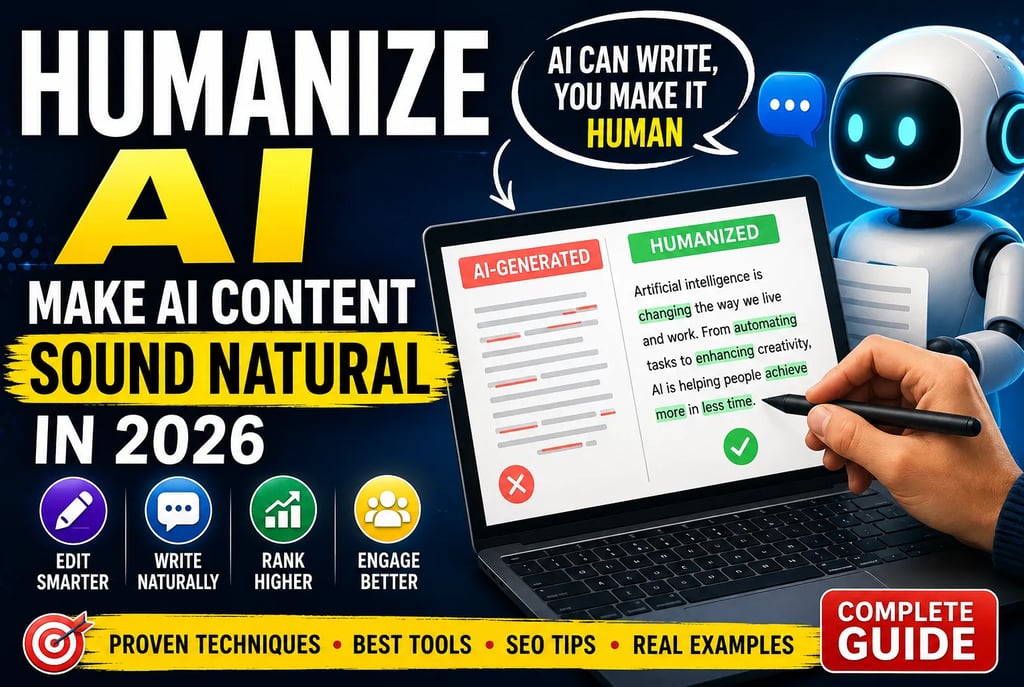
Humanize AI is the process of editing AI-generated text so it reads naturally and connects with readers in the same way that professionally written human content does. The objective isn't to disguise the fact that AI helped create the content. Instead, the goal is to improve clarity, flow, originality, and usefulness.
A well-humanized article feels conversational, informative, and engaging. It avoids repetitive wording, explains ideas clearly, and provides practical insights rather than generic statements. This approach aligns with what both readers and search engines expect from high-quality content.
For example, instead of writing:
"Artificial intelligence is transforming industries worldwide. It offers many benefits for businesses."
A humanized version would be:
"Artificial intelligence is changing how businesses operate every day. From automating repetitive tasks to helping teams make faster decisions, AI is becoming an essential tool across nearly every industry."
The second version is more specific, easier to read, and provides immediate value to the reader.
Why Humanizing AI Content Matters
AI writing tools save time, but publishing their output without editing can reduce trust and engagement. Humanizing your content helps bridge the gap between machine-generated drafts and content that genuinely resonates with readers.
Here are some key benefits:
Improves readability and keeps readers engaged.
Builds trust by providing clear, natural explanations.
Increases the likelihood of visitors spending more time on your website.
Supports better SEO by creating helpful, user-focused content.
Encourages readers to explore additional pages on your site.
If you're interested in how AI is reshaping gaming infrastructure, you may also enjoy our guide on AI World of Warcraft Server:
https://simplifiedaihub.com/ai-world-of-warcraft-server
Similarly, if you're exploring how AI is influencing technology investments, our article on Cursor AI Stock Explained provides a practical overview:
https://simplifiedaihub.com/cursor-ai-stock-explained
These related resources help build a broader understanding of AI's expanding role across different industries.
How Search Engines Evaluate AI Content
One of the biggest misconceptions is that search engines automatically penalize AI-generated content. In reality, modern search algorithms focus on quality rather than authorship.
Content performs well when it:
Answers user intent.
Demonstrates expertise.
Provides accurate information.
Is well-structured and easy to read.
Offers original insights or practical examples.
Avoids unnecessary repetition.
Whether a human, AI, or a combination of both created the content is less important than whether it genuinely helps readers.
This means your editing process is critical. Humanizing AI-generated text improves its overall usefulness, making it more likely to satisfy both readers and search engine quality guidelines.
Characteristics of High-Quality Humanized AI Content
Not all edited AI content is equally effective. High-performing articles typically share several characteristics.
Natural Flow
Ideas transition smoothly from one section to the next. Instead of jumping abruptly between topics, the content guides readers through the discussion.
Conversational Tone
The language feels approachable without becoming overly casual. Readers should feel as though an experienced professional is explaining the topic rather than reading a technical manual.
Sentence Variety
Human writers naturally mix short, medium, and longer sentences. This variation creates rhythm and makes the article more enjoyable to read.
Practical Examples
Real-world examples make complex ideas easier to understand. Rather than simply defining concepts, strong content demonstrates how they apply in everyday situations.
Clear Explanations
Technical terminology should be explained in simple language whenever possible. Readers appreciate clarity over unnecessary complexity.
Helpful Structure
Using descriptive headings, bullet points, numbered lists, and concise paragraphs improves readability, especially for mobile users.
Signs Your AI Content Still Sounds Robotic
Even after editing, some articles continue to feel machine-generated. Watch for these warning signs:
Repeated sentence patterns.
Generic introductions.
Overuse of transition phrases.
Excessive passive voice.
Unnecessary filler words.
Repetitive conclusions.
Keyword stuffing.
Lack of specific examples.
Removing these issues immediately improves readability and reader engagement.
Humanized vs Raw AI Content
Best Methods to Humanize AI Content
Humanizing AI-generated content doesn't require rewriting every sentence. Instead, focus on thoughtful editing and refinement.
Rewrite the Introduction
Avoid generic openings. Instead, begin by identifying a real problem your audience faces and explain how your article will help solve it.
Replace Repetitive Language
AI often repeats phrases throughout an article. Read each section carefully and replace repeated wording with natural alternatives.
Add Personal Insight
Even if you're writing an informational article, include practical observations, lessons learned, or recommendations based on experience. This helps demonstrate expertise and makes the content feel more authentic.
Improve Transitions
Guide readers naturally from one idea to the next using smooth transitions rather than abrupt topic changes.
Include Real Examples
Whenever possible, explain concepts using relatable scenarios or practical use cases instead of relying solely on definitions.
For example, if you're interested in AI-powered productivity, our detailed review of the Miro AI Diagram Generator Review 2026 explores how AI simplifies brainstorming and workflow visualization:
https://simplifiedaihub.com/miro-ai-diagram-generator-review-2026
This type of contextual internal linking helps readers discover related resources while strengthening your site's topical authority.
Use Active Voice Whenever Possible
One of the easiest ways to make AI-generated content sound more natural is to write in the active voice. Active voice makes sentences clearer, more direct, and easier to understand.
For example:
Passive Voice:
The article was written by an AI tool.
Active Voice:
An AI tool wrote the article.
Although passive voice has its place, using active voice for most of your content creates a more engaging reading experience.
Edit Like a Human Editor, Not a Machine
Many people rely on AI to generate an article and publish it immediately. Instead, treat AI as your first draft writer and yourself as the editor.
Before publishing, ask yourself these questions:
Does this paragraph answer the reader's question?
Is the information accurate and up to date?
Does every sentence add value?
Have I removed repetitive phrases?
Would I enjoy reading this article?
Reading your article aloud is another excellent editing technique. If a sentence sounds awkward when spoken, it will probably feel awkward to readers as well.
Common Mistakes When Humanizing AI Content
Even experienced writers sometimes make mistakes while editing AI-generated content. Avoiding these issues will improve both readability and SEO.
1. Keyword Stuffing
Many writers try to improve rankings by repeating the primary keyword excessively. Modern search engines understand context and semantic relationships, so repeating Humanize AI unnaturally can actually hurt readability.
Instead, naturally include related phrases such as:
Humanize AI text
AI humanizer
AI writing assistant
Make AI content sound human
Improve AI-generated writing
Human editing for AI content
AI content optimization
Human-like AI writing
These semantic keywords help search engines understand your topic without making the article feel forced.
2. Ignoring User Intent
Readers searching for "Humanize AI" usually want practical solutions rather than lengthy definitions.
Focus on answering questions like:
How do I make AI writing sound natural?
Which editing techniques work best?
Can AI-generated content rank on Google?
Which AI humanizer tools are worth using?
The more effectively your article solves these problems, the higher its value becomes.
3. Keeping Generic Examples
AI often generates broad examples that don't add much value.
Instead of saying:
Businesses use AI.
Write something more specific:
A small eCommerce store can use AI to generate product descriptions, but an editor should refine those descriptions to match the brand's tone and improve customer trust.
Specific examples make your content more memorable.
4. Overusing Complex Words
Many AI-generated articles rely on formal vocabulary.
Simple writing usually performs better because it reaches a wider audience.
Instead of writing:
Utilize sophisticated methodologies.
Write:
Use proven methods.
Simple doesn't mean shallow—it means accessible.
5. Publishing Without Fact Checking
AI models occasionally produce outdated or incorrect information.
Before publishing:
Verify statistics.
Check product features.
Confirm pricing.
Review company names.
Update screenshots if necessary.
Accurate content builds long-term trust with readers.
Best AI Humanizer Tools in 2026
While manual editing delivers the best results, several tools can help improve AI-generated writing.
Remember that these tools should assist your editing process—not replace it.
Human Editing vs AI Humanizer Tools
Many users wonder whether they should use automated AI humanizer tools or edit content manually.
Here's a quick comparison.
The strongest content combines both approaches. Use AI for speed, then apply human judgment to improve quality.
Best Practices for Humanizing AI Content
If you consistently follow these best practices, you'll produce articles that readers enjoy and search engines recognize as helpful.
Start With a Strong Outline
Planning your article before writing helps maintain logical flow and prevents unnecessary repetition.
Write for Readers First
Always prioritize user experience over search engine optimization. Good SEO naturally follows valuable content.
Add Unique Insights
Whenever possible, include observations, recommendations, or lessons that readers won't find in every competing article.
Use Short Paragraphs
Large blocks of text discourage readers, especially on mobile devices.
Aim for two to four sentences per paragraph.
Include Helpful Tables
Comparison tables simplify complex information and improve readability.
Update Older Articles
AI evolves rapidly. Refreshing your existing content keeps it accurate and competitive.
Improve Internal Linking
Strategic internal links help readers discover related articles while strengthening your site's SEO.
For example, readers interested in AI-powered productivity may benefit from exploring your review of Miro AI Diagram Generator Review 2026, while those following AI investment trends may enjoy Cursor AI Stock Explained. Likewise, gaming enthusiasts can learn about AI's growing influence through your AI World of Warcraft Server article.
This interconnected approach creates a stronger content ecosystem and encourages visitors to spend more time exploring your website.
Why Humanized AI Content Performs Better
Humanized content succeeds because it addresses the needs of real people.
Instead of simply repeating facts, it:
Explains concepts clearly.
Solves real problems.
Uses practical examples.
Maintains a conversational tone.
Builds trust through accuracy.
Encourages readers to continue learning.
These qualities improve user experience, which can contribute to better engagement metrics over time.
Final Thoughts
Artificial intelligence has become an essential part of modern content creation, but great writing still requires thoughtful editing. Humanizing AI isn't about hiding the technology—it's about making the content more valuable, readable, and engaging.
When you combine AI's efficiency with human creativity, you create content that informs, builds trust, and performs well in search results. Focus on clarity, accuracy, originality, and the reader's needs, and your articles will stand out in an increasingly competitive digital landscape.
Frequently Asked Questions (FAQs)
1. What does Humanize AI mean?
Humanize AI refers to the process of editing AI-generated content so it sounds more natural, conversational, and engaging. Instead of publishing raw AI text, you refine the wording, improve the flow, add examples, and ensure the content feels like it was written by an experienced human writer. The goal is to create content that readers enjoy while maintaining accuracy and SEO value.
2. Can Google detect AI-generated content?
Google's primary focus is on content quality, not whether it was created by AI or a human. Helpful, accurate, and original content that satisfies user intent can perform well in search results, regardless of the writing method. This is why human editing remains an important step before publishing AI-assisted articles.
3. Why should I humanize AI-generated content?
Humanizing AI content offers several benefits:
Improves readability
Builds trust with readers
Reduces repetitive wording
Increases engagement
Supports better SEO performance
Encourages visitors to spend more time on your website
High-quality content is always more valuable than quickly generated content that hasn't been reviewed.
4. What are the best ways to humanize AI writing?
Some of the most effective techniques include:
Rewrite generic introductions.
Add practical examples.
Remove repetitive phrases.
Use active voice.
Shorten long paragraphs.
Vary sentence length.
Add original insights.
Fact-check all important information.
Read the article aloud before publishing.
These simple improvements can dramatically enhance the overall quality of AI-generated text.
5. Can AI-generated content rank on Google?
Yes. AI-generated content can rank well if it is accurate, helpful, well-structured, and written to satisfy user intent. Search engines prioritize quality over authorship. Human editing improves the chances of achieving strong search performance because it creates a better experience for readers.
6. Are AI humanizer tools worth using?
AI humanizer tools can save time by improving sentence structure and readability, but they shouldn't replace manual editing. The best results come from combining automated assistance with careful human review.
7. Which industries benefit from humanized AI content?
Almost every industry can benefit, including:
Blogging
Digital marketing
E-commerce
SaaS companies
Education
Healthcare
Finance
Technology
Travel
Real estate
Any business that publishes online content can improve engagement by humanizing AI-generated text.
8. How long does it take to humanize AI content?
The time depends on the article's length and complexity. A 1,500-word blog usually requires 20–60 minutes of careful editing. Spending this extra time often results in significantly higher-quality content.
Additional FAQs
Is humanized AI content plagiarism-free?
Yes, provided the content is original and not copied from existing sources. Always run plagiarism checks and ensure your final article reflects your own insights and expertise.
Does humanizing AI content improve SEO?
Indirectly, yes. Humanized content tends to improve readability, engagement, and user satisfaction. These qualities align with search engine expectations for helpful content and can contribute to stronger SEO performance over time.
Can beginners learn how to humanize AI content?
Absolutely. Anyone can improve AI-generated writing by practicing basic editing techniques such as simplifying language, adding examples, improving transitions, and removing repetitive wording. Over time, these skills become second nature.
Should I rely entirely on AI for content creation?
AI is an excellent writing assistant, but it works best when paired with human expertise. Use AI to generate ideas or first drafts, then refine the content to match your brand voice, verify facts, and provide unique insights.
What is the future of AI-assisted writing?
AI will continue to play a major role in content creation, but human creativity, critical thinking, and editorial judgment will remain essential. The most successful creators will be those who combine AI's speed with thoughtful human editing to produce trustworthy, engaging, and valuable content.
Conclusion
Learning how to humanize AI is one of the most valuable skills for modern content creators. AI can dramatically reduce the time it takes to produce a first draft, but readers and search engines still expect content that is accurate, engaging, and genuinely helpful.
Rather than publishing AI-generated text as-is, invest time in refining it. Rewrite generic sections, add real-world examples, improve transitions, and make sure every paragraph provides value. This approach not only creates a better reading experience but also strengthens your website's authority and long-term SEO performance.
As you continue building your knowledge of AI tools, you may also find these in-depth resources helpful:
AI World of Warcraft Server: https://simplifiedaihub.com/ai-world-of-warcraft-server
Cursor AI Stock Explained: https://simplifiedaihub.com/cursor-ai-stock-explained
Miro AI Diagram Generator Review 2026: https://simplifiedaihub.com/miro-ai-diagram-generator-review-2026
Exploring related topics helps you stay informed about how AI is transforming industries ranging from gaming and software development to visual collaboration and business productivity.