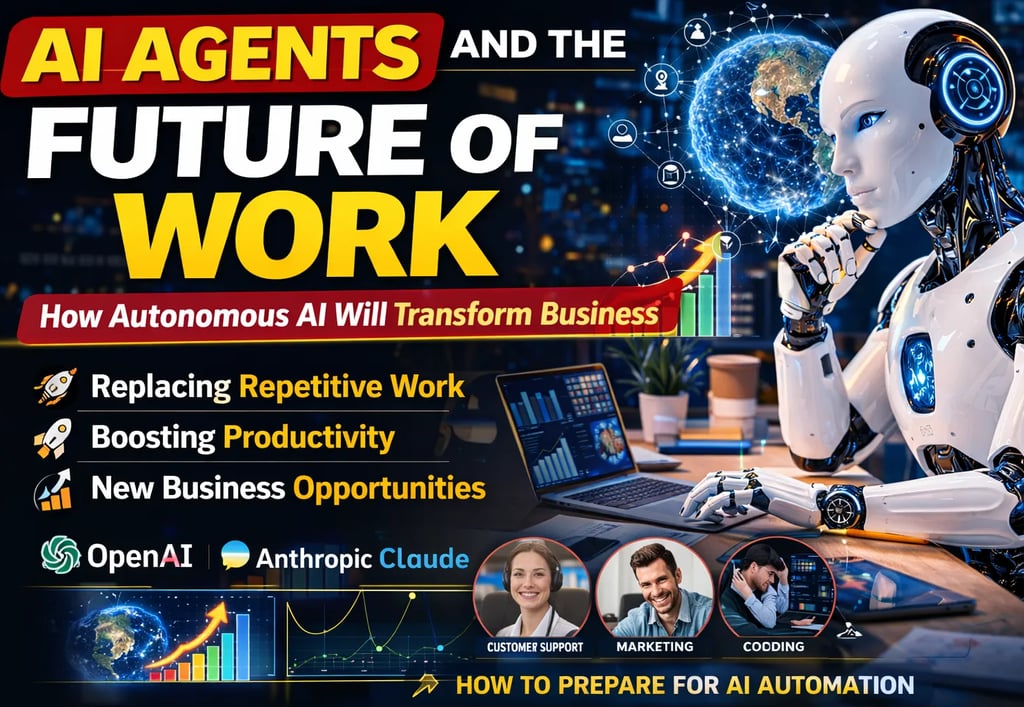
AI Agents and the Future of Work: How Autonomous AI Will Transform Business
Discover how AI agents are transforming jobs and businesses. Learn how autonomous AI will automate work, boost productivity, and create new opportunities.
AI TOOLSAGITECHNOLOGY & AI
DIPJYOTI SHARMA
3/9/20266 min read
AI Agents and the Future of Work: How Autonomous AI Will Transform Business
Artificial intelligence is rapidly transforming how people work. One of the most powerful developments in recent years is the emergence of AI agents—autonomous systems capable of completing tasks, making decisions, and automating workflows with minimal human involvement.
Unlike traditional AI tools that simply generate responses to prompts, AI agents can plan tasks, execute multi-step processes, analyze results, and continuously improve.
As companies adopt these systems, many experts believe that AI agents will reshape industries, redefine job roles, and create new opportunities for entrepreneurs.
In this article, we explore how AI agents will change jobs and businesses, how AI-powered automation systems work, and why this technology could define the future of work.
Table of Contents
What Are AI Agents
Why AI Agents Are Transforming Work
AI Replacing Repetitive Work
AI Agents in Marketing
AI Agents in Coding and Software Development
AI Agents in Customer Support
AI-Powered Automation Systems
Opportunities for Entrepreneurs
Platforms Powering AI Agents
Challenges and Ethical Considerations
Future of AI Agents in the Workplace
Frequently Asked Questions (FAQs)What Are AI Agents?
AI agents are autonomous software systems powered by artificial intelligence that can perform tasks independently.
These systems are capable of:
Breaking large objectives into smaller tasks
Searching and gathering information
Making decisions based on data
Executing workflows automatically
Learning from previous results
Unlike simple chatbots, AI agents can perform complex multi-step tasks such as research, content creation, workflow automation, and data analysis.
For example, an AI agent could be assigned the goal:
“Research competitors and generate a marketing report.”
The agent would then gather data, analyze trends, and produce a structured report automatically.
Because of these capabilities, AI agents are becoming an important part of modern digital workplaces.
Why AI Agents Are Transforming Work
The rise of AI agents is changing how businesses operate.
Several factors explain why these systems are gaining popularity.
Increased Productivity
AI agents can perform tasks significantly faster than humans, allowing companies to complete projects quickly.
Cost Reduction
Automation reduces the need for repetitive manual work, lowering operational costs.
24/7 Availability
Unlike human workers, AI agents can operate continuously without breaks.
Scalability
Businesses can handle large workloads without hiring additional staff.
Because of these advantages, many organizations are adopting AI-powered automation tools to increase efficiency.
AI Replacing Repetitive Work
One of the biggest impacts of AI agents will be the automation of repetitive tasks.
Many routine tasks across industries are predictable and structured, making them ideal candidates for automation.
Examples include:
Data entry
Email responses
Report generation
Basic research
Document processing
AI agents can handle these tasks quickly and accurately.
Jobs Most Likely to Be Automated
However, automation does not necessarily mean job loss. Instead, many roles will evolve toward higher-level strategic work.
AI Agents in Marketing
Marketing is one of the industries already benefiting from AI agents.
AI agents can automate several marketing tasks that previously required large teams.
Marketing Tasks Automated by AI Agents
Keyword research
Content creation
Competitor analysis
Ad campaign optimization
Social media scheduling
For example, an AI agent could:
Analyze trending keywords
Generate blog content
Create social media posts
Track performance metrics
This type of automation allows businesses to scale marketing efforts more efficiently.
AI Agents in Coding and Software Development
Software development is another area where AI agents are making significant progress.
Developers can now use AI systems to assist with:
Code generation
Debugging
Documentation writing
Software testing
AI coding assistants can analyze large codebases and recommend improvements.
This helps developers:
build software faster
reduce errors
improve productivity
Instead of replacing programmers, AI agents often act as collaborative tools that enhance developer efficiency.
AI Agents in Customer Support
Customer support is one of the most common applications of AI automation.
AI agents can handle customer interactions through chat systems and automated helpdesk tools.
Tasks AI Agents Can Perform
Answer frequently asked questions
Provide product recommendations
Process simple service requests
Route complex issues to human agents
This approach reduces response times and improves customer experience.
Customer Support Comparison
Many companies now combine human support teams with AI agents to deliver faster and more efficient service.
AI-Powered Automation Systems
AI agents are often integrated into larger automation platforms.
These systems allow organizations to automate complex workflows across multiple departments.
Examples of automated workflows include:
Lead generation pipelines
Marketing campaign management
financial reporting
supply chain monitoring
AI automation systems typically combine:
AI models
workflow tools
data analysis engines
integration platforms
These technologies allow companies to automate entire business processes rather than individual tasks.
Opportunities for Entrepreneurs
While AI automation may replace certain tasks, it also creates many opportunities for entrepreneurs.
Business owners can use AI agents to:
launch digital products faster
automate marketing
manage online stores
generate content at scale
For example, an entrepreneur could build an online business where AI agents handle:
content production
customer communication
analytics reporting
This dramatically reduces the resources needed to start and operate a digital business.
As a result, AI agents may enable a new generation of AI-powered startups and micro-businesses.
Platforms Powering AI Agents
Several major technology platforms are driving the development of AI agents.
Two important platforms include:
OpenAI
OpenAI
OpenAI develops advanced AI models used in many autonomous systems.
These models power applications such as:
chatbots
AI assistants
automation tools
OpenAI technology is widely used by developers building AI-powered products.
Anthropic Claude
Anthropic
Anthropic develops AI models designed for reliability and safety.
Its Claude AI models are often used for:
business automation
document analysis
enterprise AI systems
These platforms are accelerating the development of next-generation AI agents.
Challenges and Ethical Considerations
Despite their benefits, AI agents also raise important challenges.
Job Displacement
Some roles may be reduced as automation increases.
Data Privacy
AI systems often require access to large amounts of data.
Algorithm Bias
AI decisions may reflect biases present in training data.
Regulation
Governments are still developing policies for AI governance.
Organizations must balance innovation with responsible AI development.
Future of AI Agents in the Workplace
Experts believe AI agents will become an essential part of the future workplace.
In the coming years, AI agents may be able to:
coordinate complex projects
analyze global market data
assist with strategic decision-making
operate autonomous business systems
Instead of replacing humans entirely, AI agents will likely act as digital collaborators, helping workers focus on creativity and strategy.
Companies that adopt AI automation early may gain a significant competitive advantage.
FAQs
What are AI agents?
AI agents are autonomous software systems capable of performing tasks, making decisions, and executing workflows with minimal human involvement.
Will AI agents replace human jobs?
AI agents may automate repetitive tasks, but they will also create new roles focused on strategy, creativity, and AI management.
Which industries will be affected most by AI agents?
Industries such as marketing, customer support, software development, finance, and research will experience significant AI automation.
What platforms support AI agents?
Major AI platforms include OpenAI and Anthropic, which develop powerful AI models used in automation systems.
Can entrepreneurs benefit from AI agents?
Yes. Entrepreneurs can use AI agents to automate marketing, manage digital businesses, and scale operations efficiently.
Conclusion
AI agents represent one of the most important technological developments shaping the future of work.
By automating repetitive tasks, improving productivity, and enabling advanced workflow automation, AI agents are transforming how businesses operate.
While challenges such as job displacement and ethical concerns remain, the opportunities created by AI automation are enormous.
Organizations and entrepreneurs who embrace AI agents today will likely be better positioned to thrive in the AI-powered economy of the future.
Related AI Tools That Work With Automation
Automation platforms like Make.com become far more powerful when combined with other AI tools. Many modern automation systems rely on multiple AI platforms working together to research information, analyze data, and generate content automatically.
Below are some helpful AI tools you should understand if you want to build advanced automation workflows.
Gemini AI — Advanced AI for Research and Content Generation
AI automation workflows often use powerful AI models to generate ideas, analyze information, and create content automatically. One of the most advanced tools available today is Gemini AI.
Gemini AI can assist with:
AI content generation
research and data analysis
automation workflows
advanced AI integrations
If you want to learn how this AI works in detail, read this guide:
Gauth AI — AI Research and Problem Solving Tool
When building automation systems, accurate research and structured information are important. Tools like Gauth AI help users analyze questions, break down complex topics, and generate detailed explanations.
This makes it useful for:
educational content creation
technical research
AI-powered learning
automation content planning
Learn more here:
👉 https://simplifiedaihub.com/what-is-gauth-ai-complete-beginner-guide-2026
AI Email Automation Systems
Email automation is one of the most common use cases for automation tools like Make.com. Businesses use AI to automatically send follow-up emails, customer notifications, and marketing campaigns.
If you want to understand how AI email automation works step-by-step, read this tutorial:
👉 https://simplifiedaihub.com/email-automation-using-ai-complete-beginner-guide-2026
Julius AI — AI Data Analysis Tool
Automation systems often work with large datasets. AI tools like Julius AI help analyze spreadsheets, generate insights, and simplify complex data tasks.
Instead of manually processing data in spreadsheets, AI tools can automatically analyze information and produce reports.
Read the full review here:
AI Website Design Using Automation
AI tools are also transforming how websites are designed and built. Many designers now use AI tools to automate layout creation, content generation, and design workflows.
If you want to learn how to start a website design career using AI tools, read this guide: