NotebookLM Complete Guide 2026: Features, Workflow, Use Cases, and How to Use Google’s AI Research Assistant
Learn how to use NotebookLM in 2026. Discover features, workflows, prompts, and tips to turn Google’s AI research assistant into your ultimate productivity tool.
,AI FOR BEGINNERSAI TOOLSTECHNOLOGY & AI
DIPJYOTI SHARMA
3/9/20266 min read
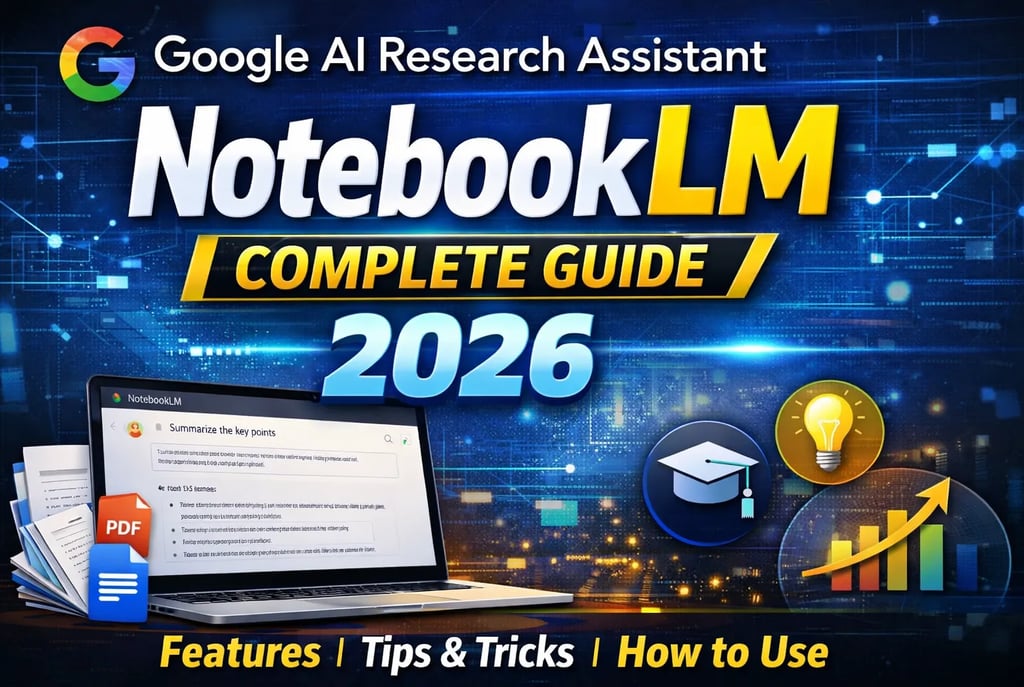
NotebookLM Complete Guide 2026: Features, Workflow, Use Cases, and How to Use Google’s AI Research Assistant
Artificial intelligence is transforming how people research, organize knowledge, and create content. One of the most powerful tools in this transformation is NotebookLM, an advanced AI research assistant designed to analyze documents, generate insights, and simplify complex information.
Developed by Google, NotebookLM allows users to upload their own sources and interact with them using artificial intelligence. Instead of relying only on general web knowledge, the AI answers questions based on the documents you provide.
This approach makes NotebookLM extremely useful for:
students and researchers
bloggers and content creators
marketers and business teams
educators and professionals
In 2026, NotebookLM has evolved into one of the most powerful AI productivity and knowledge management tools available online.
In this complete guide, you will learn:
What NotebookLM is
How it works
Key features in 2026
Step-by-step usage guide
Real-world workflows
Advanced tips and prompts
SEO and content creation strategies
By the end of this article, you will understand how NotebookLM can become your ultimate AI research assistant.
Table of Contents
What is NotebookLM
The Evolution of NotebookLM
How NotebookLM Works
Key Features of NotebookLM in 2026
Step-by-Step Guide to Using NotebookLM
NotebookLM Workflow for Bloggers
NotebookLM for Students and Researchers
NotebookLM for Business and Marketing
Advanced NotebookLM Tips and Best Prompts
Benefits of Using NotebookLM
Limitations and Challenges
NotebookLM vs Other AI Tools
SEO Content Creation with NotebookLM
Future of NotebookLM
FAQs
Final Thoughts
What is NotebookLM
NotebookLM is an AI-powered research and note-taking tool that helps users analyze information from documents using artificial intelligence.
Instead of searching the internet for answers, NotebookLM focuses on source-based reasoning. This means the AI generates responses using the documents you upload.
Users can upload:
PDFs
research papers
website links
Google Docs
presentations
study materials
Once the sources are uploaded, NotebookLM reads and understands the content. You can then ask questions about the material, and the AI will generate answers based on those sources.
For example, if a student uploads a textbook chapter, NotebookLM can:
summarize the chapter
explain complex concepts
generate study questions
create flashcards for revision
This makes NotebookLM a powerful AI learning assistant and research tool.
The Evolution of NotebookLM
NotebookLM began as an experimental AI project called Project Tailwind in 2023.
The goal of the project was to create an AI system that could learn directly from user documents instead of relying only on internet data.
2023 – Experimental Stage
Google introduced Project Tailwind as a prototype AI notebook for research tasks.
2024 – Public Release
The tool was renamed NotebookLM and became available to more users. Early versions focused on:
summarizing documents
answering questions
organizing notes
2025 – AI Feature Expansion
Several major features were added, including:
AI audio summaries
advanced document analysis
structured research insights
2026 – Full AI Knowledge Assistant
Today, NotebookLM has become a complete AI research platform with features like:
AI podcasts
multimedia explanations
knowledge organization tools
advanced research workflows
These improvements make NotebookLM one of the most powerful AI research assistants available today.
How NotebookLM Works
NotebookLM combines artificial intelligence with document indexing technology.
The system works through a simple workflow.
1. Upload Sources
Users upload documents containing information they want to analyze.
Examples include:
academic research papers
blog articles
business reports
textbooks
2. AI Document Analysis
NotebookLM reads and processes the uploaded material.
The AI identifies:
key topics
important ideas
relationships between concepts
3. AI Chat Interaction
Users can interact with the AI through a chat interface.
Examples of questions include:
“Summarize this document.”
“Explain the main arguments.”
“Create study notes.”
4. Insight Generation
The AI generates answers and insights based on the uploaded sources.
This makes the responses more reliable compared to general AI chat systems.
Key Features of NotebookLM in 2026
NotebookLM offers several advanced capabilities designed to improve research and productivity.
AI Document Summarization
NotebookLM can summarize long documents instantly.
This helps users understand complex material quickly.
Examples include:
research papers
industry reports
academic articles
Source-Based AI Answers
Unlike many AI tools, NotebookLM answers questions using the documents you provide.
This reduces misinformation and improves accuracy.
AI Audio Overviews
NotebookLM can convert documents into podcast-style discussions between AI hosts.
This feature allows users to listen to research content instead of reading it.
Video Learning Content
Another advanced feature is the ability to generate video explanations from uploaded materials.
These videos include:
narration
visual explanations
structured learning content
AI Study Tools
NotebookLM can generate:
quizzes
flashcards
study guides
This makes it extremely useful for students preparing for exams.
Presentation and Infographic Creation
NotebookLM can convert research documents into:
slide presentations
structured outlines
infographics
This helps professionals present information more effectively.
Step-by-Step Guide to Using NotebookLM
Using NotebookLM is simple and beginner-friendly.
Step 1: Open NotebookLM
Visit the NotebookLM website and sign in with your Google account.
Step 2: Create a Notebook
Create a notebook based on your topic.
Examples:
AI research
business strategy
marketing study
Step 3: Upload Sources
Add documents, PDFs, or links related to your topic.
Step 4: Ask Questions
Use the AI chat interface to explore the content.
Examples:
“Summarize the main ideas.”
“Explain this concept in simple terms.”
Step 5: Generate Content
NotebookLM can create:
summaries
reports
podcasts
presentations
NotebookLM Workflow for Bloggers
Bloggers can use NotebookLM to dramatically speed up content creation.
Example Workflow
Step 1 – Upload research articles
Step 2 – Ask AI to summarize sources
Step 3 – Generate blog outline
Step 4 – Expand each section
Step 5 – optimize content for SEO
This workflow can reduce research time by up to 70%.
NotebookLM for Students and Researchers
Students can use NotebookLM to simplify complex study materials.
Benefits include:
faster textbook understanding
automated study guides
quick revision notes
practice quizzes
Researchers can also analyze large volumes of academic literature quickly.
NotebookLM for Business and Marketing
Businesses can use NotebookLM for knowledge management and analysis.
Possible use cases include:
analyzing market research reports
reviewing competitor data
summarizing meeting notes
organizing internal documentation
Marketing teams can use NotebookLM to extract insights from large datasets.
Advanced NotebookLM Tips and Best Prompts
Using the right prompts can significantly improve results.
Useful Prompts
“Summarize the key arguments in this document.”
“Create a structured outline based on these sources.”
“Explain this concept in simple language.”
“Generate study questions based on this material.”
“Create a blog article outline from these research documents.”
These prompts help users unlock the full power of NotebookLM.
Benefits of Using NotebookLM
NotebookLM provides several advantages.
Faster Research
AI can analyze large volumes of information within seconds.
Higher Productivity
Users spend less time reading and more time applying insights.
Organized Knowledge
Information can be stored in structured notebooks.
Multimedia Learning
NotebookLM supports text, audio, and video content generation.
Limitations and Challenges
Despite its benefits, NotebookLM has some limitations.
Dependence on Sources
The AI works best when users upload high-quality documents.
AI Interpretation Errors
Complex material may sometimes be interpreted incorrectly.
Privacy Concerns
Users should avoid uploading confidential information.
NotebookLM vs Other AI Tools
NotebookLM stands out because it focuses on document-based AI intelligence.
SEO Content Creation with NotebookLM
SEO writers can use NotebookLM to produce high-quality content.
Example workflow:
Upload research articles
extract insights
generate blog outlines
expand into long-form articles
This approach helps create authoritative content optimized for search engines.
Future of NotebookLM
The future of AI research assistants looks promising.
Possible developments include:
real-time research analysis
deeper AI reasoning
integration with productivity apps
smarter knowledge organization
Tools like NotebookLM may soon become essential productivity tools for professionals worldwide.
Frequently Asked Questions
Is NotebookLM free?
Yes, Google currently offers a free version of NotebookLM.
Who should use NotebookLM?
Students, bloggers, researchers, marketers, and business professionals.
Is NotebookLM better than ChatGPT?
NotebookLM is better for document-based research, while ChatGPT is better for general conversation and creative writing.
Can NotebookLM generate podcasts?
Yes, it can create AI podcast discussions from documents.
Final Thoughts
NotebookLM represents a major step forward in AI-powered research tools.
By combining document analysis, AI chat, multimedia generation, and knowledge organization, it provides capabilities that traditional note-taking apps cannot match.
Whether you are a student, researcher, blogger, or professional, NotebookLM can dramatically improve how you interact with information.
As AI technology continues to evolve, tools like NotebookLM will likely become a central part of the modern knowledge workflow.
Related AI Tools That Work With Automation
Automation platforms like Make.com become far more powerful when combined with other AI tools. Many modern automation systems rely on multiple AI platforms working together to research information, analyze data, and generate content automatically.
Below are some helpful AI tools you should understand if you want to build advanced automation workflows.
Gemini AI — Advanced AI for Research and Content Generation
AI automation workflows often use powerful AI models to generate ideas, analyze information, and create content automatically. One of the most advanced tools available today is Gemini AI.
Gemini AI can assist with:
AI content generation
research and data analysis
automation workflows
advanced AI integrations
If you want to learn how this AI works in detail, read this guide:
Gauth AI — AI Research and Problem Solving Tool
When building automation systems, accurate research and structured information are important. Tools like Gauth AI help users analyze questions, break down complex topics, and generate detailed explanations.
This makes it useful for:
educational content creation
technical research
AI-powered learning
automation content planning
Learn more here:
👉 https://simplifiedaihub.com/what-is-gauth-ai-complete-beginner-guide-2026
AI Email Automation Systems
Email automation is one of the most common use cases for automation tools like Make.com. Businesses use AI to automatically send follow-up emails, customer notifications, and marketing campaigns.
If you want to understand how AI email automation works step-by-step, read this tutorial:
👉 https://simplifiedaihub.com/email-automation-using-ai-complete-beginner-guide-2026
Julius AI — AI Data Analysis Tool
Automation systems often work with large datasets. AI tools like Julius AI help analyze spreadsheets, generate insights, and simplify complex data tasks.
Instead of manually processing data in spreadsheets, AI tools can automatically analyze information and produce reports.
Read the full review here:
AI Website Design Using Automation
AI tools are also transforming how websites are designed and built. Many designers now use AI tools to automate layout creation, content generation, and design workflows.
If you want to learn how to start a website design career using AI tools, read this guide: