
Prompt Engineering: The Ultimate Guide to Writing Effective AI Prompts in 2026
Discover prompt engineering: expert techniques, examples, and best practices to write effective AI prompts and optimize your AI workflows in 2026.
,AI FOR BEGINNERSTECHNOLOGY & AIONLINE EARNING & AI TOOLS
DIPJYOTI SHARMA
2/13/20266 min read
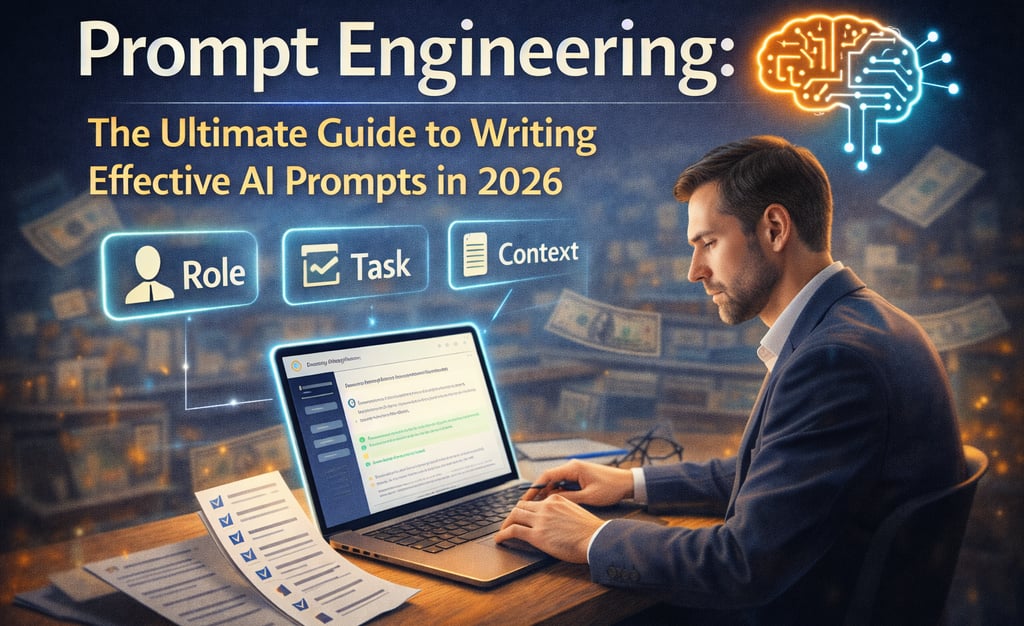
In the rapidly evolving world of artificial intelligence, the ability to communicate effectively with AI models is one of the most valuable skills you can acquire. At the heart of this communication lies prompt engineering — the art and science of crafting instructions that guide AI to deliver the most accurate, relevant, and creative responses. Whether you're a beginner exploring AI tools for the first time or a seasoned developer integrating advanced AI into your workflows, understanding prompt engineering is crucial for maximizing the potential of AI systems.
In this comprehensive and SEO-optimized guide, we will dive deep into prompt engineering, covering everything from the basics to advanced techniques, real-world examples, best practices, and common mistakes. By the end of this article, you’ll have a thorough understanding of how to write better AI prompts and leverage prompt engineering to achieve your goals.
What is Prompt Engineering?
Prompt engineering refers to the process of designing, structuring, and refining the input (prompts) given to artificial intelligence models—such as ChatGPT, Claude, Gemini, or any large language model (LLM)—to elicit the most useful and accurate outputs. It involves understanding how AI interprets language and using that knowledge to guide the model's responses.
In simple terms, prompt engineering is about knowing how to ask so that AI can answer effectively. A well-engineered prompt can mean the difference between a generic, unhelpful response and a detailed, actionable answer tailored to your needs.
Why is Prompt Engineering Important?
Improves Response Quality: Better prompts lead to more accurate and relevant answers.
Reduces Ambiguity: Clear instructions help avoid misunderstandings.
Saves Time: Efficient prompts can reduce the need for follow-up questions.
Enables Complex Tasks: Advanced prompt techniques allow you to solve multi-step or domain-specific problems.
Optimizes AI Workflow: Streamlined prompts can automate and enhance business processes.
Prompt Engineering Guide: From Beginner to Expert
Whether you're just starting or looking to refine your skills, this prompt engineering guide is designed to take you from the fundamentals to advanced strategies. Let’s break down the journey step by step.
Types of Prompt Engineering
Prompt engineering isn’t a one-size-fits-all discipline. Different scenarios call for different approaches. Here are the primary types:
1. Direct Prompting
Straightforward instructions that ask the AI to perform a simple task.
Example:
Summarize this article in one paragraph.
2. Role-Based Prompting
Assigning a specific role or identity to the AI to influence its response style.
Example:
Act as a professional career coach. Give me advice on how to prepare for a software engineering job interview.
3. Few-Shot Prompting
Providing a few examples to demonstrate the desired output format or style.
Example:
Translate the following sentences from English to Spanish.
Hello → Hola
How are you? → ¿Cómo estás?
4. Chain-of-Thought Prompting
Encouraging the AI to break down complex problems into logical steps before providing an answer.
Example:
Explain how to bake a cake step by step, starting from preparing the ingredients to baking and cooling.
5. Structured Prompting
Using formatting (such as bullet points, tables, or templates) to organize the input and guide the output structure.
Example:
List three advantages and three disadvantages of remote work in a table.
6. Contextual Prompting
Supplying background information or context to help the AI generate a more relevant response.
Example:
You are advising a startup founder in the healthcare sector. Suggest three cost-effective marketing strategies specific to this industry.
Prompt Engineering Techniques for Beginners
If you’re new to prompt engineering, start with these foundational techniques to improve your AI interactions.
1. Be Clear and Specific
Vague prompts lead to vague answers.
Instead of:
Tell me about AI.
Try:
Explain the basics of artificial intelligence in simple terms for a 10-year-old.
2. Assign Roles and Context
Giving the AI a role or context helps shape the response.
Example:
You are a friendly travel guide. Recommend a 3-day itinerary for Paris.
3. Use Step-by-Step Instructions
For complex tasks, break them down clearly.
Example:
First, summarize the article. Next, identify the main arguments. Finally, suggest improvements.
4. Provide Examples or Formats
Show the AI what you want.
Example:
Write a product description for wireless headphones. Use bullet points for features and a short paragraph for the summary.
5. Iterate and Refine
If the first response isn’t what you want, revise your prompt and try again.
Iteration is key.
How to Write AI Prompts: Step-by-Step Tutorial
Step 1: Define Your Objective
Be specific about the desired outcome.
Example objective:
Generate a persuasive email to convince a client to sign a contract.
Step 2: Choose the Right Prompt Type
Select direct, role-based, few-shot, etc.
Example approach:
Role-based prompting.
Step 3: Set Context and Constraints
Provide background and limits.
Example:
You are a sales manager at a software company. The email should be concise, professional, and highlight time-saving features.
Step 4: Specify Format and Tone
Example:
Write a formal email in three short paragraphs.
Step 5: Draft the Prompt
You are a sales manager at a software company. Write a formal, concise email to a potential client interested in a project management tool. Highlight the tool’s time-saving features. Structure the email in three short paragraphs: introduction, benefits, and call to action. Use a professional and friendly tone.
Step 6: Review and Iterate
Evaluate output and adjust wording if needed.
Prompt Engineering Examples with Explanation
Example 1: Basic Information Request
Prompt:
What is blockchain technology?
Issue: Too broad.
Improved Prompt:
Explain blockchain technology in simple terms suitable for a high school student.
Why it works: Defines audience and complexity.
Example 2: Role-Based Prompt
Prompt:
Act as a career counselor. List five tips for preparing for a tech industry interview.
Why it works: Role improves relevance and authority.
Example 3: Few-Shot Prompting
Prompt:
Here are two examples of product reviews:
“The headphones are comfortable…”
“The battery life is impressive…”
Now write a short review for a smartwatch.
Why it works: Examples define style and structure.
Example 4: Chain-of-Thought Prompting
Prompt:
Solve this math problem and explain your reasoning step by step.
Why it works: Shows reasoning process clearly.
Example 5: Structured Prompting
Prompt:
Create a table comparing Google Docs, Microsoft Word, and Zoho Writer including price, collaboration features, and offline access.
Why it works: Format is explicitly defined.
Advanced Prompt Engineering Methods
1. Multi-Turn Conversations
Maintain context across multiple exchanges.
Example:
First list digital marketing channels, then explain budget allocation.
2. Zero-Shot and Few-Shot Learning
Zero-shot example:
Translate “Good morning” to Japanese.
Few-shot example:
Hello → Bonjour
Thank you → Merci
Now translate: “How are you?”
3. In-Context Learning
Teach the model through examples inside the prompt.
4. Function Calling and Tool Use
Ask AI to use external tools when supported.
5. Prompt Chaining
Break complex tasks into multiple connected prompts:
Summarize article
Extract key points
Create presentation outline
Prompt Engineering Best Practices
Start simple
Be specific
Test and iterate
Use constraints
Leverage role play
Provide examples
Verify facts
Respect model limits
Optimize for use case
Document successful prompts
Common Mistakes in Prompting (and How to Avoid Them)
Being Too Vague
Fix by adding audience and context.
Overloading the Prompt
Break tasks into smaller prompts.
Ignoring Context
Provide industry, audience, and background.
Not Specifying Format
Define lists, tables, or paragraph structure.
Expecting Perfect Results First Time
Iterate and improve.
Real-World Prompt Engineering Examples
Content Marketing
Generate a structured blog outline.
Customer Support
Write empathetic responses to complaints.
Coding Assistance
Analyze code and suggest improvements.
Educational Tutoring
Explain complex topics using simple analogies.
Advanced Methods for ChatGPT and Other LLMs
Multi-Modal Prompts
Use text + images when supported.
Recursive Prompts
Summarize sections, then combine results.
Self-Critique Prompts
Ask AI to rate and improve its own output.
Dynamic Prompt Generation
Generate prompts automatically from user data.
AI Prompt Writing Tips
Speak clearly
Be concise but complete
Use active voice
Specify output length
Use delimiters
Ask for reasoning
Test variations
Create reusable templates
How to Improve AI Responses Using Prompts
Provide context
Refine iteratively
Use constraints
Break down tasks
Combine techniques
Critically evaluate outputs
Prompt Engineering for Business Workflow Optimization
Automating support responses
Content generation
Data extraction and summarization
Research assistance
Code review
Internal knowledge search
Well-engineered prompts reduce manual workload and improve consistency.
Prompt Engineering Tools and Resources
OpenAI Playground
LangChain
PromptLayer
Hugging Face Spaces
Prompt engineering cheat sheets
Prompt libraries
Frequently Asked Questions
What is prompt engineering used for?
Guiding AI to produce accurate and relevant outputs.
How do I start?
Use simple prompts, then add roles and context.
Does it work on all AI models?
Yes, though impact varies by model.
Can it fix hallucinations?
It helps reduce errors but verification is still required.
Are there risks?
Overly complex prompts can confuse models; always use responsibly.
Conclusion: Mastering Prompt Engineering for AI Success
Prompt engineering is a vital skill in the age of artificial intelligence. It transforms AI from a generic text generator into a precise collaborator capable of delivering practical, creative, and actionable results.
Whether you are a beginner exploring AI or a professional optimizing workflows, mastering prompt engineering will significantly enhance your results. Start simple, be specific, iterate often, and apply different techniques such as role-based prompting, structured prompts, and chain-of-thought reasoning.
As AI continues to evolve, the ability to communicate effectively with it will become even more valuable. Keep experimenting, keep refining your prompts, and continue building your expertise — one well-crafted prompt at a time.
Related Guides You May Also Like
If you want to go deeper into practical AI usage and productivity, explore these helpful guides:
7 AI Tools for Remote Work That Boost Productivity in 2026 — Discover powerful AI tools that help remote workers automate tasks, improve collaboration, and increase daily productivity.
How Beginners Are Making Money with AI in 2026 — Learn beginner-friendly ways people are turning AI skills into real income through side hustles, content creation, and automation.
AI for Beginners: How to Choose the Right Tool for Learning and Research — A simple guide to selecting the best AI tools for studying, research, and everyday learning without feeling overwhelmed.