What Is Happenstance AI? The Viral AI Tool Explained (2026 Guide)
What Is Happenstance AI? Complete 2026 Guide to the Viral AI Networking Tool
TECHNOLOGY & AI,AI FOR BEGINNERSAI TOOLS
DIPJYOTI SHARMA
2/21/202610 min read
If you've been spending any time in startup circles, sales Slack channels, or recruiting communities lately, you've probably heard the buzz. Happenstance AI is being called everything from "an absolute weapon" to "the most elite networking tool" professionals have ever used. But what exactly is Happenstance AI, how does it work, and why is everyone suddenly talking about it? This 2026 guide breaks it all down — from its core features to real-world use cases — so you can decide whether it belongs in your professional toolkit.
What Is Happenstance AI?
At its core, Happenstance AI is an AI-powered people search engine built for professionals. Rather than replacing your existing network, it supercharges it. The platform connects to your existing social and professional accounts — including LinkedIn, Gmail, and Twitter — and uses large language models (LLMs) combined with embedding search technology to let you find specific people using nothing more than a plain-English description.
Think about it this way: instead of clicking through a dozen LinkedIn filters, fumbling with Boolean search strings, or scrolling through your email contacts trying to remember who works where, you simply type something like "fintech product manager in NYC with a startup background" — and Happenstance AI surfaces the most relevant people from across your entire network instantly.
That's the core magic of this AI contact search platform: it translates your intent into results, rather than forcing you to translate your intent into filters. It's backed by Y Combinator and has been gaining serious momentum in 2025 and into 2026 as professionals increasingly look for smarter, faster ways to leverage the relationships they've already built.
How Happenstance AI Works
Understanding what is Happenstance AI and how does it work starts with one simple concept: your network is a goldmine, but most people can only access a fraction of it at any given time. Happenstance AI fixes that.
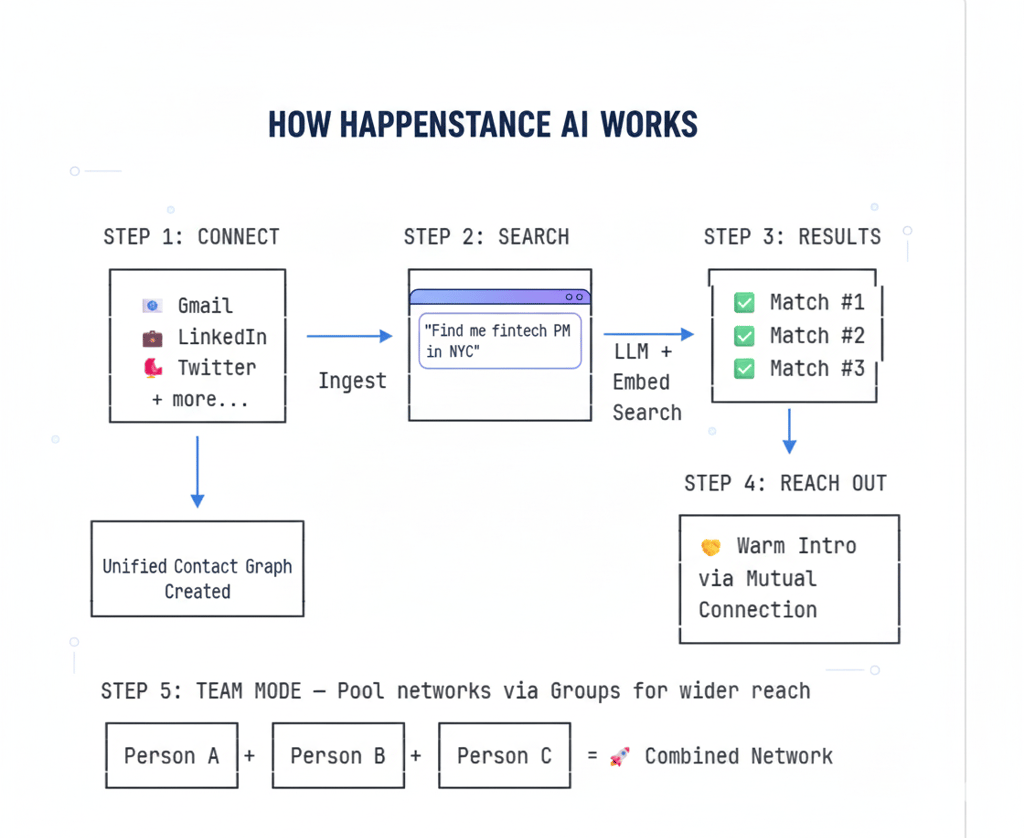
How Happenstance AI Works — Step-by-Step Diagram
Step 1: Connect Your Accounts
When you sign up, you connect your professional accounts — LinkedIn, Gmail, Twitter/X, and more. Happenstance AI then ingests your contact data and uses AI to analyze, tag, and organize every person in your network based on their role, skills, location, industry, company, and other attributes. This creates a searchable, unified database of everyone you know, without requiring you to manually input a single thing.
Step 2: Search in Plain English
Once your accounts are connected, you simply describe the person you're looking for. There are no dropdowns, no rigid filters, and no Boolean logic required. You can type something as specific as "an AI founder in San Francisco, ideally a Stanford alum at pre-seed stage" and the platform will understand your intent. The AI uses LLMs to interpret what you mean — not just what you typed — and runs that against your contact database using embedding search to find the most semantically similar matches.
Step 3: See the Logic Behind the Results
One of Happenstance AI's most distinctive features is its transparency. Unlike most AI-powered networking platforms that return results as if from a black box, Happenstance shows you the reasoning behind each match. It displays the filters, traits, keywords, and even the underlying query logic it used to find those results. This means you can trust the output and quickly understand why certain people surfaced — and whether the search needs to be refined.
Step 4: Get Warm Introductions
Happenstance AI doesn't just find people — it helps you reach them. The platform identifies mutual connections, making it easy to request or facilitate warm introductions rather than cold outreach. In a world where response rates on cold messages are at an all-time low, the ability to come in through a trusted mutual contact is genuinely valuable.
Step 5: Expand via Groups and Integrations
Happenstance AI also supports group searches, where teams can pool their networks together to run collaborative searches. It integrates directly with Slack (you can tag @happenstance in any channel), email forwarding (forward requests to agent@happenstance.ai), and a full API for custom integrations. This makes it not just a personal tool, but an infrastructure layer for teams that rely on relationship-driven work.
Why Is Happenstance AI Trending in 2026?
Several forces are converging to make Happenstance AI one of the most talked-about AI professional networking software tools of the year.
The Quality-Over-Quantity Shift
Professional networking has spent years in a quantity-obsessed phase. LinkedIn connections ballooned into the thousands, email lists grew massive, and follower counts became the proxy for influence. But there's been a growing backlash. Professionals are realizing that having 5,000 connections is meaningless if you can't quickly identify and reach the ten people who actually matter for your current goal. Happenstance AI is perfectly timed for this pendulum swing back toward quality and relevance over raw volume.
The Rise of AI-Powered Workflows
Across sales, recruiting, and business development, AI tools are rapidly replacing manual processes. Teams that used to spend hours manually prospecting or sourcing candidates are now expecting those tasks to take minutes. Happenstance AI fits neatly into this trend by automating the most tedious part of professional networking — the search itself — while leaving the relationship-building to humans. If you're interested in how this fits into the bigger picture, check out our guide on AI Tools Transforming Professional Workflows in 2026.
LinkedIn's Growing Limitations
LinkedIn remains the dominant professional network, but its search functionality has frustrated users for years. The platform's filters are rigid, its algorithm prioritizes advertisers, and finding someone with a highly specific background often requires a premium subscription and still delivers imprecise results. Happenstance AI vs LinkedIn search is a comparison that comes up constantly among power users, and many are finding that Happenstance's natural language AI search outperforms LinkedIn's native tools for targeted, intent-driven searches.
Remote Work and Distributed Networks
As professional communities have become more globally distributed and more niche, the need to search across fragmented networks has grown. Your relevant contacts might be scattered across LinkedIn connections, email threads from five years ago, and Twitter followers you haven't spoken to in months. Happenstance AI unifies all of these into a single searchable layer, which is especially powerful for remote professionals and distributed teams.
Happenstance AI Features and Use Cases
Let's look at the specific features that make Happenstance AI stand out, and the practical scenarios where it shines.
Natural Language Search
The headline feature. You describe who you're looking for in plain English, and the AI figures out the rest. This works for simple queries ("senior engineers in Austin") and highly nuanced ones ("a second-time founder who's previously worked in climate tech and now advising startups"). The platform's use of LLMs means it understands context, synonyms, and intent — not just literal keyword matches.
Cross-Platform Contact Aggregation
By connecting Gmail, LinkedIn, Twitter, and other accounts, Happenstance creates a unified contact graph. This means a search can surface someone who emailed you two years ago and also follows you on Twitter, even if you'd never have thought to look for them manually. This cross-platform visibility is one of the most underappreciated features of the tool.
Group and Team Network Search
For organizations, the Groups feature is a game-changer. Sales teams can combine their individual contact lists to search across a much larger pool of warm leads. Recruiting teams can pool their networks to source passive candidates. VC-backed startups can merge their investors' networks with their own to find introductions to potential partners or clients. This collaborative approach to AI relationship intelligence dramatically increases the reach and effectiveness of every search.
Slack and Email Integration
Happenstance AI meets teams where they already work. By tagging @happenstance in Slack or forwarding emails to the platform's agent address, teams can trigger searches without ever leaving their existing workflows. This kind of seamless integration is critical for adoption — the best tools are the ones that add value without adding friction.
Transparency and Explainability
As noted earlier, Happenstance shows you the reasoning behind its results. In a professional context, this matters enormously. You're not just getting a list of names — you're getting context that helps you evaluate the quality of the match and make a more informed decision about how to reach out.
API Access for Custom Integrations
For teams with more technical resources, Happenstance offers a Search and Research API that allows custom integrations. This means the platform's AI contact discovery capabilities can be embedded into proprietary CRMs, ATS platforms, or sales tools.
Who Should Use Happenstance AI?
The short answer: anyone whose professional success depends on finding and connecting with the right people. But let's get more specific.
Sales and Business Development Professionals
For anyone doing sales prospecting, Happenstance AI is a remarkably efficient tool. Rather than cold-calling or buying leads lists, you can identify potential customers who are already within your network's orbit and reach them through a warm introduction. Teams using Happenstance for AI sales prospecting report dramatically higher response rates compared to cold outreach, because the connection is inherently warmer.
Recruiters and Hiring Managers
Recruiting is fundamentally a search problem, and Happenstance AI is a powerful answer to it. Instead of posting a job and waiting, or purchasing expensive LinkedIn Recruiter licenses, hiring teams can proactively search their combined networks for passive candidates who match very specific criteria. This is one of the strongest use cases for AI tools for hiring and recruiting in 2026, particularly for roles that require niche skills or industry experience. See our full breakdown of Best AI Recruiting Tools of 2026 for a wider comparison.
Founders and Startup Teams
Raising money, finding early customers, building advisory boards, hiring the first ten employees — all of these startup challenges come down to finding the right people fast. Happenstance AI use cases for startups are extensive. A founder can search their investors' combined networks for warm introductions to specific VCs. A founding team can pool their contacts to find early beta users with specific job titles. The platform essentially gives small, resource-constrained teams access to a level of network intelligence that used to require expensive software or a dedicated operations hire.
Investors and VCs
Venture capitalists and angel investors spend enormous amounts of time doing reference checks, identifying domain experts, and sourcing deals. Happenstance AI accelerates all of these activities. An investor can search across their portfolio founders' networks for subject matter experts in a specific field, or quickly find mutual connections who can vouch for a founder they're evaluating.
Event Organizers and Community Builders
If you're planning a conference, running a professional community, or building a peer group, finding the right people to invite is often the hardest part. Happenstance AI's group and directory search features let organizers search across their networks using interest or expertise criteria, making curation dramatically more efficient.
Professionals in Career Transition
If you're exploring a new role or industry, the ability to quickly identify people in your existing network who are already working in that space is invaluable. Happenstance AI makes it easy to find mentors, informational interview contacts, or hiring managers within your extended network — without the awkwardness of cold outreach.
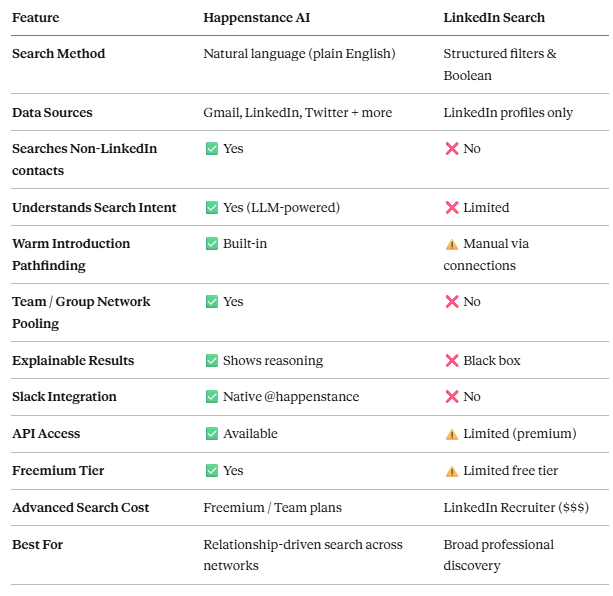
Happenstance AI vs LinkedIn Search: Full Comparison Table
The comparison is inevitable, so let's address it head-on — not just in words, but with a clear side-by-side breakdown.
The two tools aren't entirely in competition — many professionals will use both. But for intent-driven, relationship-aware searches where context and nuance matter, Happenstance AI offers capabilities that LinkedIn's native search doesn't come close to replicating.
Is Happenstance AI Worth Using in 2026?
Based on what we know, the answer for most relationship-driven professionals is yes — particularly for sales, recruiting, and startup use cases. The platform's core value proposition is strong: it unlocks the latent value in networks that professionals have already built, reduces the time spent on manual searching, and increases the quality and warmth of the connections it helps facilitate.
The freemium model means the barrier to entry is low, and the Slack and email integrations make it easy to weave into existing workflows. The Groups feature in particular represents a meaningful step forward for team-based networking.
That said, like any AI-powered networking platform, Happenstance is only as good as the data you feed it. The more accounts you connect and the more actively you maintain your professional networks across platforms, the better your results will be. It also raises legitimate questions about data privacy and network access — users should be thoughtful about which networks they share and with whom.
Final Thoughts + Next Steps
Happenstance AI represents one of the most practical applications of large language model technology in the professional world. It doesn't try to replace human relationships — it makes them more accessible. In a professional landscape where who you know still matters enormously, having an AI-powered people search engine that can instantly surface the right person from thousands of contacts is a genuine competitive advantage.
Whether you're a founder trying to find your first investor introduction, a recruiter hunting for a passive candidate with a very specific background, or a salesperson looking for a warm path into a dream account, Happenstance AI is a tool worth exploring. The combination of natural language search, cross-platform contact aggregation, transparent AI reasoning, and team-level collaboration makes it one of the most compelling AI networking tools of 2026.
Your network is already your most valuable professional asset. Happenstance AI just makes it searchable.
Frequently Asked Questions About Happenstance AI
The following FAQ section is structured for Google FAQ Schema / rich snippet eligibility.
Q: What is Happenstance AI and what does it do?
Happenstance AI is an AI-powered people search engine for professionals. It connects to your existing accounts — Gmail, LinkedIn, Twitter, and more — and lets you search your entire professional network using plain-English descriptions. Instead of manually scrolling through contacts or using rigid search filters, you simply describe who you're looking for and Happenstance's AI surfaces the most relevant matches instantly, along with the reasoning behind each result.
Q: How is Happenstance AI different from LinkedIn search?
Unlike LinkedIn, which only searches its own database of profiles, Happenstance AI searches across your actual relationships on multiple platforms simultaneously. It uses large language models (LLMs) to understand search intent rather than relying on predefined filter categories. It also surfaces people from your Gmail history and Twitter network who may not be active on LinkedIn at all. Additionally, Happenstance shows you why each person was matched and helps you find a warm introduction path — features LinkedIn doesn't offer natively.
Q: Is Happenstance AI free to use?
Yes, Happenstance AI offers a freemium tier that lets individuals connect their accounts and run searches at no cost. Paid plans are available for teams and organizations that want access to the Groups feature (collaborative network pooling), API access, and higher search volumes. This makes it significantly more affordable than tools like LinkedIn Recruiter for many use cases.
Q: Who is Happenstance AI best suited for?
Happenstance AI is most valuable for professionals whose work depends on finding and connecting with specific people quickly. This includes sales and business development teams doing AI sales prospecting, recruiters searching for passive candidates, founders and startup teams looking for investor introductions or early customers, venture capitalists doing reference checks, and professionals in career transition. Any role that benefits from warm introductions over cold outreach is a strong fit.
Q: Is my data safe with Happenstance AI?
Happenstance AI connects to your accounts to read and index your contact data for search purposes. As with any AI contact discovery platform, users should review the platform's privacy policy and be intentional about which accounts they connect, particularly in team or group settings where your contacts become part of a shared searchable pool. Happenstance is a YC-backed company, and like most professional tools in this category, it is subject to standard data handling and privacy compliance expectations. Always review terms of service before connecting sensitive accounts.
Related Articles
📌 What Is Neysa AI? Complete Beginner Guide (2026)
📌Who Is Matt Shumer? The AI Creator Everyone Is Talking About in 2026
📌AI Ethics Explained (2026): Responsible AI, Bias, Privacy & Future Risks