AI Awareness in 2026: Why Understanding AI Matters More Than Ever
Learn why AI awareness is essential in 2026. Discover AI benefits, risks, ethics, career opportunities, and practical tips for responsible AI use.
,AI FOR BEGINNERS
DIPJYOTI SHARMA
6/5/20265 min read
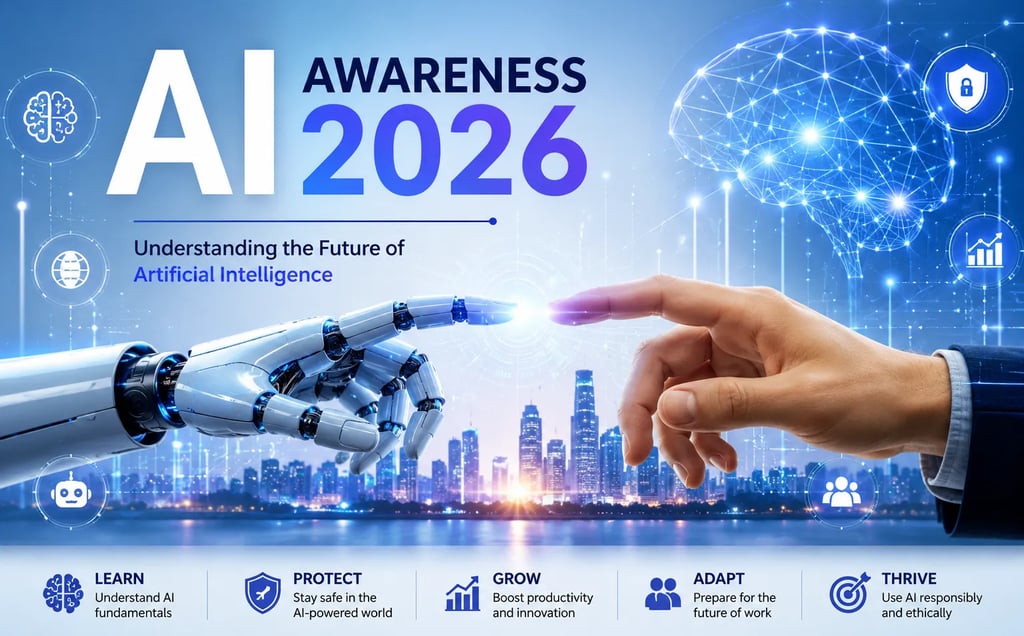
AI Awareness in 2026: Why Understanding Artificial Intelligence Is Essential for Everyone
Table of Contents
What Is AI Awareness?
Why AI Awareness Matters in 2026
Real-World Applications of AI
Benefits of AI Awareness
Risks and Challenges of Artificial Intelligence
How to Become More AI Aware
The Future of AI Awareness
Conclusion
Frequently Asked Questions
Additional FAQs
What Is AI Awareness?
AI awareness is the understanding of artificial intelligence, its capabilities, limitations, benefits, risks, and ethical considerations. It involves knowing how AI systems work, how they influence daily life, and how to use them responsibly.
In simple terms, AI awareness helps people make informed decisions when interacting with AI-powered technologies.
Today, artificial intelligence is embedded in search engines, smartphones, online shopping platforms, navigation apps, customer service systems, healthcare solutions, and educational tools. As AI continues to evolve, AI awareness is becoming as important as digital literacy and internet literacy.
AI Awareness in One Minute
AI awareness means understanding how artificial intelligence works, recognizing its benefits and limitations, identifying AI-generated content, protecting personal data, and using AI responsibly. In 2026, AI awareness is essential for students, professionals, business owners, and everyday internet users.
Why AI Awareness Matters in 2026
Artificial intelligence is transforming the global economy at an unprecedented rate. Organizations across industries are adopting AI-powered solutions to improve efficiency, reduce costs, and enhance customer experiences.
As a result, individuals who understand AI technology gain significant advantages in education, employment, and entrepreneurship.
1. AI Is Changing the Workplace
Many routine tasks can now be automated using AI tools. Content creation, data analysis, customer support, scheduling, and research are increasingly assisted by AI systems.
Rather than replacing all jobs, AI is changing how work is performed. Professionals who learn to work alongside AI are likely to remain more competitive in the job market.
To prepare for the future workplace, consider developing these essential AI-related skills:
Related Reading: https://simplifiedaihub.com/5-ai-skills-you-need-to-stay-ahead-in-2026
2. AI Improves Productivity
AI tools help individuals complete tasks faster by automating repetitive activities. Businesses use AI to generate reports, analyze data, answer customer inquiries, and streamline workflows.
When used correctly, AI can significantly improve productivity while allowing humans to focus on creativity, strategy, and decision-making.
3. AI Awareness Helps Combat Misinformation
Deepfakes, AI-generated images, and synthetic content are becoming increasingly sophisticated. AI awareness helps users identify potentially misleading content and verify information before sharing it.
4. AI Is Becoming a Core Digital Skill
Just as computer literacy became essential in the 2000s, AI literacy is becoming a fundamental skill for success in the modern world.
Real-World Applications of Artificial Intelligence
Artificial intelligence is already impacting nearly every industry.
Healthcare
AI assists medical professionals in diagnosing diseases, analyzing medical scans, predicting health risks, and improving patient outcomes.
For example, AI-powered imaging systems can help identify abnormalities in X-rays and MRIs more efficiently.
Education
AI is personalizing learning experiences for students worldwide. Intelligent tutoring systems can adapt lessons based on individual learning styles and performance levels.
Educational tools such as MagicSchool AI are helping teachers save time and enhance classroom experiences.
Related Reading: https://simplifiedaihub.com/magicschool-ai-review-2026
Software Development
AI-powered coding assistants are making software creation more accessible than ever.
Today, entrepreneurs and creators can build applications without extensive programming knowledge.
Related Reading: https://simplifiedaihub.com/how-to-make-and-publish-an-app-for-free-using-lovable-ai-2026
Business Intelligence and Analytics
Organizations use AI to analyze massive datasets and uncover valuable insights.
For instance, AI-powered analytics platforms can identify trends, forecast demand, and optimize business operations.
Related Reading: https://www.asimplifiedhub.blog/2026/06/how-to-analyze-excel-sales-reports-using-julius-ai.html
Content Creation
Writers, marketers, and content creators use AI tools to generate ideas, create drafts, optimize content, and improve productivity.
AI does not replace creativity; instead, it acts as a powerful assistant that enhances human capabilities.
Benefits of AI Awareness
Understanding AI provides several advantages.
Better Career Opportunities
Employers increasingly value candidates who understand artificial intelligence and automation technologies.
Professionals with AI knowledge can often access more career opportunities and higher-paying positions.
Improved Decision-Making
AI-powered tools analyze data faster than humans, helping businesses and individuals make more informed decisions.
Enhanced Productivity
AI automates repetitive tasks, reducing workload and increasing efficiency.
Greater Digital Safety
AI awareness helps individuals recognize scams, misinformation, phishing attempts, and manipulated content.
Responsible Technology Use
Understanding AI ethics promotes fairness, transparency, accountability, and trust.
Risks and Challenges of Artificial Intelligence
While AI offers many benefits, users should also understand its challenges.
Privacy Concerns
Many AI systems require access to large amounts of data. Users should carefully review privacy policies and understand how their information is collected and stored.
Algorithmic Bias
AI systems learn from historical data. If training data contains biases, AI-generated decisions may also reflect those biases.
Job Displacement
Some repetitive roles may become automated over time. However, new opportunities are also emerging in AI development, management, oversight, and implementation.
Overreliance on AI
AI systems can make mistakes. Users should always apply critical thinking and verify important information independently.
Security Risks
Cybercriminals can misuse AI technologies to create convincing scams, fake content, and sophisticated cyberattacks.
This makes AI awareness more important than ever.
How to Become More AI Aware
Developing AI awareness does not require a technical background.
Learn AI Fundamentals
Start by understanding:
Machine Learning
Generative AI
Natural Language Processing
Computer Vision
AI Ethics
Experiment with AI Tools
Hands-on experience is one of the best ways to learn.
Explore popular AI platforms and understand their strengths and limitations.
Related Reading: https://simplifiedaihub.com/claude-ai-review-2026
Stay Informed
Artificial intelligence evolves rapidly. Follow reputable technology blogs, industry reports, and research publications.
Develop Practical AI Skills
Focus on skills such as:
Prompt engineering
AI-assisted research
Data analysis
Workflow automation
AI content creation
Practice Critical Thinking
Never assume AI-generated outputs are always accurate. Verify facts and cross-check important information.
The Future of AI Awareness
The future will require individuals to work alongside increasingly capable AI systems.
Schools are beginning to integrate AI education into curricula. Businesses are investing heavily in AI training programs. Governments and international organizations are developing guidelines to ensure ethical AI deployment.
Experts believe that AI awareness will soon become a foundational skill alongside reading, writing, mathematics, and digital literacy.
Individuals who embrace AI education today will be better prepared for tomorrow's opportunities.
The goal is not to compete with AI but to collaborate effectively with it.
Conclusion
AI awareness is one of the most important skills of the modern digital era. As artificial intelligence continues transforming industries, education, healthcare, and everyday life, understanding how AI works has become essential.
By improving AI literacy, individuals can increase productivity, enhance career prospects, protect themselves from misinformation, and use technology responsibly.
The future belongs to people who understand and adapt to emerging technologies. Developing AI awareness today is an investment in long-term success, digital safety, and professional growth.
Rather than fearing artificial intelligence, we should focus on learning how to use it wisely, ethically, and effectively.
Frequently Asked Questions (FAQs)
What is AI awareness?
AI awareness is the understanding of artificial intelligence, including its applications, benefits, limitations, risks, and ethical considerations.
Why is AI awareness important in 2026?
AI awareness helps people use AI responsibly, improve productivity, identify misinformation, and stay competitive in an increasingly AI-driven world.
Who should learn about AI?
Everyone can benefit from AI awareness, including students, teachers, professionals, entrepreneurs, and business owners.
Is AI awareness the same as AI literacy?
AI literacy is a component of AI awareness. AI awareness includes broader knowledge about AI's impact on society, ethics, risks, and opportunities.
Can AI replace human workers?
AI may automate certain tasks, but human creativity, critical thinking, leadership, and emotional intelligence remain valuable and difficult to replace.
Additional FAQs
How can beginners start learning AI?
Beginners can start with online courses, AI tools, educational blogs, tutorials, and practical experimentation.
What are the most useful AI skills in 2026?
Prompt engineering, AI-assisted research, automation, data analysis, and AI content creation are among the most valuable skills.
What industries use AI the most?
Healthcare, education, finance, retail, marketing, manufacturing, logistics, and software development extensively use AI technologies.
What are the risks of AI?
Common risks include misinformation, privacy concerns, algorithmic bias, cybersecurity threats, and overreliance on automated systems.
How does AI improve productivity?
AI automates repetitive tasks, processes large datasets quickly, assists with content creation, and helps users make faster decisions.
What is responsible AI?
Responsible AI refers to the ethical, transparent, fair, and accountable development and use of artificial intelligence technologies.