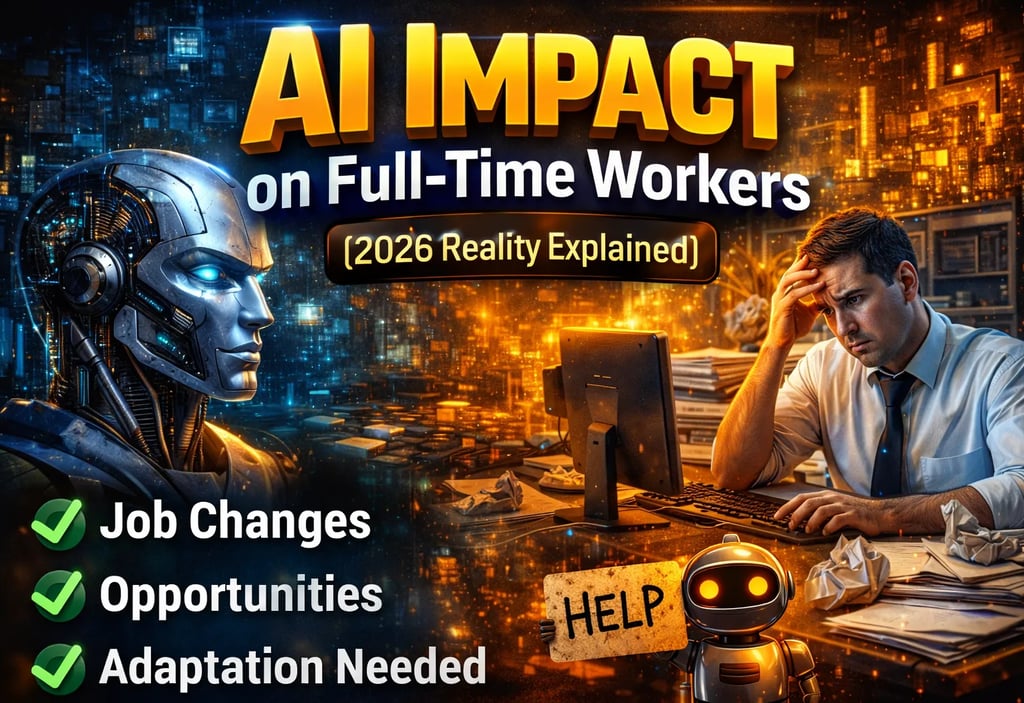
AI Impact on Full-Time Workers (2026 Reality Explained)
AI impact on full-time workers in 2026 explained. Discover job changes, opportunities, risks, and how to adapt and future-proof your career.
,AI FOR BEGINNERSAI TOOLS
DIPJYOTI SHARMA
4/11/20267 min read
AI Impact on Full-Time Workers (2026 Reality Explained)
In 2026, artificial intelligence (AI) is no longer a distant promise—it’s an integral part of daily work life for millions of full-time employees. From automating repetitive tasks to enhancing creativity and decision-making, AI is reshaping how we work, what we do, and how we grow in our careers. But what does this AI revolution really mean for you as a full-time worker? Is AI a threat to your job, or an opportunity to future-proof your career?
In this in-depth guide, we’ll break down the real-world impact of AI on full-time workers in 2026, covering practical opportunities, challenges, the essential skills you need, and how you can adapt to thrive. We’ll also highlight the best AI tools and strategies you can start using today—backed by trusted resources like the AI Humanizer Guide 2026, 25 Powerful AI Tools for Beginners in 2026, and the Ultimate Guide to Prompt Engineering in 2026.
Table of Contents
AI in the Modern Workplace: 2026 Overview
How AI is Changing Full-Time Jobs
Opportunities AI Brings to Full-Time Workers
Key Challenges and Concerns in 2026
Top AI Skills for Future-Proofing Your Career
Essential AI Tools Every Worker Should Know
How to Adapt: Practical Steps for Full-Time Workers
The Human Element: Why AI Can’t Replace You Entirely
AI and Workplace Culture: Collaboration and Ethics
Case Studies: Real Stories of AI Transforming Jobs in 2026
Future Outlook: What’s Next for AI and Work?
FAQs: AI’s Impact on Full-Time Workers
Conclusion: Embracing AI for a Brighter Work Future
AI in the Modern Workplace: 2026 Overview
By 2026, AI has moved from the periphery to the core of workplace operations. According to recent studies, over 70% of organizations worldwide use some form of AI daily—ranging from automated scheduling and data analysis to creative brainstorming and customer support.
AI isn’t just about robots or chatbots. It’s about smarter tools that help you work faster, smarter, and with greater satisfaction. However, this transformation brings both exciting opportunities and real challenges for full-time workers.
How AI is Changing Full-Time Jobs
AI’s impact on full-time work can be seen in several key ways:
1. Automation of Routine Tasks
AI-powered tools now handle repetitive, time-consuming tasks such as data entry, email sorting, report generation, and basic customer queries. This frees up workers for more creative and strategic activities.
Example:
Accountants now use AI to automate invoice processing, allowing them to focus on financial strategy and client advisory.
2. Enhanced Decision-Making
AI analyzes massive datasets in seconds, providing actionable insights for everything from marketing campaigns to supply chain management.
Example:
Sales teams use AI-driven analytics to predict customer behavior and personalize outreach, as highlighted in the AI Humanizer Guide 2026.
3. Augmented Creativity
From generating marketing copy to designing presentations, AI tools act as powerful co-pilots for creative professionals.
Example:
Writers and designers leverage AI to brainstorm ideas and refine concepts, often using prompt engineering techniques covered in the Ultimate Guide to Prompt Engineering in 2026.
4. Improved Collaboration
AI enhances communication and teamwork through real-time translation, automated meeting notes, and intelligent task assignment.
Example:
Global teams use AI to overcome language barriers and streamline project management, using tools from the 25 Powerful AI Tools for Beginners in 2026.
5. Personalized Learning and Upskilling
AI tailors training programs to individual needs, ensuring every worker has access to the right skills at the right time.
Opportunities AI Brings to Full-Time Workers
Instead of fearing AI, forward-thinking workers are leveraging it as a career accelerator:
1. Increased Productivity
AI automates the mundane, allowing you to focus on high-impact work. Tasks that used to take hours can now be completed in minutes.
2. Better Work-Life Balance
With AI handling routine tasks, many workers report less stress and more time for personal pursuits or upskilling.
3. Career Advancement
Those who master AI tools are in high demand. Companies value employees who can efficiently use AI to solve problems and drive innovation.
4. New Job Roles and Hybrid Skills
As AI takes over certain functions, new roles emerge—such as AI trainers, prompt engineers, and data ethicists. Workers who combine domain expertise with AI literacy are especially valuable.
Tip:
Check out the 25 Powerful AI Tools for Beginners in 2026 to get started with the tools that are transforming workplaces now.
Key Challenges and Concerns in 2026
While AI creates opportunities, it also presents significant challenges:
1. Job Displacement in Certain Roles
Jobs that involve repetitive, rule-based tasks are most at risk of automation. However, most experts agree that AI will augment rather than fully replace most jobs.
2. Skills Gap
The rapid evolution of AI has created a gap between those who can use these tools and those who cannot. Workers need to continuously update their skills to stay relevant.
3. Data Privacy and Security
As AI relies on large amounts of data, concerns about privacy and security are growing. Workers must be vigilant and follow company protocols.
4. Overreliance on AI
AI is not infallible. Blind trust in AI-generated outputs can lead to errors or ethical issues. Critical thinking and human oversight remain essential.
5. Changing Workplace Culture
AI is changing how teams communicate and collaborate. Workers must adapt to new workflows and embrace a culture of continuous learning.
Top AI Skills for Future-Proofing Your Career
To thrive in the AI-driven workplace, focus on developing these key skills:
1. Digital Literacy and AI Tool Proficiency
Knowing how to use popular AI tools is now as essential as knowing how to use spreadsheets. Explore beginner-friendly tools in the 25 Powerful AI Tools for Beginners in 2026.
2. Prompt Engineering
The quality of AI output depends on how you ask for it. Mastering prompt engineering (how to write clear, effective instructions for AI) is a must-have skill in 2026. Learn more from the Ultimate Guide to Prompt Engineering in 2026.
3. Critical Thinking and Problem-Solving
AI can generate answers, but humans must interpret, evaluate, and apply them wisely.
4. Emotional Intelligence and Communication
AI can analyze data, but it can’t replicate empathy, negotiation, or leadership. These uniquely human traits are more valuable than ever.
5. Data Literacy
Understanding how to interpret data, spot patterns, and make decisions based on AI insights is crucial.
6. Adaptability and Lifelong Learning
The AI landscape evolves rapidly. Being open to change and committed to ongoing learning is essential.
Essential AI Tools Every Worker Should Know
To stay competitive and productive, familiarize yourself with these widely used AI tools in 2026:
ChatGPT & Gemini: For writing, brainstorming, and research assistance.
Notion AI & Microsoft Copilot: For smarter note-taking and productivity.
GrammarlyGO: For improving writing and communication.
Otter.ai: For AI-powered meeting transcription.
Canva AI: For effortless design and presentation creation.
Zapier AI: For automating workflows without coding.
Salesforce Einstein: For AI-driven customer relationship management.
For a beginner-friendly overview, see the 25 Powerful AI Tools for Beginners in 2026.
How to Adapt: Practical Steps for Full-Time Workers
Feeling overwhelmed? Here’s how to proactively adapt and thrive with AI in your career:
1. Audit Your Current Skills
Identify which tasks in your job are already being automated or could be soon. Use this insight to focus your upskilling efforts.
2. Enroll in AI and Digital Skills Courses
Many platforms offer free or low-cost courses. Start with the basics and progress to advanced applications.
3. Experiment with AI Tools in Your Work
Try integrating AI into your daily workflow. For example, use AI to draft emails, analyze data, or summarize reports.
4. Learn Prompt Engineering
Effective AI use starts with clear instructions. Study and practice prompt engineering using the Ultimate Guide to Prompt Engineering in 2026.
5. Build a Peer Learning Network
Connect with colleagues or online communities to share tips and best practices for working with AI.
6. Advocate for Responsible AI Use
Encourage ethical AI deployment and data privacy in your organization. Be a champion for balanced, human-centered AI adoption.
The Human Element: Why AI Can’t Replace You Entirely
Despite rapid advances, AI has clear limitations:
Creativity and Innovation: AI can mimic existing patterns but struggles with true creativity and original problem-solving.
Emotional Intelligence: Empathy, persuasion, and relationship-building are uniquely human.
Complex Decision-Making: Situations requiring nuanced judgment, ethics, or cultural sensitivity still need a human touch.
Adaptability: Humans can pivot quickly in unpredictable or ambiguous situations—something AI struggles with.
As the AI Humanizer Guide 2026 explains, the most successful teams in 2026 are those that blend AI’s efficiency with human intuition, empathy, and creativity.
AI and Workplace Culture: Collaboration and Ethics
AI is changing not just what we do, but how we work together:
Remote and Hybrid Work: AI-powered tools make it easier to collaborate across time zones and languages.
Bias and Fairness: AI systems can inherit biases from their training data. Workers must advocate for transparency and fairness.
Trust and Transparency: Open communication about how AI is used builds trust among team members.
Continuous Feedback: AI can provide real-time feedback, but human mentorship and coaching remain irreplaceable.
Case Studies: Real Stories of AI Transforming Jobs in 2026
Let’s look at how real workers are leveraging AI:
Case Study 1: The Marketing Manager
A marketing manager uses AI tools like ChatGPT and Canva AI to generate campaign ideas and create visual assets. By mastering prompt engineering (see the Ultimate Guide to Prompt Engineering in 2026), she’s doubled her output and improved campaign performance.
Case Study 2: The Customer Service Representative
Instead of spending hours answering repetitive questions, she now uses an AI chatbot to handle common queries. She focuses on complex issues and customer relationships, resulting in higher job satisfaction and better customer outcomes.
Case Study 3: The Accountant
With AI automating invoice processing and reconciliation, this accountant now spends more time on strategic financial planning and client advisory—tasks that require human judgment and creativity.
Future Outlook: What’s Next for AI and Work?
Looking beyond 2026, expect to see:
Greater Personalization: AI will tailor tasks, workflows, and learning experiences to individual preferences.
Deeper Human-AI Collaboration: Hybrid teams of humans and AI agents will become the norm.
More Focus on Ethics and Governance: Organizations will invest in AI ethics, data privacy, and responsible use.
Universal Upskilling: Continuous learning will become a core part of every job description.
Workers who embrace AI as a partner, not a competitor, will lead the way in this new era.
FAQs: AI’s Impact on Full-Time Workers
1. Will AI take away my job in 2026?
AI may automate some tasks, but it’s also creating new opportunities. Workers who upskill and adapt are likely to thrive.
2. Do I need to be a programmer to use AI at work?
No. Most AI tools are designed for non-technical users. However, understanding basic digital skills and prompt engineering is increasingly valuable.
3. What’s the best way to start using AI in my job?
Begin with beginner-friendly tools (see the 25 Powerful AI Tools for Beginners in 2026) and practice prompt engineering.
4. How can I prove I’m AI-ready to my employer?
Showcase your ability to use AI tools, share examples of increased productivity, and highlight your commitment to continuous learning.
5. Are there risks to using AI at work?
Yes, including data privacy concerns and overreliance on automated outputs. Always follow your organization’s AI policies and use critical thinking.
Conclusion: Embracing AI for a Brighter Work Future
The AI revolution of 2026 isn’t about replacing humans—it’s about empowering them. By embracing AI as a tool for growth, efficiency, and creativity, full-time workers can unlock new levels of productivity and job satisfaction.
Remember: the most successful professionals in 2026 and beyond will be those who combine AI’s strengths with uniquely human skills—creativity, empathy, and adaptability.
Ready to future-proof your career? Start today by exploring AI tools, mastering prompt engineering, and building the skills that matter most in the AI era.
Further Reading
Bookmark this guide and check back as AI continues to shape the future of work. Your journey to AI readiness starts now!