Stop Asking ChatGPT for Stock Tips (Use These 7 Prompts)
Stop asking ChatGPT for stock tips. Learn 7 powerful prompt engineering frameworks to analyze stocks, manage risk, and make smarter trading decisions.
AI PRODUCTIVITY
DIPJYOTI SHARMA
5/1/20265 min read
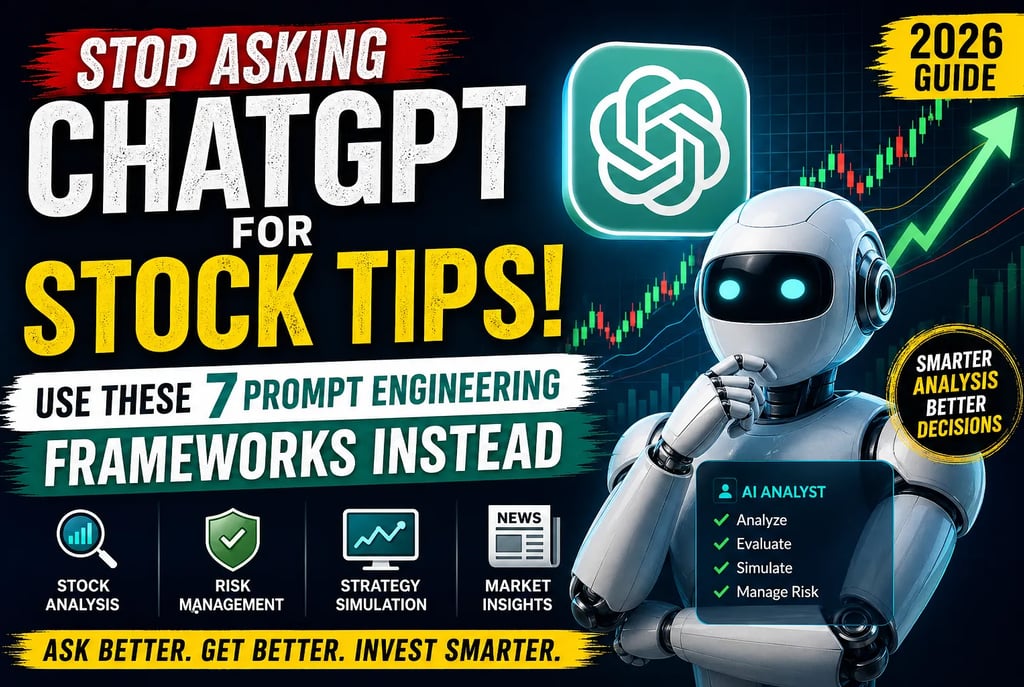
Stop Asking ChatGPT for Stock Tips: 7 Prompt Engineering Frameworks That Actually Work (2026 Guide)
If you’re still asking ChatGPT:
“Which stock should I buy today?”
You’re using one of the most powerful AI tools in the world in the weakest possible way.
The real advantage in 2026 is not information.
It’s the ability to extract structured intelligence from information.
That’s where prompt engineering changes everything.
Why Most AI Stock Advice Fails
Let’s be realistic.
Stock prices move because of:
Institutional money flow
Global news events
Economic data
Retail sentiment
Algorithmic trading systems
Interest rates and inflation
No AI tool can perfectly predict tomorrow’s market.
So when people ask:
❌ “Which stock will go up tomorrow?”
They are forcing AI into prediction mode.
But when they ask:
✅ “Analyze this company’s risks, strengths, valuation, and market position”
AI becomes extremely useful.
The goal is not prediction.
The goal is better decision-making.
The Shift: From Guessing → Structured Analysis
Most beginner traders:
Chase hype
Follow random stock tips
Trade emotionally
Ignore risk management
Professional investors do the opposite.
They:
Follow systems
Use frameworks
Think in probabilities
Focus on risk first
Prompt engineering helps beginners think more like professionals.
1. Fundamental Analysis Prompt Framework
Long-term investors should focus on business quality instead of daily price movement.
Prompt
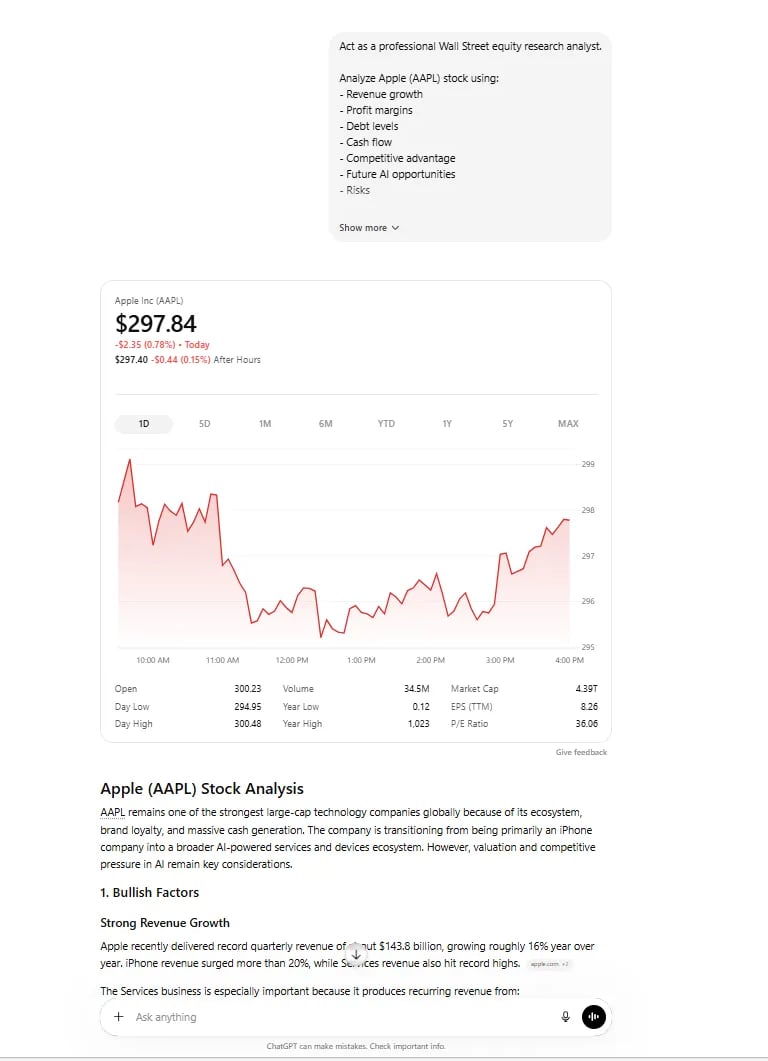
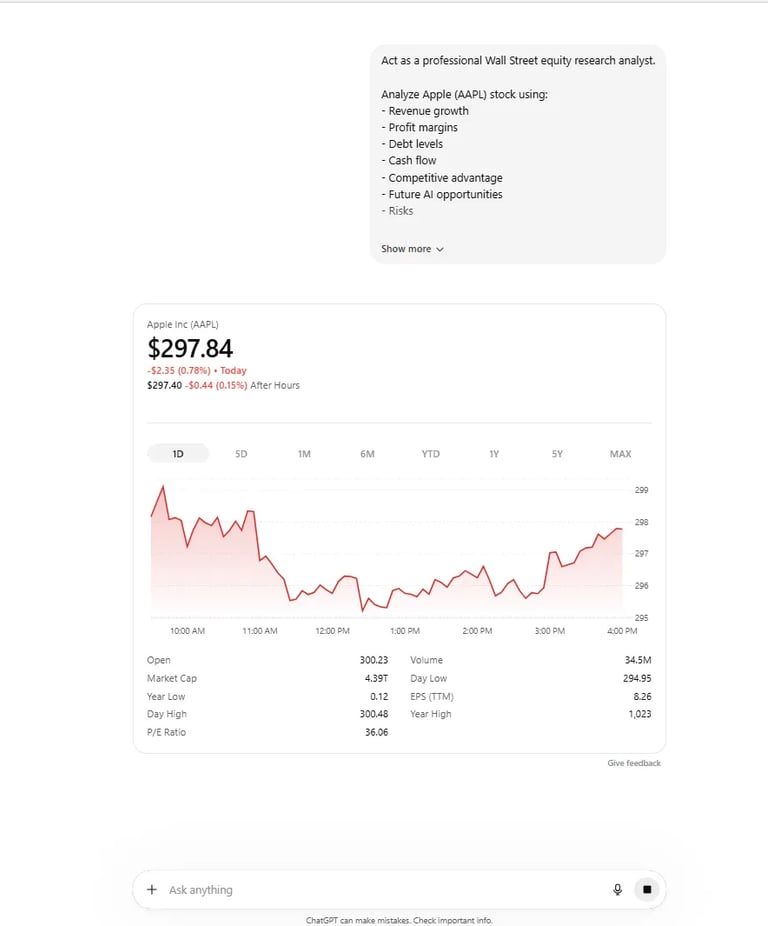
Act as a professional Wall Street equity research analyst.
Analyze Apple (AAPL) stock using:
- Revenue growth
- Profit margins
- Debt levels
- Cash flow
- Competitive advantage
- Future AI opportunities
- Risks
Format the output with:
1. Bullish Factors
2. Bearish Factors
3. Financial Health Score
4. Long-Term Outlook
5. Final Verdict
Keep the analysis beginner-friendly but professional.
Why This Prompt Works
Instead of asking for stock predictions, this framework forces AI to analyze:
Business strength
Financial stability
Competitive moat
Future opportunities
Risks
This creates structured investment thinking.
2. Technical Analysis Prompt Framework
Technical traders need scenario-based analysis instead of emotional trading decisions.
Prompt
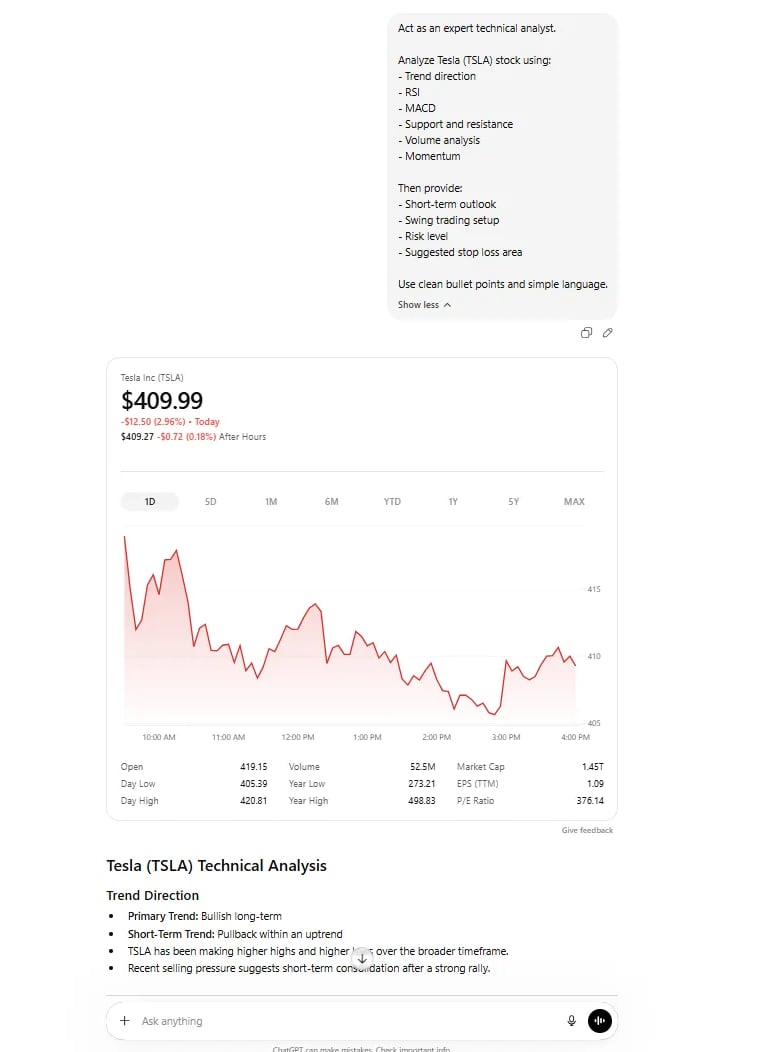
Act as an expert technical analyst.
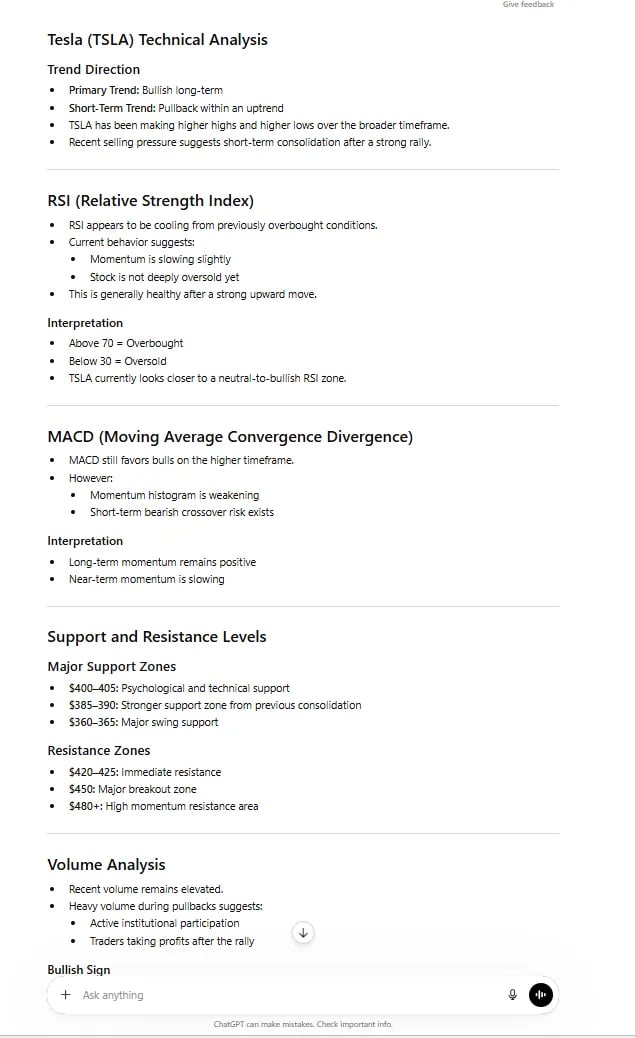
Analyze Tesla (TSLA) stock using:
- Trend direction
- RSI
- MACD
- Support and resistance
- Volume analysis
- Momentum
Then provide:
- Short-term outlook
- Swing trading setup
- Risk level
- Suggested stop loss area
Use clean bullet points and simple language.
Why This Prompt Works
This framework teaches traders to think in probabilities.
Instead of:
❌ “Will Tesla go up tomorrow?”
You get:
✅ Support zones
✅ Resistance levels
✅ Risk scenarios
✅ Momentum analysis
That’s how professional traders operate.
3. AI Stock Comparison Framework
One of the best uses of ChatGPT is comparing companies side by side.
Prompt
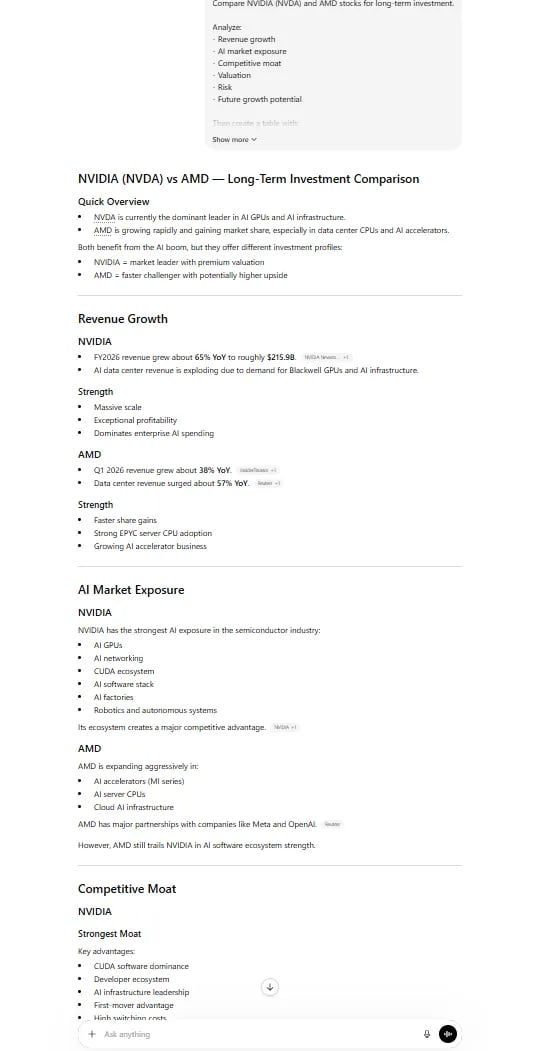
Compare NVIDIA (NVDA) and AMD stocks for long-term investment.
Analyze:
- Revenue growth
- AI market exposure
- Competitive moat
- Valuation
- Risk
- Future growth potential
Then create a table with:
- Better Growth Stock
- Safer Investment
- Better AI Opportunity
- Better Long-Term Buy
Keep it concise and visually clean.
Why This Prompt Works
AI comparison prompts help investors:
Reduce emotional bias
Compare companies objectively
Understand valuation differences
Evaluate growth potential faster
This is significantly better than watching random YouTube stock videos.
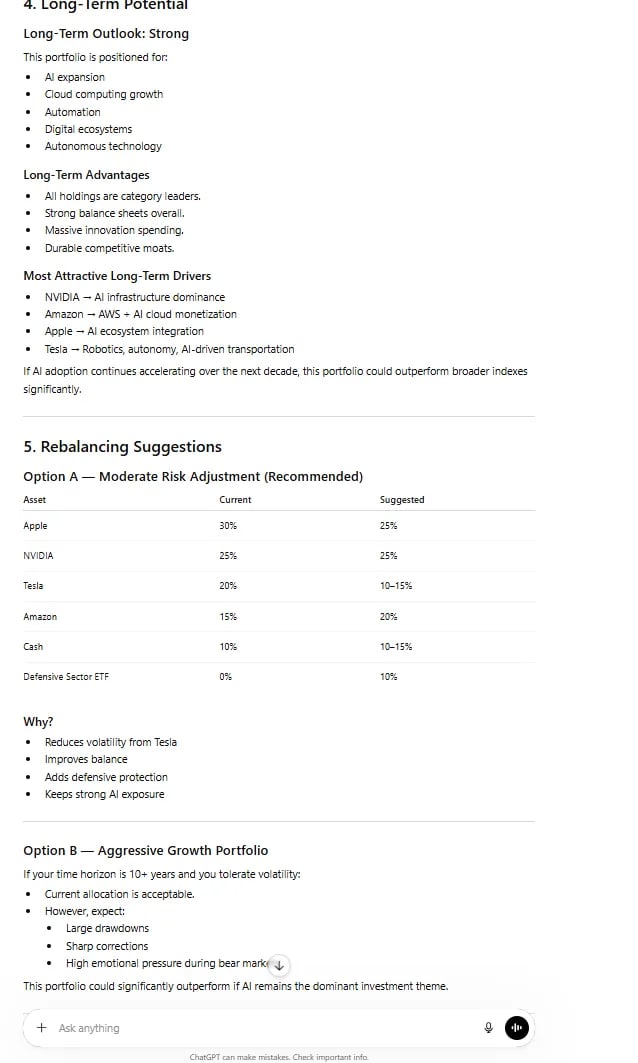
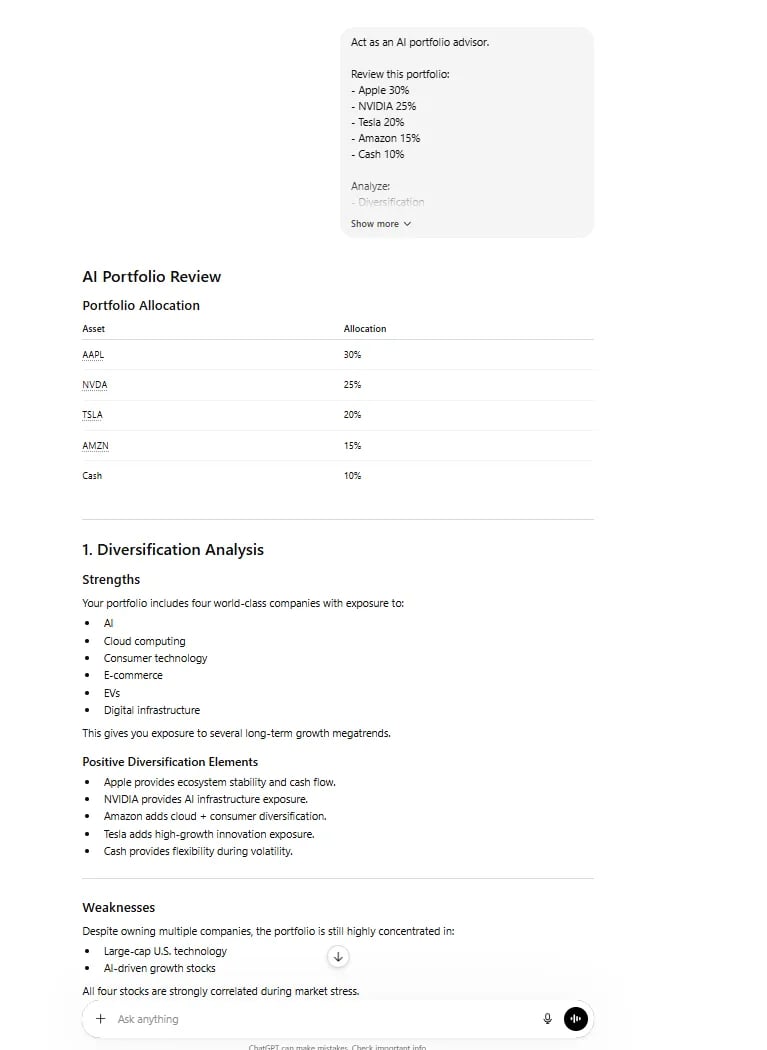
4. Portfolio Review Framework
Most traders focus too much on entries and not enough on portfolio structure.
This is a huge mistake.
Prompt
Act as an AI portfolio advisor.
Review this portfolio:
- Apple 30%
- NVIDIA 25%
- Tesla 20%
- Amazon 15%
- Cash 10%
Analyze:
- Diversification
- Risk exposure
- Sector concentration
- Long-term potential
- Rebalancing suggestions
Provide a professional investment-style summary.
Why This Prompt Works
This framework improves:
Portfolio balance
Risk management
Diversification
Long-term planning
Most beginners never analyze their portfolio structure properly.
AI can help identify concentration risk quickly.
5. Warren Buffett Style Investing Framework
Value investors can use AI to study businesses through long-term investing principles.
Prompt
Analyze Coca-Cola (KO) stock using Warren Buffett style investing principles.
Focus on:
- Brand moat
- Consistent earnings
- Dividend history
- Long-term stability
- Competitive advantage
- Economic resilience
Then provide:
- Buffett-style rating
- Long-term investment score
- Key risks
- Final verdict
Why This Prompt Works
This framework focuses on:
Durable businesses
Long-term stability
Predictable earnings
Competitive advantages
Instead of chasing hype stocks, investors learn how to evaluate business quality.
6. Risk Management Framework (Most Important)
Most traders lose money because they ignore risk.
Not because they choose bad stocks.
Use AI to improve decision discipline.
Prompt
Act as a professional risk management advisor.
Create a trading risk plan with:
- Position sizing rules
- Daily loss limits
- Risk-to-reward ratio
- Stop-loss strategy
- Portfolio exposure limits
Assume:
- Moderate risk trader
- Swing trading style
- Long-term capital preservation focus
Use simple and practical language.
7. Daily Market Intelligence Framework
Consistency matters more than occasional lucky trades.
Use ChatGPT as a daily market research assistant.
Prompt
Act as a daily stock market analyst.
Summarize today's market including:
- Index performance
- Sector strength
- Key risks
- Major news events
- Trading opportunities
- Market sentiment
Format the report for beginner investors.
Can ChatGPT Really Analyze Stocks?
Yes — but with limitations.
ChatGPT is excellent for:
Research
Summaries
Scenario analysis
Risk evaluation
Learning investing concepts
But it should NOT replace:
Personal research
Financial advisors
Risk management
Independent thinking
AI is an assistant.
Not a guaranteed money machine.
Common Mistakes People Make
Even with great prompts, many people still fail because they:
Ask prediction-based questions
Ignore risk management
Blindly trust AI outputs
Trade emotionally
Jump between strategies constantly
The best traders focus on consistency and discipline.
The Master Prompt Formula
Almost every high-quality investing prompt follows this structure:
Role: [Expert Role]
Context: [Market + Experience Level]
Task: [What You Want Analyzed]
Constraints: [Rules or Conditions]
Output: [Preferred Format]
This single structure dramatically improves AI output quality.
Why Structured Prompts Beat Random Questions
The difference is not AI.
The difference is how you ask.
Final Verdict
If you use ChatGPT like this:
❌ “Give me stock tips.”
You stay average.
But if you use it like this:
✅ Analyze
✅ Evaluate
✅ Compare
✅ Simulate
✅ Manage risk
You start thinking like a professional investor.
That’s the real edge in 2026.
FAQs
What is the best way to use ChatGPT for stock analysis?
Use structured prompts with defined roles, context, and output formatting instead of prediction-style questions.
Can ChatGPT help with Indian stocks?
Yes. You can add NSE/BSE context inside prompts for more relevant analysis.
Is AI reliable for trading decisions?
AI is useful for research and structured thinking, but final investment decisions should always involve human judgment.
Can beginners use these prompts?
Absolutely. These prompts simplify complex investing concepts into easy-to-understand analysis.
Disclaimer
This content is for educational purposes only and should not be considered financial advice. Always conduct your own research before making investment decisions.
Related Articles You May Like
👉 How I Automated Blog and Digital Product Promotion Using Make.com and Groq AI
Learn how AI automation workflows can save hours of manual work for creators, bloggers, and digital product sellers.
👉 How I Started Selling AI Digital Products in 2026
A beginner-friendly guide explaining how AI tools can help create and sell digital products online.
👉 Google Flow AI Review 2026
Explore how Google Flow AI works, its best features, practical use cases, and whether it’s worth using in 2026.
👉 Digen AI Review 2026: Advanced Workflow Testing
Detailed review of Digen AI workflows, automation capabilities, and real-world productivity testing.
👉 Gemini AI Daily Tasks Guide 2026
See how Gemini AI can help automate research, planning, content creation, and daily productivity tasks.
👉 AI Second Brain Guide 2026: Tools, Workflow Examples and Setup
Build a complete AI-powered workflow system for productivity, research, organization, and business.
👉 Explore more at:
Simplified AI Hub