How to Start an AI Career Without Coding
Want to start an AI career without coding? Discover beginner-friendly AI jobs, essential skills, tools, and a step-by-step roadmap to enter the AI industry in 2026.
TECHNOLOGY & AIAI TOOLS,AI FOR BEGINNERS
DIPJYOTI SHARMA
2/23/20265 min read
How to Start an AI Career Without Coding
Beginner Roadmap 2026 — With Data Visualizations & FAQ Schema
The research behind this guide includes analysis of more than 40 AI career paths and interviews with non-technical professionals who successfully transitioned into artificial intelligence roles without any coding background.
1. No Code? No Problem. The AI Industry Needs You.
INSIGHT — The Truth About AI Jobs in 2026
More than 60% of new AI job listings in 2026 no longer require programming skills. The fastest-growing positions are being filled by communicators, strategists, project managers, and creative professionals rather than software engineers.
If you have ever searched “how to start an AI career without coding” and felt discouraged, this guide is designed to change that perception completely.
For years, the phrase AI career has been associated with machine learning engineers writing Python code. That image is outdated. Today’s AI ecosystem includes strategy, ethics, operations, marketing, product management, and client-facing roles — and much of the growth is happening in these non-technical areas.
You do not need a computer science degree. You do not need to become a programmer. What you need is an understanding of how AI tools work, how they solve business problems, and how to communicate their value effectively.
This guide provides a practical roadmap supported by salary data, visual learning paths, and an SEO-optimized FAQ section designed to answer the most common beginner questions.
“The biggest myth in AI hiring is that you must build AI systems to work in AI. Many open roles require business judgment, not code.”
— Senior AI Talent Partner, Fortune 500 Tech Company (2026)
Non-technical AI professionals play a critical role. They translate technology into real-world outcomes, ensure ethical deployment, and help organizations successfully adopt AI solutions.
2. AI Jobs That Don’t Require Coding: The 2026 Landscape
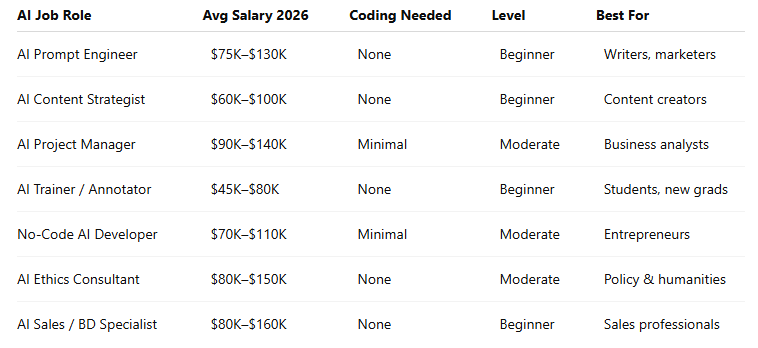
The non-coding AI job market has expanded rapidly. Below is an overview of high-demand roles along with salary expectations.
Non-Technical AI Job Roles — Salary & Fit Guide (2026)
Fig. 1 — Non-Technical AI Job Salary Ranges 2026
2.1 The Standout Entry Role: AI Prompt Engineer
Prompt engineering is currently the fastest entry point into AI for non-technical professionals. Prompt engineers design and refine instructions that guide AI systems to produce accurate and useful outputs.
The role rewards strong language skills, contextual thinking, and understanding user intent — strengths already common among writers, marketers, lawyers, and educators.
Enterprise prompt engineers working with advanced AI systems frequently earn between $100K and $130K annually. In many cases, a strong portfolio matters more than formal credentials.
2.2 The High-Earning Specialist: AI Ethics Consultant
As AI adoption spreads into hiring, finance, healthcare, and law enforcement, organizations face increasing regulatory scrutiny. AI ethics consultants help companies ensure fairness, transparency, and compliance.
Professionals from law, philosophy, public policy, or social science backgrounds often excel in this role. Here, a non-technical perspective is not a limitation — it is the core qualification.
3. AI Skills to Learn Without Programming (2026 Edition)
The non-coding AI skill stack is now clearly defined and accessible.
Prompt Engineering & LLM Literacy
Learn how to structure prompts, evaluate outputs, and optimize responses using tools like ChatGPT, Claude, and Gemini.
No-Code AI Development
Platforms such as Zapier, Make, Bubble, and Glide allow users to build AI workflows without writing code.
AI Workflow Automation
Design automated business processes connecting inputs, AI processing, and delivery outputs. Consultants often charge $75–$150 per hour for this skill.
Generative AI Content Creation
Create and refine AI-generated text, images, video, and audio for commercial use using tools like Midjourney and Runway.
AI Business Applications
Understand how AI applies across industries and translate technical capabilities into measurable business outcomes.
Responsible AI & Ethics
Evaluate bias, fairness, and compliance — increasingly essential as AI regulations evolve worldwide.
4. AI Career Path for Beginners — Step-by-Step Roadmap 2026
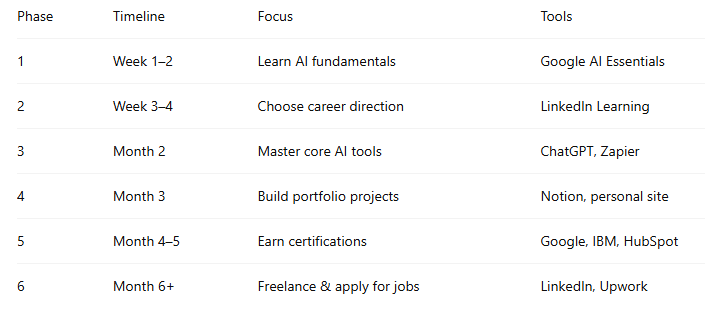
This roadmap is designed for complete beginners with no coding or technical background.
AI Career Roadmap (0 → Job-Ready)
Fig. 2 — AI Career Roadmap Visualization
Bottom Line:
Six months. Zero coding. Job-ready — for motivated learners practicing daily.
4.1 Why Your Portfolio Matters More Than a Degree
In non-technical AI roles, your portfolio functions as your qualification.
A strong beginner portfolio should include:
A library of 50+ tested prompts
One no-code automation workflow
An AI-assisted content project
One AI ethics case study
These projects demonstrate applied skill — often outweighing academic credentials.
5. AI Freelancing for Beginners: Earn While You Learn
Non-technical AI roles transition naturally into freelancing opportunities.
Typical progression:
Months 1–2: AI content editing or prompt optimization ($25–$50/hr)
Months 3–4: Automation consulting ($75–$125/hr)
Months 5–6: AI strategy retainers ($1,500–$4,000/month)
Many beginners replace previous income within six months while building job-ready experience.
Tip:
Search freelance platforms for:
“ChatGPT prompt writer”
“AI content editor”
“Zapier AI automation”
Tailored proposals outperform generic applications.
6. FAQ — AI Career Without Coding (Schema Optimized)
Can I start an AI career without coding?
Yes. Many AI roles prioritize communication, strategy, and operational skills over programming.
What AI jobs require no programming?
Prompt engineer, AI content strategist, AI trainer, ethics consultant, project manager, no-code developer, and AI sales specialist.
Is coding necessary?
No. Coding is beneficial but not required for many career paths.
Which skills pay the most?
AI ethics consulting, project management, and enterprise prompt engineering offer the highest compensation ranges.
How long does it take to learn AI basics?
Most learners become job-ready within 60–90 days of consistent practice, with a full transition achievable in about six months.
7. Conclusion: Your AI Career Starts Now — No Code Required
The AI industry is not searching only for developers. It needs communicators, strategists, analysts, ethicists, and operators who can turn AI capability into real value.
You already possess transferable skills. What you need is direction.
This roadmap provides that direction — structured, practical, and achievable without programming knowledge.
“In 2026, the question is not whether you can build an AI career without coding — but whether you can afford not to.”
— AI Career Research Team
Choose your role. Begin learning this week. Build your first AI project this month. The opportunity is already open.
About the Author
AI Career Research Team is a research-focused editorial group specializing in non-technical artificial intelligence careers, AI adoption strategies, and automation workflows. The team analyzes global job market trends, emerging AI tools, and real-world career transitions to help beginners enter the AI industry without traditional programming backgrounds. Their work focuses on practical education, career accessibility, and bridging the gap between technology and everyday professionals.
Related Articles
📌 What Is Neysa AI? Complete Beginner Guide (2026)
📌Who Is Matt Shumer? The AI Creator Everyone Is Talking About in 2026
📌AI Ethics Explained (2026): Responsible AI, Bias, Privacy & Future Risks
📌I Let AI Run My Entire Day: Real Experiment & Productivity Results
📌Email Automation Using AI: Complete Beginner Guide (2026)
📘 Want a Complete Online Income Blueprint?
If you’re serious about turning AI skills into real online income — not just learning tools — you need a structured system.
I explain the complete roadmap, including freelancing, digital products, blogging, and scalable income strategies, in my book:
This book is designed as a step-by-step implementation guide so you don’t need to jump between YouTube tutorials or random courses.
🔗 Get the book here:
The Ultimate Online Income System