The 2026 Master Guide: Scaling the Orchestrator Economy
The Orchestrator Economy: How AI Architects Will Make Money in 2026
TECHNOLOGY & AIONLINE EARNING & AI TOOLS
DIPJYOTI SHARMA
2/28/20262 min read
The 2026 Master Guide: Scaling the Orchestrator Economy
The AI revolution has reached its maturity phase. In 2024, we talked about prompts; in 2025, we talked about tools. By 2026, the wealth gap is defined by the "Orchestrator Economy." > The Data Anchor: According to industry projections, the global AI services market is set to exceed $1.5 trillion by the end of 2026, with 70% of enterprise workflows expected to integrate autonomous agents by 2027.
Businesses no longer hire "AI Writers"—those tasks have been commoditized. Today, high-ticket revenue belongs to the AI Architects who design the Autonomous Business Layer.
The Signature Concept: "The Agent Stack Model"
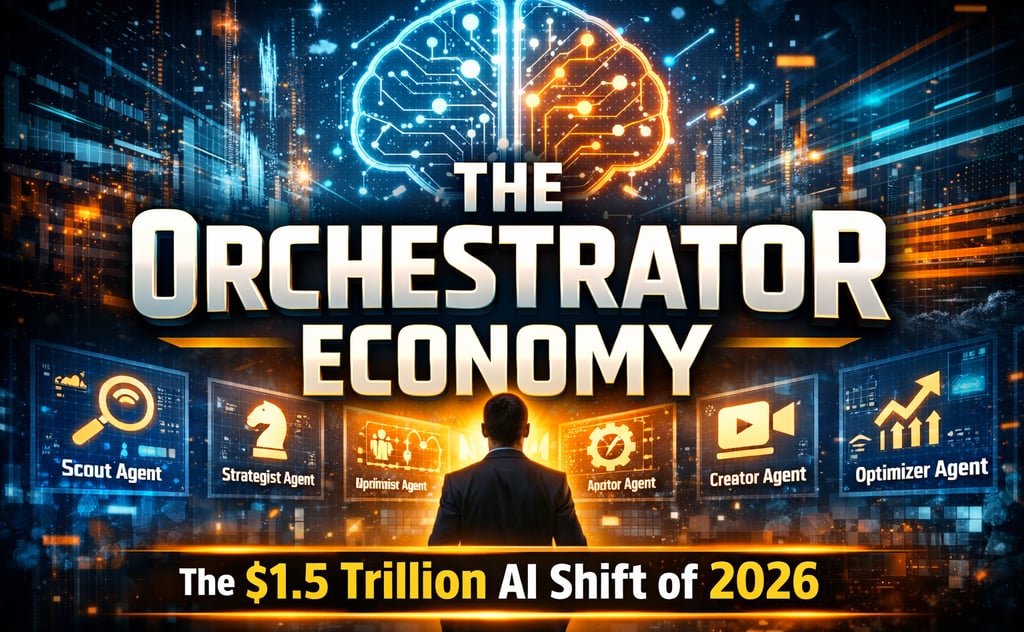
In 2026, the most profitable online businesses are built on the Agent Stack. Instead of a "Marketing Department," an Architect builds a stack of digital workers:
The Scout Agent: Constant market/competitor research.
The Strategist Agent: Analyzes data and sets the weekly "angle."
The Creator Agent: Produces high-fidelity video, text, and audio.
The Optimizer Agent: Real-time Generative Engine Optimization (GEO) to ensure the brand ranks in AI search results (Perplexity, SearchGPT).
The Proprietary Method: The 5-Step Agent Deployment Method™
To charge enterprise rates, you must follow a repeatable process. This is the framework used by top-tier AI agencies:
Task Decomposition: Breaking a complex business goal into 5–10 micro-tasks.
Agent Role Definition: Assigning a specific LLM and persona to each task (e.g., "The Fact-Checker," "The Creative Lead").
Workflow Orchestration: Connecting agents via middleware like CrewAI or LangGraph.
HITL Validation: Implementing Human-in-the-Loop checkpoints for quality and ethics.
Continuous Optimization: Monitoring the "swarm" and updating the model logic based on real-world ROI.
The 2026 Monetization Roadmap
Frequently Asked Questions
Q: Is "Prompt Engineering" still a real job? A: No. In 2026, it is a baseline skill. Companies hire AI Architects who build "Systems" that generate the prompts automatically.
Q: How do I build AI agents without coding? A: Tools like Zapier Central and MindStudio allow you to build complex agents using natural language and logic blocks. Logic Mapping is the new coding.
The Strategic Outlook: Positioning for the Decade
The winners of the AI decade will not be those who use AI the fastest, but those who design the systems that others depend on. By 2026, the goal is no longer to "work with AI"—it is to own the automated decision systems that drive the global economy.
The future belongs to the Architect. Are you ready to stop prompting and start building?
Related Articles
📌 What Is Neysa AI? Complete Beginner Guide (2026)
📌Who Is Matt Shumer? The AI Creator Everyone Is Talking About in 2026
📌AI Ethics Explained (2026): Responsible AI, Bias, Privacy & Future Risks
📌I Let AI Run My Entire Day: Real Experiment & Productivity Results
📌Email Automation Using AI: Complete Beginner Guide (2026)
📌I Let AI Run My Entire Day: Real Experiment & Productivity Results | AI Simplified Hub
📌JULIUS AI REVIEW 2026 Can This AI Actually Replace Excel for Data Analysis? | AI Simplified Hub
📌How to Start an AI Career Without Coding | AI Simplified Hub
📌How to Start a Website Designer Career Using AI in 2026 (Beginner to Pro Guide) | AI Simplified Hub