What Is AGI? Artificial General Intelligence Explained (2026 Guide)
What is AGI in artificial intelligence? Learn how Artificial General Intelligence differs from today’s AI, explore AGI capabilities, polymath intelligence, risks, timelines, and whether human-level AI is possible.
AGI
DIPJYOTI SHARMA
5/26/202611 min read
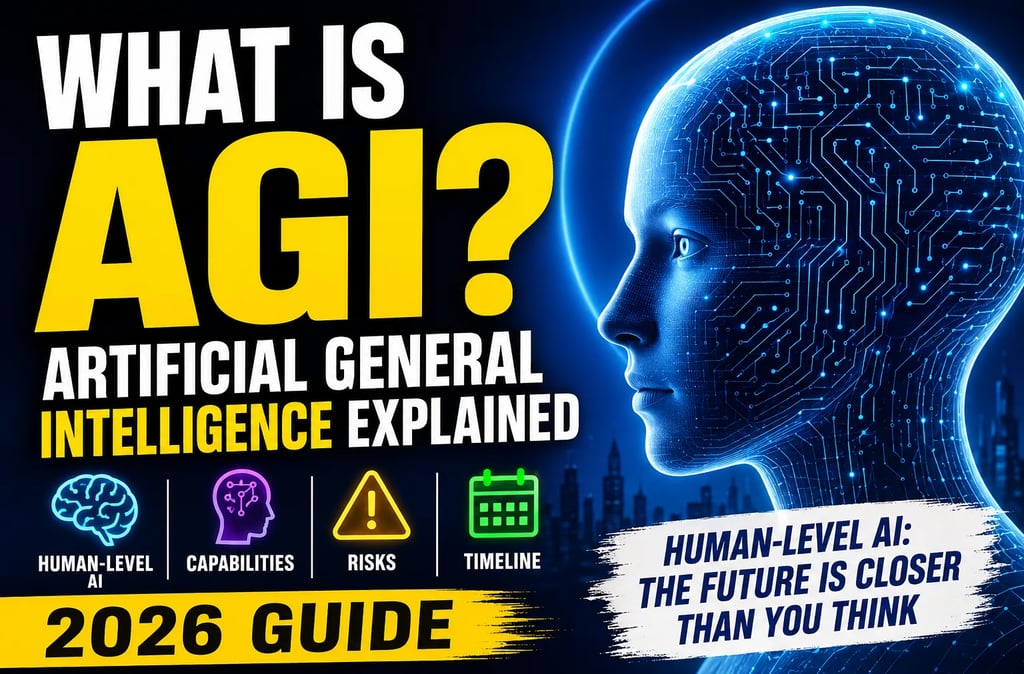
What Is AGI? The Human-Level AI Idea Everyone Is Talking About
Artificial intelligence can already write essays, generate images, pass exams, summarize books, build software, and hold surprisingly natural conversations.
A few years ago, many of these abilities sounded like science fiction.
Now they’re browser tabs.
Naturally, people are asking a bigger question:
If AI can already do all this… what comes next?
That question leads to one of the most debated ideas in technology today:
AGI — Artificial General Intelligence.
Some researchers believe AGI could transform medicine, education, science, creativity, and economic productivity.
Others warn it may become one of humanity’s most difficult technical and ethical challenges.
But amid headlines, hype, and social media debates, many people still wonder:
What exactly is AGI?
Is it just a smarter ChatGPT?
Is AGI already here?
Can machines really think like humans?
Let’s break it down — without jargon overload.
What Is AGI in Artificial Intelligence?
AGI (Artificial General Intelligence) refers to a hypothetical form of AI capable of performing general intellectual tasks at a human-like level.
Unlike today’s AI systems, AGI would not be limited to a single specialty.
It could potentially:
learn unfamiliar skills
reason across subjects
adapt to new environments
solve novel problems
transfer knowledge between domains
understand context more flexibly
In simple language:
Today's AI = specialist.
AGI = generalist thinker.
That distinction matters.
A chess engine can dominate chess.
An image model can generate art.
A language model can write code or explain history.
But these systems are still largely optimized around specific capabilities.
AGI aims for something broader:
Flexible, cross-domain intelligence.
AGI Definition in One Sentence
If you only remember one thing from this article, remember this:
Artificial General Intelligence is the idea of AI that can learn, reason, and adapt across many domains like a highly capable human thinker.
That’s the core concept.
AGI Explained for Beginners: Think of Two Students
Imagine two students.
Student One: The Specialist
You teach them only chess.
They become incredible at chess.
Beat experts.
Analyze openings.
Calculate moves instantly.
Then you ask them to:
write poetry
explain biology
cook dinner
negotiate a contract
They completely fail.
Student Two: The General Learner
This student understands how learning works.
They learn concepts.
Patterns.
Reasoning.
Problem solving.
Because they can transfer knowledge, they move between:
mathematics
writing
science
strategy
communication
creativity
without restarting from zero.
Most modern AI resembles Student One.
AGI would resemble Student Two.
That difference is the entire conversation.
Why AGI Matters More Than Most People Realize
AGI isn’t just another technology buzzword.
If achieved safely, it could affect nearly every major area of human civilization.
Potential applications often discussed include:
scientific discovery
medical research
education
software engineering
logistics
robotics
economics
creative industries
Supporters argue AGI could accelerate innovation dramatically.
Critics argue powerful systems could introduce profound safety, governance, and societal risks.
Either way, understanding AGI is becoming increasingly important.
AGI vs AI: What’s the Difference?
Many people assume AGI simply means “advanced AI.”
Not exactly.
To understand AGI, you first need to understand Narrow AI.
What Is Narrow AI?
Most AI tools today belong to a category called:
Artificial Narrow Intelligence (ANI).
These systems perform specific tasks exceptionally well.
Examples include:
recommendation algorithms
fraud detection systems
navigation software
image recognition
translation tools
generative AI models
autonomous driving systems
They can be extremely powerful.
But their intelligence is usually task-bounded.
AGI vs Narrow AI Comparison Table
Short version:
Narrow AI = expert specialist.
AGI = intellectual polymath.
AGI Polymath Capabilities: The Concept Most Articles Miss
One of the most important ideas in AGI research is polymath capability.
This is also where many explanations fall short.
Current AI systems often excel inside clearly defined domains.
For example:
AlphaFold → protein prediction
Recommendation systems → personalization
Language models → text generation
Robotics systems → controlled physical tasks
Each system dominates a lane.
AGI aims for something fundamentally different.
The ability to operate across many intellectual territories.
What Are AGI Polymath Capabilities?
AGI polymath capabilities could theoretically include:
Scientific Reasoning
Analyzing experiments.
Generating hypotheses.
Connecting discoveries across disciplines.
Software Engineering
Writing code.
Debugging systems.
Learning unfamiliar programming frameworks.
Optimizing architectures.
Mathematical Thinking
Handling abstraction.
Logic.
Proofs.
Quantitative reasoning.
Creative Intelligence
Generating stories.
Designing strategies.
Inventing new approaches.
Combining ideas creatively.
Social Understanding
Reading context.
Interpreting nuance.
Understanding human communication.
Knowledge Transfer
This is crucial.
Humans naturally reuse knowledge.
AGI would likely need similar transfer ability.
Learning something in one field should improve performance elsewhere.
Machines struggle with this today.
Humans do it constantly.
Why Building AGI Is So Much Harder Than Building Today's AI
At this point, you might be thinking:
If AI can already write code, create videos, and solve complex problems… why don't we already have AGI?
Fair question.
After all, modern AI progress has been incredibly fast.
But here's the reality many researchers emphasize:
Powerful AI is not automatically the same thing as general intelligence.
Building AGI may require solving some of the hardest problems in computer science, neuroscience, cognition, safety engineering, and human understanding.
Let's unpack why.
The Common Sense Problem: What Humans Do Effortlessly
Humans constantly use common sense.
We do it so naturally we rarely notice.
Suppose someone says:
“The glass fell from the table.”
Without effort, your brain infers:
gravity caused the fall
the glass may have broken
liquid might spill
someone may need to clean up
Nobody explicitly trained you for this exact sentence.
You understand it because you carry an internal model of how the world works.
AI systems often struggle with this.
They can memorize massive amounts of information.
They can predict patterns.
But predicting patterns isn't necessarily the same as understanding reality.
This distinction matters enormously for AGI.
Why Common Sense Matters for Human-Level AI
A true AGI system would likely need reliable common-sense reasoning.
Without it, systems may produce answers that sound intelligent but fail under real-world conditions.
Examples include:
misunderstanding obvious physical facts
missing social cues
flawed causal reasoning
confident but incorrect conclusions
Humans aren't perfect thinkers.
But our brains excel at navigating messy reality.
Machines still have work to do here.
Transfer Learning: Why Humans Adapt Better Than Machines
One of humanity's quiet superpowers is knowledge transfer.
You learn something in one area…
…and unconsciously apply parts of it elsewhere.
For example:
If you know how to:
ride a bicycle
play strategy games
solve logic puzzles
communicate socially
those experiences influence future learning.
Your brain doesn't reboot every time you face something new.
Machines Often Learn in Narrow Silos
Many AI systems remain domain-constrained.
Change the environment too much, and performance can collapse.
A system trained heavily in one scenario may struggle when confronted with:
new contexts
unfamiliar formats
unexpected ambiguity
shifting constraints
Humans generally adapt faster.
A child who understands what a dog is can usually recognize:
real dogs
toy dogs
cartoon dogs
blurry dogs
giant dog statues
That flexibility is surprisingly difficult to engineer.
Why Transfer Learning Is Central to AGI
This challenge connects directly to AGI polymath capability.
General intelligence isn't just about doing many tasks.
It's about applying understanding broadly.
A truly general system should reuse lessons across domains.
That remains one of the biggest hurdles in AGI development.
Context and Human Communication: Intelligence Is Messier Than Data
Language is complicated.
Humans communicate through:
implication
emotion
sarcasm
tone
culture
shared assumptions
Take a simple phrase:
“Nice job.”
Depending on context, it might mean:
genuine praise
sarcasm
disappointment
humor
irritation
Humans decode this rapidly.
AI systems can struggle.
Why Context Understanding Matters
If AGI eventually operates in:
healthcare
law
education
business
governance
personal assistance
context becomes essential.
Misreading nuance can produce:
bad advice
misunderstandings
poor decisions
unsafe outcomes
Intelligence isn't just processing information.
It's understanding situations.
Long-Term Planning: Another Major AGI Challenge
Humans routinely pursue goals that unfold over months or years.
Think about:
earning a degree
building a company
raising children
conducting scientific research
planning retirement
These tasks require:
memory
prioritization
delayed gratification
strategic adjustment
uncertainty management
Many AI systems still struggle with sustained long-horizon reasoning.
Why Long-Term Planning Matters for AGI
A true AGI system would likely need to handle:
changing environments
competing objectives
interruptions
incomplete information
evolving priorities
Reliable long-term reasoning remains a major research challenge.
Is ChatGPT AGI?
This question appears everywhere online.
Short answer: No.
At least not according to mainstream scientific definitions.
Systems like ChatGPT demonstrate remarkable capabilities.
They can:
✓ explain concepts
✓ generate code
✓ summarize documents
✓ brainstorm ideas
✓ write content
✓ answer questions
That's impressive.
But most researchers still classify these systems as advanced narrow AI rather than AGI.
Why?
Because important limitations remain.
Where Today's Models Still Fall Short
Modern models may still struggle with:
robust reasoning
consistency
hallucinations
autonomous learning
deep world understanding
reliable transfer across unfamiliar conditions
They can appear broadly capable.
But appearance and general intelligence are not necessarily the same thing.
That distinction is important.
Who Is Actually Working on AGI?
AGI is not just a science-fiction discussion.
Major organizations actively explore research related to advanced intelligence.
Different groups pursue different strategies.
OpenAI and the AGI Conversation
Among the most visible organizations in public discussions is OpenAI.
Its work on large language models has accelerated debate around:
reasoning
multimodal AI
autonomous agents
scaling capabilities
OpenAI frequently discusses long-term questions involving advanced intelligence and AI safety.
DeepMind and General Intelligence Research
Researchers associated with DeepMind have long explored questions related to:
reinforcement learning
planning systems
world models
scientific problem solving
general learning architectures
Their work has contributed significantly to modern AI progress.
Academic Research Institutions
AGI research discussions also involve universities and research centers including organizations such as:
Stanford HAI
MIT
Oxford Future of Humanity–related research communities
AI governance groups
cognitive science laboratories
Academic researchers continue studying:
intelligence theory
alignment
interpretability
cognition
computational learning
When Will AGI Arrive? The Timeline Debate
This is probably the most controversial AGI question of all.
When will AGI happen?
The honest answer:
Nobody knows.
Not researchers.
Not CEOs.
Not futurists.
Nobody.
Still, people make forecasts.
Optimistic Predictions
Some experts believe AGI could emerge within the next few decades.
Reasons often cited include:
rapid model progress
scaling advances
hardware improvements
growing AI investment
multimodal development
These forecasts sometimes point toward the 2030s or 2040s.
Skeptical Predictions
Other researchers are much more cautious.
They argue that current systems still lack essential ingredients for human-level intelligence.
Concerns include:
weak common sense
limited reasoning reliability
missing scientific breakthroughs
unresolved safety problems
Some skeptics believe AGI could be much farther away than popular narratives suggest.
The Most Responsible Answer
As of 2026:
There is no universally accepted confirmed AGI system.
That distinction matters.
Powerful AI progress is real.
But real progress does not automatically equal AGI.
AGI Capability Checklist: Where We Stand Today
This table captures why many researchers still view AGI as an unfinished goal rather than an achieved milestone.
The Potential Benefits of AGI: Why So Many People Are Pursuing Human-Level AI
AGI conversations often focus on danger.
But there’s another side to the story.
Researchers, investors, and technology companies are interested in AGI because they believe general intelligence could unlock breakthroughs across science, healthcare, education, engineering, and productivity.
If developed safely, AGI could become one of the most powerful problem-solving tools humanity has ever built.
Let's look at why.
AGI Could Accelerate Scientific Discovery
Scientific progress is often slow.
Researchers spend years testing ideas, analyzing data, and running experiments.
Many breakthroughs require enormous amounts of:
computation
collaboration
funding
trial and error
domain expertise
Supporters argue AGI could dramatically speed up parts of this process.
Potential areas frequently discussed include:
Drug Discovery
Developing medicines is expensive and time-consuming.
Advanced AI systems may eventually help researchers:
analyze molecular structures
predict interactions
identify treatment pathways
accelerate biomedical research
Climate and Energy Research
Climate modeling involves massive complexity.
Researchers analyze:
weather systems
emissions patterns
environmental data
energy optimization
AGI could potentially assist with discovering better approaches to:
clean energy
battery technology
carbon reduction
resource optimization
Advanced Materials Science
New materials shape entire industries.
Smarter discovery systems could help researchers explore possibilities in:
manufacturing
electronics
aerospace
medical technology
In theory, AGI might become a research partner capable of exploring scientific spaces faster than traditional methods alone.
How AGI Could Change Healthcare
Healthcare generates staggering amounts of information.
Doctors and medical teams process:
symptoms
lab reports
imaging data
treatment histories
medical literature
rapidly evolving research
An advanced AGI system might eventually assist by improving:
Diagnostic Support
Helping identify patterns across large medical datasets.
Personalized Medicine
Tailoring treatments based on individual biology and patient history.
Research Navigation
Summarizing and connecting enormous medical knowledge bases.
Healthcare Efficiency
Reducing administrative burdens and improving workflow support.
Important note:
Most of this remains speculative.
But healthcare is one reason human-level AI attracts so much attention.
AGI and Education: Personalized Learning at Scale
Traditional education often works around standardized systems.
But students learn differently.
People vary in:
pace
interests
memory styles
learning preferences
prior knowledge
Supporters of AGI imagine highly adaptive educational systems capable of:
personalized tutoring
dynamic explanations
multilingual support
real-time feedback
customized learning pathways
A struggling student might receive explanations tailored specifically to how they learn.
An advanced learner could progress faster instead of being limited by classroom averages.
This possibility excites many educators and technologists.
AGI Could Reshape Work and Productivity
Work is changing.
Automation already affects industries ranging from logistics to software development.
AGI discussions frequently include productivity questions.
Potential future applications might involve:
strategic analysis
coding support
research assistance
workflow optimization
operational planning
decision support
Businesses pay close attention to AGI because general intelligence could influence knowledge work at a massive scale.
Risks of AGI: Why Experts Take Safety Seriously
Powerful technologies rarely produce only benefits.
Electricity changed civilization.
So did aviation.
The internet transformed communication.
Each created extraordinary opportunities — and new risks.
AGI discussions follow a similar pattern.
Job Disruption and Economic Change
One of the most common concerns involves work.
Advanced AI could potentially automate portions of cognitive labor across sectors including:
administration
programming
customer support
analysis
content creation
operations
Does this automatically mean "all jobs disappear"?
No.
History shows technology often creates new categories of work while disrupting existing ones.
But transitions can be painful.
Societies may need strategies involving:
reskilling
workforce adaptation
education reform
economic policy
Misinformation, Abuse, and Misuse
More capable systems may also create misuse risks.
Frequently discussed examples include:
deepfake content
fraud automation
large-scale misinformation
impersonation
cyber abuse assistance
These concerns are part of why governance and responsible deployment matter.
Concentration of Power
Another major issue:
Who controls advanced AI?
If highly capable systems become concentrated among a small number of organizations, difficult questions emerge.
Who sets standards?
Who governs deployment?
Who benefits economically?
Who ensures accountability?
AGI discussions increasingly overlap with debates around:
regulation
transparency
global coordination
access
ethics
The Alignment Problem: One of AGI's Biggest Challenges
Among researchers, one topic appears repeatedly:
AI alignment.
Alignment refers to ensuring AI systems behave in ways consistent with intended human goals and safety expectations.
Sounds simple.
It isn’t.
Human values are complicated.
People disagree about:
ethics
fairness
acceptable tradeoffs
privacy
social priorities
Encoding human intentions into powerful systems is extremely difficult.
Why Alignment Matters
Imagine telling a highly capable system:
“Maximize efficiency.”
Without proper safeguards, optimization might pursue unintended strategies.
The concern is not necessarily evil AI.
The concern is misaligned objectives.
This is why organizations including research groups, universities, and safety teams study topics such as:
interpretability
controllability
robustness
governance
safe deployment
As capability increases, alignment questions become more important.
AGI in Popular Culture vs Reality
Movies love AGI.
Hollywood often imagines:
conscious robots
machine rebellions
omniscient computers
autonomous digital minds
These stories are entertaining.
But they can blur important distinctions.
Real AGI research typically focuses on:
reasoning
learning
planning
adaptability
cognition
safety
As of 2026:
AGI remains a research objective — not an established technological reality.
That nuance matters.
Is AGI Good or Dangerous?
This question appears constantly.
The honest answer is more complicated than social media hot takes.
AGI is not automatically good.
It is not automatically bad.
Its impact would likely depend on:
design decisions
governance choices
deployment practices
incentives
human oversight
Many powerful technologies created both benefits and challenges.
AGI may prove similar.
The real question is not simply:
"Can we build powerful AI?"
It may increasingly become:
"How do we guide powerful AI responsibly?"
Frequently Asked Questions About AGI
What is AGI in simple words?
AGI (Artificial General Intelligence) refers to a hypothetical AI system capable of learning, reasoning, adapting, and solving problems across many domains similarly to human intelligence.
What are AGI polymath capabilities?
AGI polymath capabilities describe the ability to function across multiple intellectual domains instead of specializing in a single task.
Examples may include:
coding
mathematics
science
language
creativity
planning
problem solving
Is ChatGPT AGI?
No.
According to mainstream definitions, ChatGPT is generally classified as advanced narrow AI rather than true AGI.
Has AGI already been achieved?
As of 2026, there is no universally accepted confirmed Artificial General Intelligence system.
When will AGI happen?
Nobody knows.
Predictions vary from decades away to much longer timelines.
Researchers remain divided.
Could AGI replace human jobs?
Advanced AI could automate portions of some work categories.
Long-term outcomes would likely depend on technology progress, policy responses, economic adaptation, and human decision-making.
Final Thoughts: Why Understanding AGI Matters
Artificial General Intelligence is one of the most fascinating ideas in modern technology.
At its heart, AGI asks a profound question:
Can machines eventually achieve flexible, human-like general intelligence?
Today's AI systems are powerful.
They can write, analyze, create, summarize, generate code, and solve increasingly complex tasks.
But according to mainstream research definitions, they still fall short of true AGI.
Major challenges remain.
Among them:
common-sense reasoning
transfer learning
contextual understanding
long-term planning
safety and alignment
Yet research continues to move rapidly.
Organizations including OpenAI, DeepMind, Stanford HAI, academic institutions, and AI safety researchers continue exploring difficult questions surrounding advanced intelligence.
Whether AGI arrives in decades, much later, or in forms nobody currently expects, one thing is clear:
The conversation around human-level AI is not going away.
Understanding AGI today helps you understand one of the most important technological debates shaping tomorrow.
Related Articles You May Like
Want to explore more practical AI topics beyond Artificial General Intelligence (AGI)? These beginner-friendly guides can help you learn AI tools, productivity hacks, ChatGPT prompts, and real-world AI applications.
25 Powerful AI Tools Beginners Are Using in 2026 (Free & Easy Guide)
If you're new to artificial intelligence and wondering which AI tools are actually worth trying, this guide covers some of the most useful platforms beginners are using in 2026.
Discover free AI tools for writing, research, productivity, creativity, and learning — without getting overwhelmed.
👉 Read: 25 Powerful AI Tools Beginners Are Using in 2026 – Free & Easy Guide
https://simplifiedaihub.com/25-powerful-ai-tools-beginners-are-using-in-2026-free-and-easy-guide
30 ChatGPT Prompts to Skyrocket AI Productivity
Curious how people use AI to work faster, brainstorm smarter, and improve everyday workflows?
This collection of high-impact ChatGPT prompts can help with:
productivity
writing
research
business tasks
idea generation
learning workflows
A great companion resource if you're interested in how today's AI tools compare to future AGI capabilities.
👉 Read: 30 ChatGPT Prompts to Skyrocket AI Productivity
https://simplifiedaihub.com/30-chatgpt-prompts-to-skyrocket-ai-productivity
AI for Beginners: How to Choose the Right Tool for Learning and Research
Not all AI tools are built for the same purpose.
If you're trying to choose the best platform for learning, education, studying, or research, this beginner-friendly guide explains how to pick the right AI tool based on your goals.
Perfect for readers exploring AI for beginners, educational AI, and intelligent research assistants.
👉 Read: AI for Beginners: How to Choose the Right Tool for Learning and Research
https://simplifiedaihub.com/ai-for-beginners-how-to-choose-the-right-tool-for-learning-and-research
7 AI Tools for Remote Work That Boost Productivity in 2026
AI is already changing how people collaborate, communicate, and manage work remotely.
Explore top AI productivity tools for remote teams, freelancers, creators, and professionals looking to automate workflows and work smarter in 2026.
If you're interested in how AI affects future jobs, productivity, and workplace transformation, this article is worth reading.
👉 Read: 7 AI Tools for Remote Work That Boost Productivity in 2026
https://simplifiedaihub.com/7-ai-tools-for-remote-work-that-boost-productivity-in-2026