AI vs Human Creativity: Can AI Really Replace Writers, Designers, and Artists? (2026 Guide)
Explore the debate between AI and human creativity. Can AI replace writers, designers, and artists? Discover the future of creativity in the AI era.
AI TOOLS
DIPJYOTI SHARMA
3/19/20264 min read
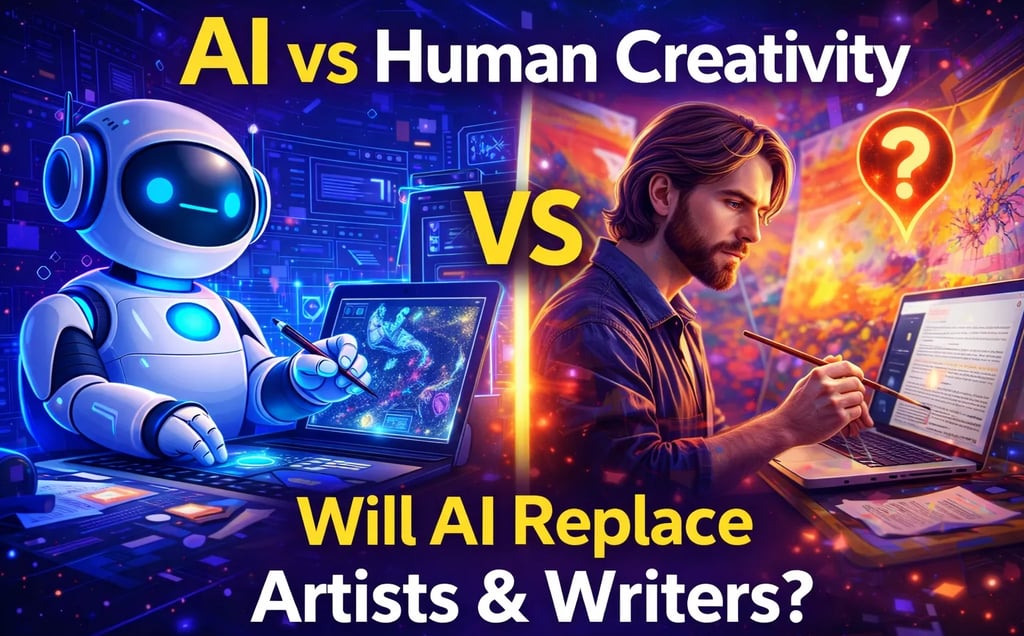
AI vs Human Creativity: Can AI Really Replace Writers, Designers, and Artists? (2026 Guide)
Artificial intelligence has dramatically transformed the creative industry. AI tools can now write articles, generate artwork, design websites, and even compose music. Platforms powered by advanced AI models are changing how creative work is produced.
But an important question remains:
Can AI truly replace human creativity?
Writers, designers, and artists around the world are debating whether artificial intelligence will become a competitor or simply a powerful creative assistant. In this article, we explore the differences between AI creativity and human creativity and what the future may look like.
Table of Contents
What Is AI Creativity
Major AI Systems Behind Creative Tools
AI vs Human Creativity
Can AI Replace Writers
Can AI Replace Designers and Artists
The Limitations of AI Creativity
Why Human Creativity Still Matters
The Future: AI and Human Collaboration
FAQs
What Is AI Creativity?
AI creativity refers to the ability of artificial intelligence systems to generate content such as:
blog articles
digital art
website designs
marketing copy
music compositions
These systems analyze massive datasets and generate new content based on patterns.
However, AI does not think creatively the way humans do. Instead, it predicts and recombines information learned from training data.
To get the best results from AI tools, many professionals learn prompt engineering, which teaches how to write effective instructions for AI models:
https://simplifiedaihub.com/prompt-engineering-the-ultimate-guide-to-writing-effective-ai-prompts-in-2026
Major AI Systems Behind Creative Tools
Many creative AI tools are powered by large AI models developed by major technology companies.
For example, Claude AI is known for its advanced reasoning and writing capabilities. It is widely used for generating articles, reports, and marketing content. You can explore its full features here:
https://simplifiedaihub.com/claude-ai-full-tutorial-2026-the-ultimate-beginner-to-advanced-guide-you-need-right-now
Another powerful AI system is Google Gemini, which supports productivity tasks, research, and content generation. This tutorial explains its advanced features and capabilities:
https://simplifiedaihub.com/gemini-ai-full-tutorial-2026-complete-beginner-to-pro-guide-advanced-features-explained
AI tools are also heavily influenced by OpenAI models, which power many writing and automation tools used by creators. This guide explains how these models work:
https://simplifiedaihub.com/openai-full-tutorial-2026-beginner-to-power-user-guide
For research tasks, professionals are increasingly using NotebookLM, an AI research assistant that analyzes documents and generates insights:
https://simplifiedaihub.com/notebooklm-complete-guide-2026-features-workflow-use-cases-and-how-to-use-googles-ai-research-assistant
Another emerging AI ecosystem is Yandex AI, which offers machine learning capabilities competing with other major AI platforms:
https://simplifiedaihub.com/yandex-ai-explained-features-tools-and-how-it-compares-to-chatgpt-2026
These systems form the foundation of many creative AI tools.
AI vs Human Creativity
Although AI can generate impressive outputs, its creative process is fundamentally different from human creativity.
AI excels at speed and efficiency, but human creativity involves emotion, culture, and personal experience.
Can AI Replace Writers?
AI writing tools can generate articles, marketing copy, product descriptions, and emails within seconds.
For example, tools designed for automated writing workflows can help generate professional communication. This AI email writing guide explains how AI can produce high-converting emails quickly:
https://simplifiedaihub.com/ai-email-writer-the-ultimate-2026-guide-to-writing-high-converting-emails-in-minutes
AI writing assistants are also becoming increasingly advanced. Platforms such as Grammarly now use AI to improve tone, clarity, and grammar automatically. This guide explains how the system works:
https://simplifiedaihub.com/how-grammarly-ai-works-in-2026-complete-beginner-guide-features-explained
Despite these capabilities, AI still struggles with storytelling, emotional expression, and deep cultural understanding.
Human writers bring perspective, creativity, and authenticity that machines cannot replicate.
Can AI Replace Designers and Artists?
AI image generators and design tools can create logos, illustrations, and marketing graphics in seconds.
These tools are transforming industries such as:
graphic design
marketing
digital art
product design
However, artistic creativity involves interpretation, emotion, and cultural expression.
Artists often draw inspiration from their experiences, beliefs, and surroundings. AI systems do not experience the world—they only analyze patterns from existing data.
Because of this, many experts believe AI will assist designers rather than replace them.
The Limitations of AI Creativity
Even though AI technology is advancing rapidly, it still has significant limitations.
Lack of emotion
Human creativity is often driven by emotion. AI systems do not feel emotions.
Lack of personal experience
Artists and writers rely on life experiences to inspire their work. AI has no personal experiences.
Limited originality
AI primarily recombines existing ideas rather than inventing completely new concepts.
Lack of cultural understanding
Human creativity often reflects culture, history, and social context.
These limitations mean AI still requires human guidance.
Why Human Creativity Still Matters
Human creativity brings qualities that machines cannot replicate.
These include:
emotional storytelling
philosophical thinking
cultural interpretation
moral judgment
AI tools can assist with generating ideas and automating tasks, but humans provide the meaning and purpose behind creative work.
Creators who learn how to combine AI tools with their own creativity may gain a powerful advantage.
The Future: AI and Human Collaboration
The most realistic future is collaboration between humans and AI.
AI will likely handle tasks such as:
generating first drafts
automating repetitive work
analyzing large datasets
producing quick design prototypes
Meanwhile, humans will focus on:
creative direction
storytelling
emotional depth
innovation
This partnership could lead to a new era of augmented creativity, where humans and AI work together.
FAQs
Will AI replace writers?
AI can assist writers, but it cannot replace human storytelling and emotional expression.
Will AI replace artists?
AI may automate certain design tasks, but human creativity and vision remain essential.
Is AI creativity real creativity?
AI can generate creative outputs, but it lacks intention, emotion, and lived experience.
Should creatives be worried about AI?
Instead of fearing AI, many creators are learning to use it as a tool to enhance their work.
Final Thoughts
Artificial intelligence is transforming creative industries, but it is unlikely to replace human creativity entirely.
While AI can generate content quickly and efficiently, it lacks the emotional depth, cultural awareness, and personal experience that define human creativity.
The future of creativity will likely involve humans and AI working together, combining the speed of machines with the imagination of people.
Creators who learn to adapt and collaborate with AI will be best positioned for success in the evolving digital landscape.
📘 Want a Complete Online Income Blueprint?
If you’re serious about turning AI skills into real online income — not just learning tools — you need a structured system.
I explain the complete roadmap, including freelancing, digital products, blogging, and scalable income strategies, in my book:
This book is designed as a step-by-step implementation guide so you don’t need to jump between YouTube tutorials or random courses.
🔗 Get the book here:
The Ultimate Online Income System